This chapter is part of my Iceland travel stories, a journey shaped by black sand, geothermal heat and nights that didn’t always bring Northern Lights.
From Bhutan’s Spice to Iceland’s Ice
We were still in Bhutan, 2023 — the three of us, Mirela, Marcia, and I — trying to survive the country’s famously spicy food when Iceland came up for the first time.
Well, “came up” might not be entirely accurate: Mirela had already decided to join a group trip and had invited us to tag along.
Until very recently, the only thing that came to mind when someone mentioned Iceland was cold. The kind of cold that feels daunting.
But then Instagram kept serving me those surreal videos: Northern Lights dancing like they had their own soundtrack, black-sand beaches scattered with blue ice, lava fields and glaciers sharing the same horizon, almost holding hands — as if the impossible felt perfectly natural there.
I usually choose destinations for their human stories rather than their landscapes — but what you find in Iceland isn’t just “nature”. It’s something else entirely.
The dates worked for me — even if I’d have to miss a couple of days — I’d be able to join most of the trip.
What didn’t work so well was the “group” part.
Everything has its pros and cons. Still, for me, the cons tend to win when it comes to group travel. I prefer going solo or with a tiny circle of my dearest friends.
But Iceland in winter isn’t the kind of place you improvise without someone experienced. And since my two girls were going, I decided to take my chances.
And I couldn’t have been more surprised: the sights were even more striking than in those fantastic videos.
Welcome to Iceland. Please Freeze Here
Although winter officially begins in November, temperatures start dropping in October — and snow can already appear by then.
I arrived in Reykjavík on November 25th, at 11:55 p.m. — deep into winter.
Keflavík Airport was small and surprisingly calm. And before I even stepped outside, I was already freezing, worried about the cold waiting for me on the other side of the door.
When I finally gathered enough courage to walk out, the only thing I managed to say, with the icy wind slicing through my body, was: WTF!!!
I was genuinely relieved that the taxis were only a few steps away.
On the way to the hotel, I noticed a few people walking outside — more like walking piles of clothing, actually — and a dark, humid landscape.
As a Brazilian who’s lived her whole life in Hell de Janeiro, cold isn’t something I’m used to. Quite the opposite. My only previous “cold-weather experience” had been a week in Norway in early May — which definitely doesn’t count as winter.
To make sure no one returned to Brazil missing body parts, the travel agency arranged online conferences with the two experienced photographers who would be leading our trip. One entire meeting was dedicated exclusively to how to dress for the extreme cold.
That conference turned out to be priceless.
The shopping list, however, was not.
The moment I started buying each of the recommended layers — each one with a very specific purpose — I complained about yet another “investment” I was making for this trip.
In the end, every single item proved essential. I couldn’t have enjoyed the country — or spent long nights out “hunting” the Northern Lights — without all of it.
A Very Cold Classroom
As the group had arrived a day earlier, when I joined them for breakfast, I didn’t find that awkward vibe of people who barely know each other. On the contrary, the room was filled with laughter and noise.
Catia, don’t panic, I told myself, focusing instead on how glad I was to be with my two girls for another adventure.
The moment we left the hotel felt like an Icelandic prank: it was almost 9:00 a.m., yet it was just as dark as when I had arrived the night before. Later, I found out the sunrise was at 10:30 a.m.
✦ Footnotes from Elsewhere
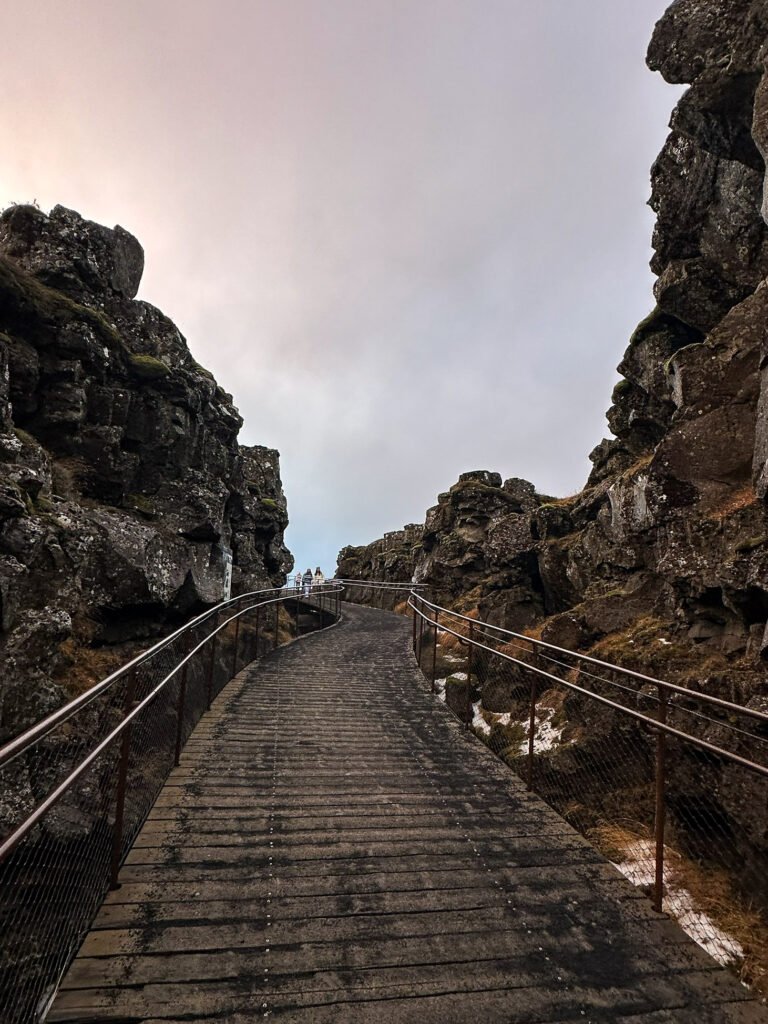
Iceland sits on a tectonic plate boundary — a rift where the North American and Eurasian plates pull apart.It’s one of the few places on Earth where you can literally walk between two continents — and the only truly explicit place on land where this separation is visible, especially in Þingvellir and on the Reykjanes Peninsula — with volcanoes and glaciers standing side by side as proof that the planet is still in motion.
For our first day, the plan was to drive the Golden Circle — a classic route connecting three iconic sites: Þingvellir National Park, Geysir Geothermal Area, and Gullfoss — the Golden Falls.
Standing right in the rift — in Þingvellir National Park — looking at its irregular “walls,” carved by fissures as the plates drift apart, I found it hard to believe any of it: two tectonic plates, two continents, constant movement. My geology classes needed a quick revival.
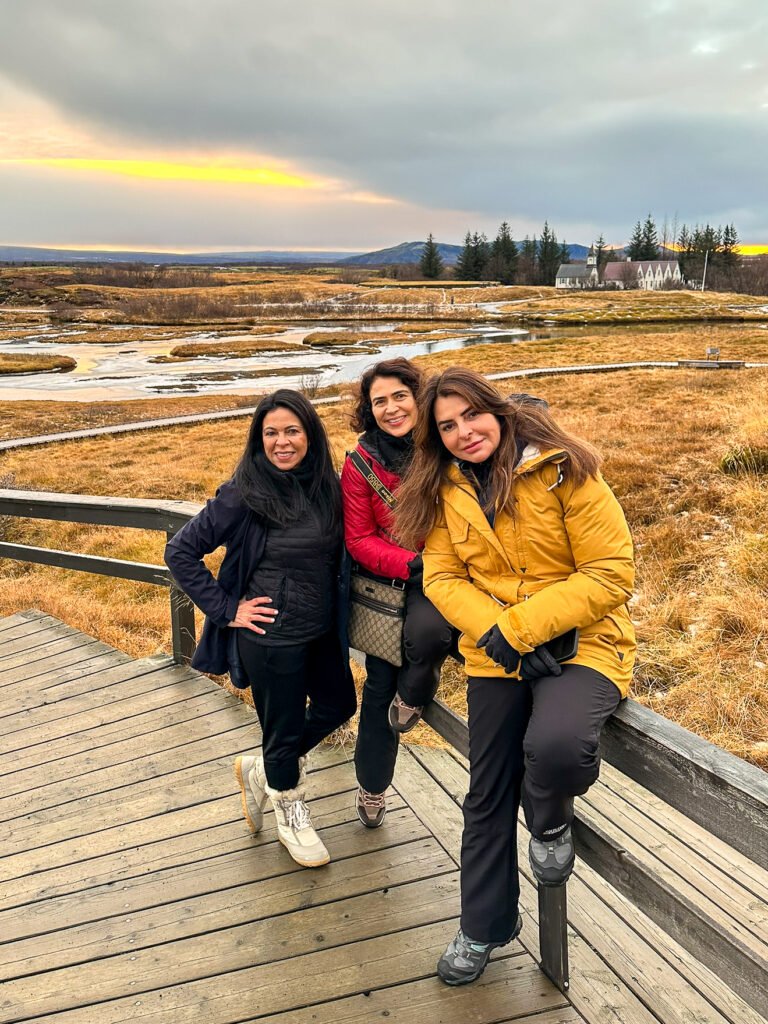
The path away from the rift softened into yellow-brown vegetation, winding wooden bridges crossing small ponds, and a lake framing the landscape.
But Þingvellir isn’t only about natural beauty — it also carries a historical weight: this is where one of the oldest parliaments in the world was founded, in 930 AD.
One thing I knew for sure: it was one of the most singular experiences I’ve ever had — and the layers of clothing recommended for the extreme cold were working perfectly.
Leaving that geology class taught by nature itself behind, it was time for another Icelandic spectacle.
Walking carefully to avoid an unwanted dive into a wide field of black mud, I heard cheerful screams in the distance, like children playing. As we got closer, I saw a small crowd gathered around a tiny boiling pool and, without any warning, it happened: a sudden explosion inside the water, sending a powerful jet straight into the air.
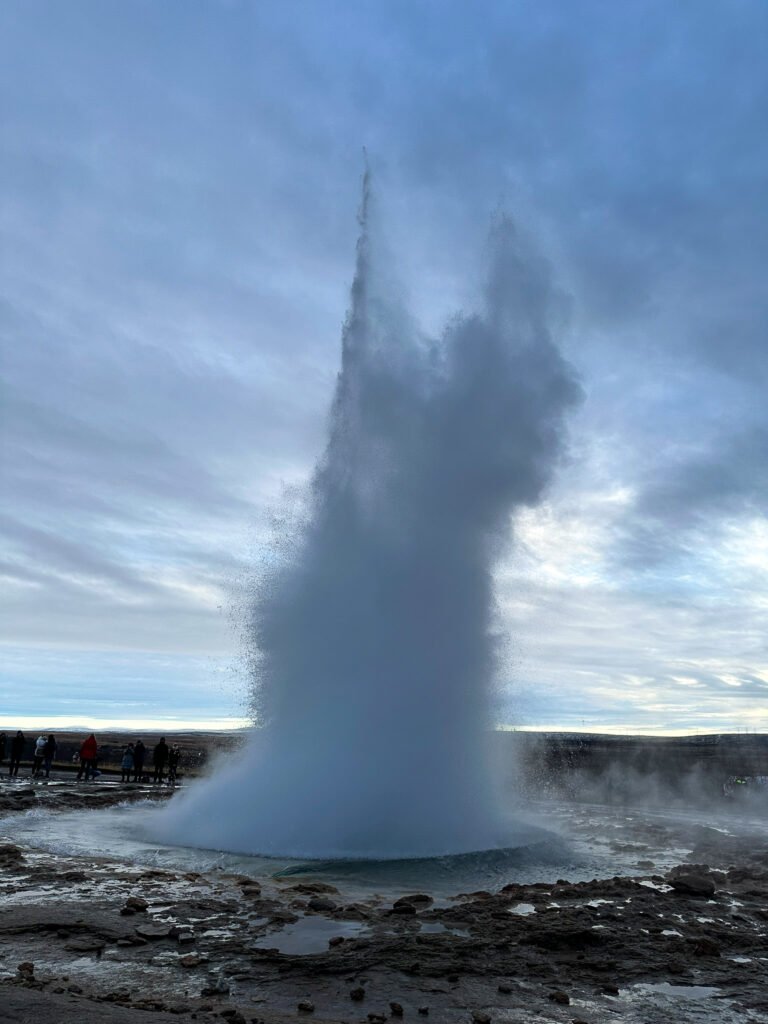
I immediately felt like a child myself, waiting for the next eruption and shouting along every time nature forced its way upward — so beautifully and peacefully. Sometimes, of course, it chooses more dramatic (and catastrophic) ways to do the same.
✦ Footnotes from Elsewhere
Geysers are rare — fewer than a thousand exist on the entire planet — and Iceland holds some of the most active ones.They erupt when super-heated groundwater turns to steam and forces its way to the surface, a reminder that in Iceland, the Earth is constantly exhaling beneath your feet.
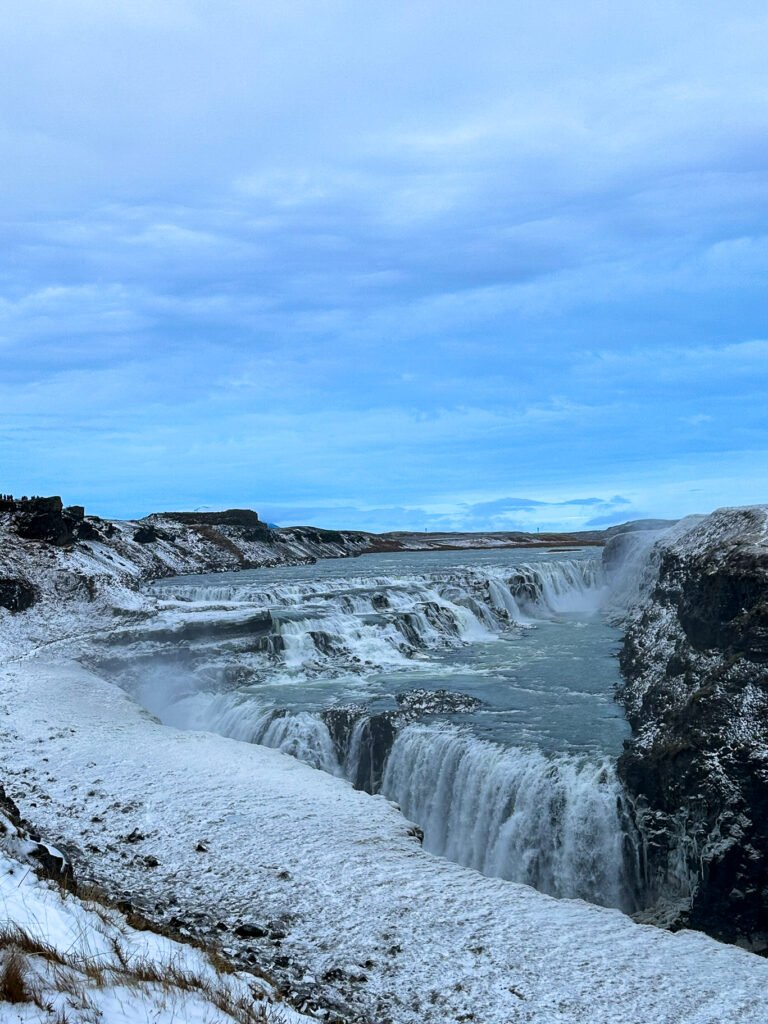
Closing the Golden Circle, we arrived at Gullfoss Falls.
The workaholic night was already forcing its way in, and the cold finally worked up the courage to challenge the entire group. The short stretch between the parking lot and the café perched on the hill suddenly felt almost impossible to cross.
I looked at the freezing water showing off its power with a roar and, after a few minutes, decided the smartest place to be was inside the café.
We managed to take a few pictures, have a quick look around, and then we started to run.
Our itinerary said: “At night, search for the Northern Lights.”
But we didn’t even try. The guides had warned us it was difficult to see them near the capital — the best chances come when you leave the city lights behind. And besides, of course, there’s an app (what doesn’t have one these days?) showing the probability.
That night, there was no chance at all.
One Chapter Written in Water
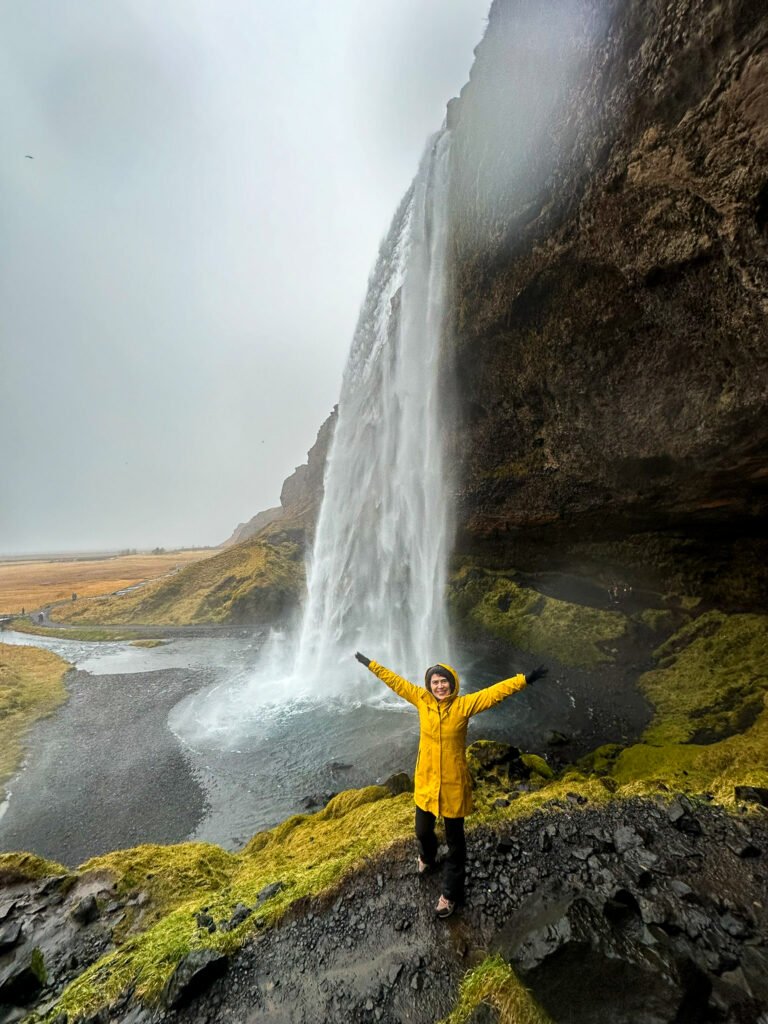
Seljalandsfoss — no, I didn’t leave my fingers pressing the keyboard randomly. That’s actually the name of a waterfall.
Our first glimpse of it was brief, as we passed right in front of Seljalandsfoss while walking toward Gljúfrabúi — a delightful waterfall hidden inside the mountain, accessible only through a narrow fissure.
What makes Seljalandsfoss truly special is the possibility of walking behind the waterfall. No need to take a boat or wade through freezing water. You simply walk — and let your jaw drop in front of such breathtaking scenery.
But the diamond of the day was saved for last — Skógafoss.
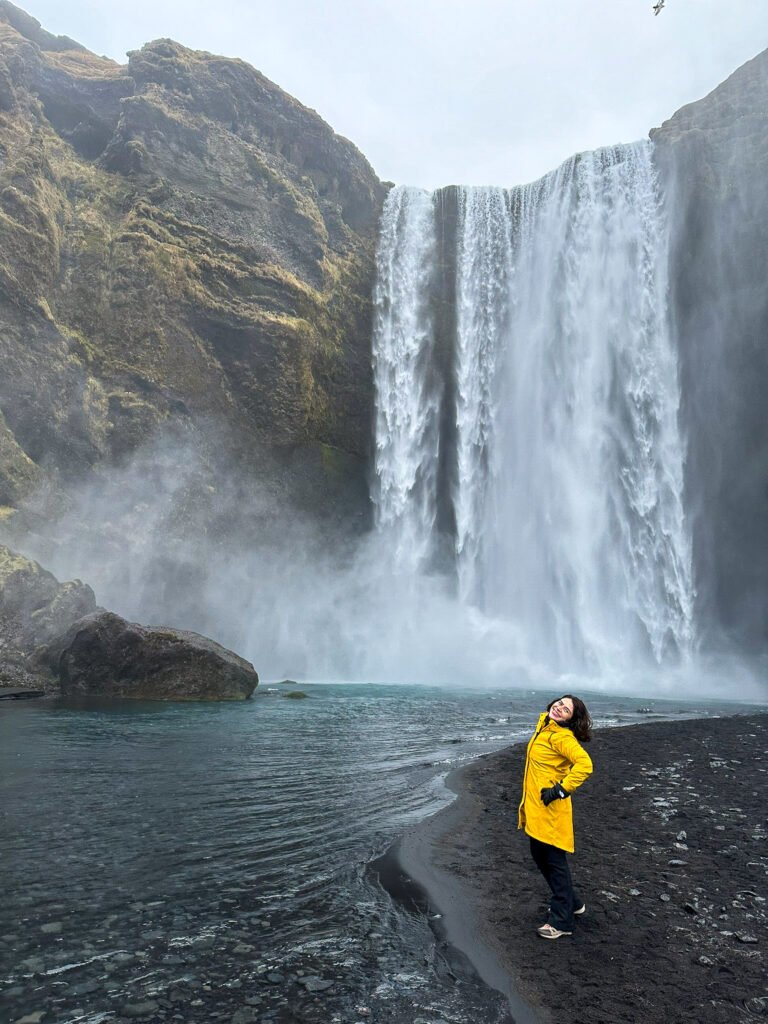
One of the largest waterfalls on the island, and without any doubt the most photogenic. It feels as if it was made to be a star.
The splendor is undeniable, but what truly makes it mesmerizing is what surrounds it. The volcanic soil — dark, almost black — turns everything more dramatic. And when it comes to waterfalls, that contrast feels almost contradictory.
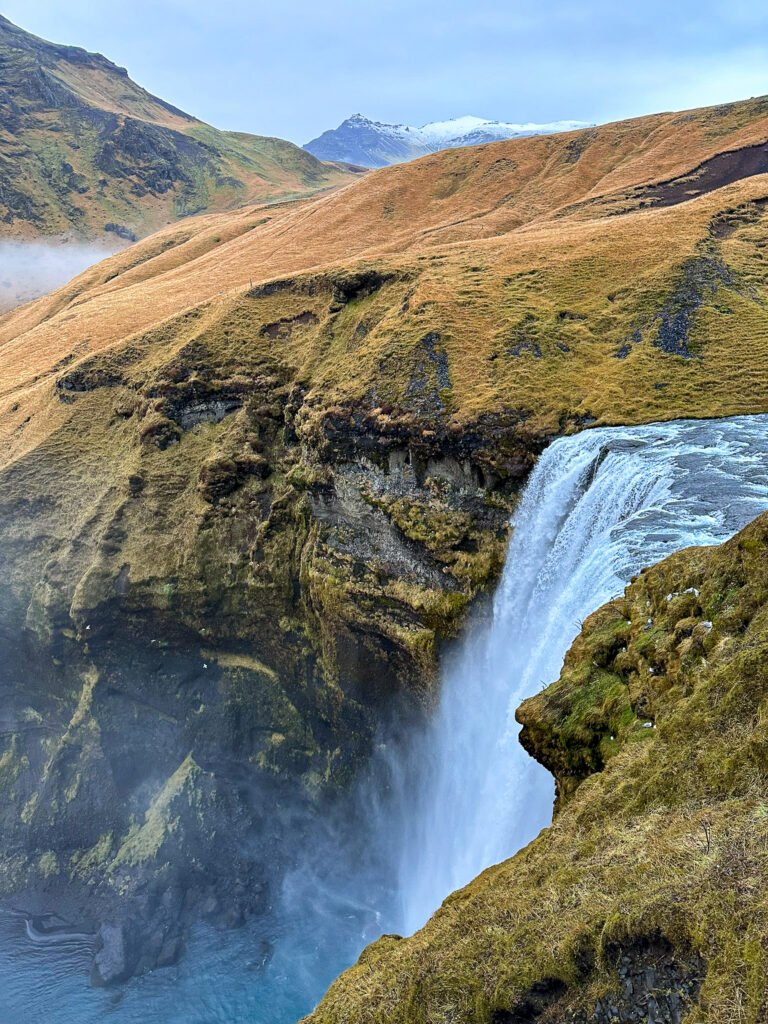
The hypnotic movement of the water plunges into a haunting pool, black stretching in every direction.
I noticed a path leading to the upper part and asked if I could check it out. A little while later, I was standing at the very edge, discovering the river moments before it finds its way down, leaping from that high platform.
I’ve seen many waterfalls before, but Skógafoss belongs to a category of its own.
A Shore Dressed in Black
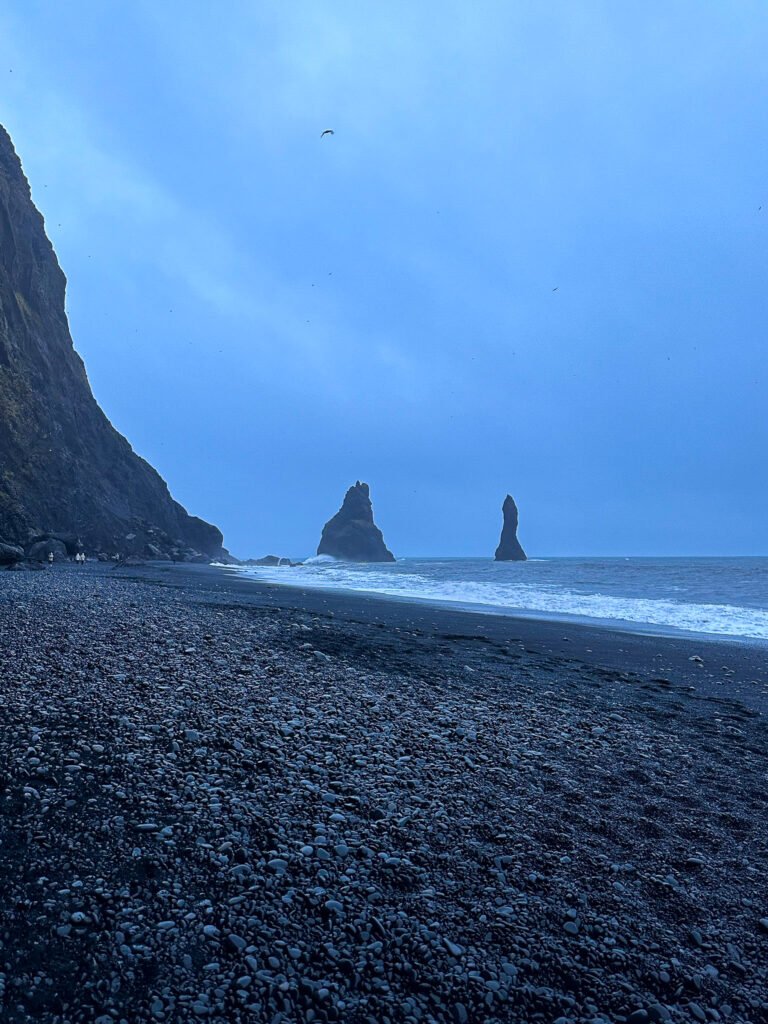
Although we knew we were there in winter to “chase” the Northern Lights, the moment I set foot on Reynisfjara, I couldn’t help imagining how that incredible place would look without the heavy mist trailing the rain that had reached Vík before us.
I’ve had my fair share of beaches. Big and small. Deserted and crowded. Nude bodies and dressed ones. Sand, stones, palm trees, buildings — even that famous beach in Thailand from The Beach.
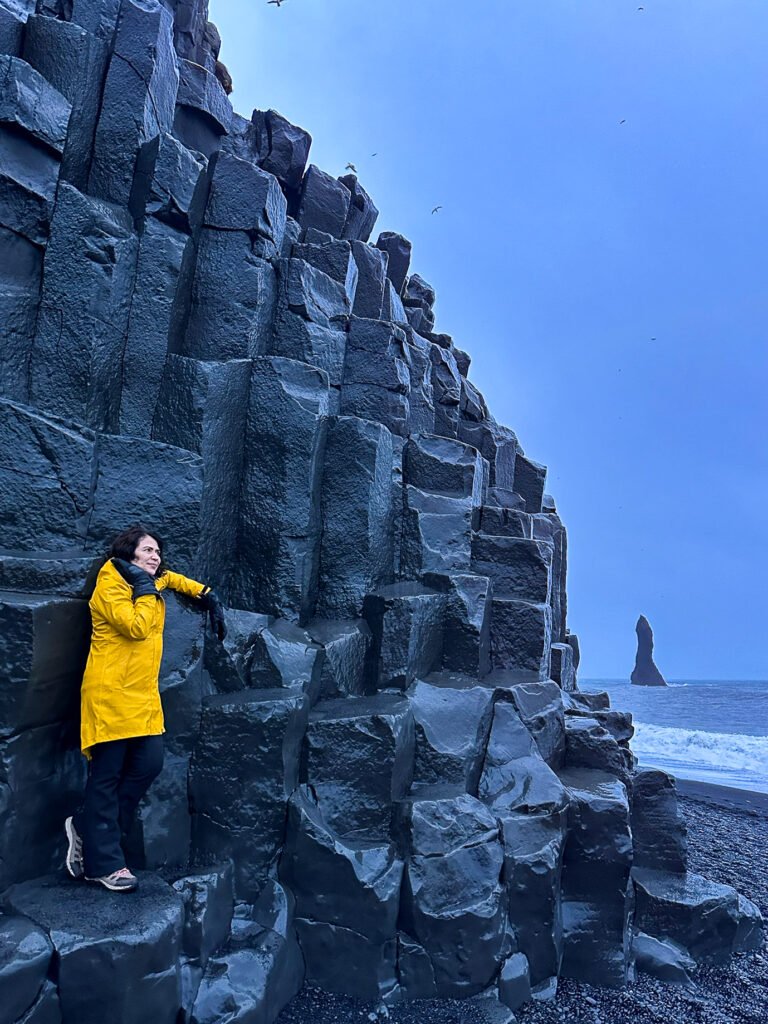
But what I had never seen until then was a shore entirely black: black stones instead of white sand, framed by a dramatic black cliff.
Under that weather, the landscape felt almost apocalyptic. Even the long, narrow sea stacks rising from the water seemed to amplify the gloom, making the atmosphere heavier and more powerful.
✦ Footnotes from Elsewhere
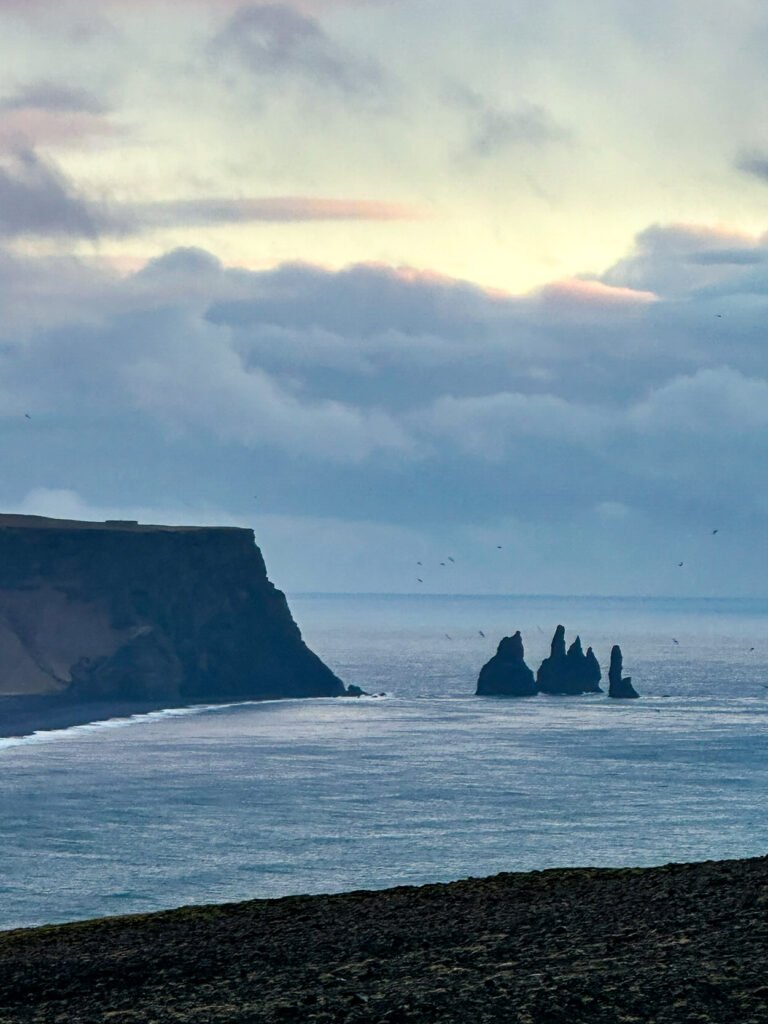
The Reynisdrangar are basalt sea stacks rising from the Atlantic Ocean off Reynisfjara Beach. According to Icelandic legend, they were trolls caught by the sunrise while trying to pull a ship ashore — and turned into stone forever.
On a clear blue-sky day, it would have been a completely different place.
Still, I treasure having seen Reynisfjara exactly like that.
It felt like a once-in-a-lifetime vision.
When you choose to visit Iceland in early December, you also choose darkness. And, with it, the possibility of seeing the Northern Lights — even if that means giving up blue skies.
That night, far from the city lights, we accepted that the Northern Lights wouldn’t show up.
So we did the only reasonable thing left: a warm dinner, a good bottle of wine — and the quiet satisfaction of a day that had already given us more than enough.
I would spend seven nights in Iceland.
The first of four nights in places with higher chances was a no-show.
From Cliffs to Diamonds
Before breakfast, Mirela was already checking the app, scanning our chances of seeing the Northern Lights.
As the person who practically invented anxiety, I had promised myself — before even setting foot on the island — that I’d enjoy the days without obsessing over it. No plunging into icy lakes. No drama.
So far, it was working.
I avoided looking at her screen and moved on with the day.
Later, I found myself facing the Atlantic from the top of Dyrhólaey. Right at the edge of the cliff, a massive rock with a hole carved through it — almost like a portal — jutted into the sea.
Following the shoreline to the left, the black beach reappeared, along with its trolls — now from an entirely different perspective.
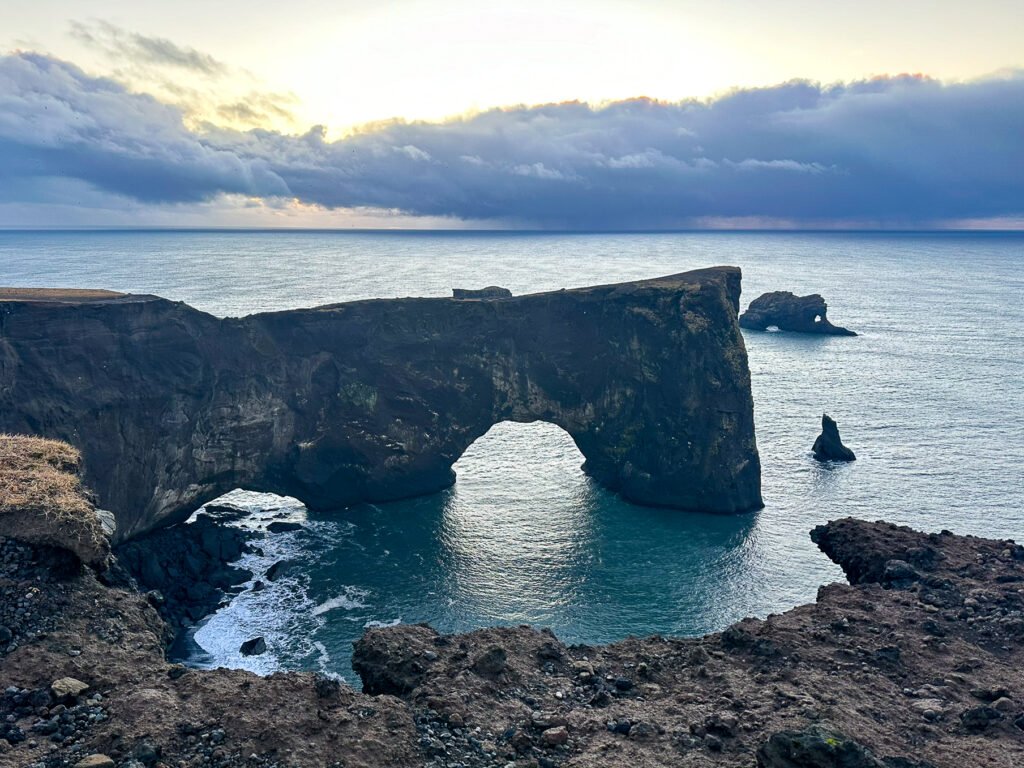
Even the weather seemed to cooperate. No rain, no fog. Just hints of blue and lilac in the sky.
The landscape was so overpowering it almost made me forget the small lighthouse, perched quietly at the top.
Running along the road, golden, sparse vegetation gave way to a rocky slope. From time to time, a volcano appeared on the horizon.
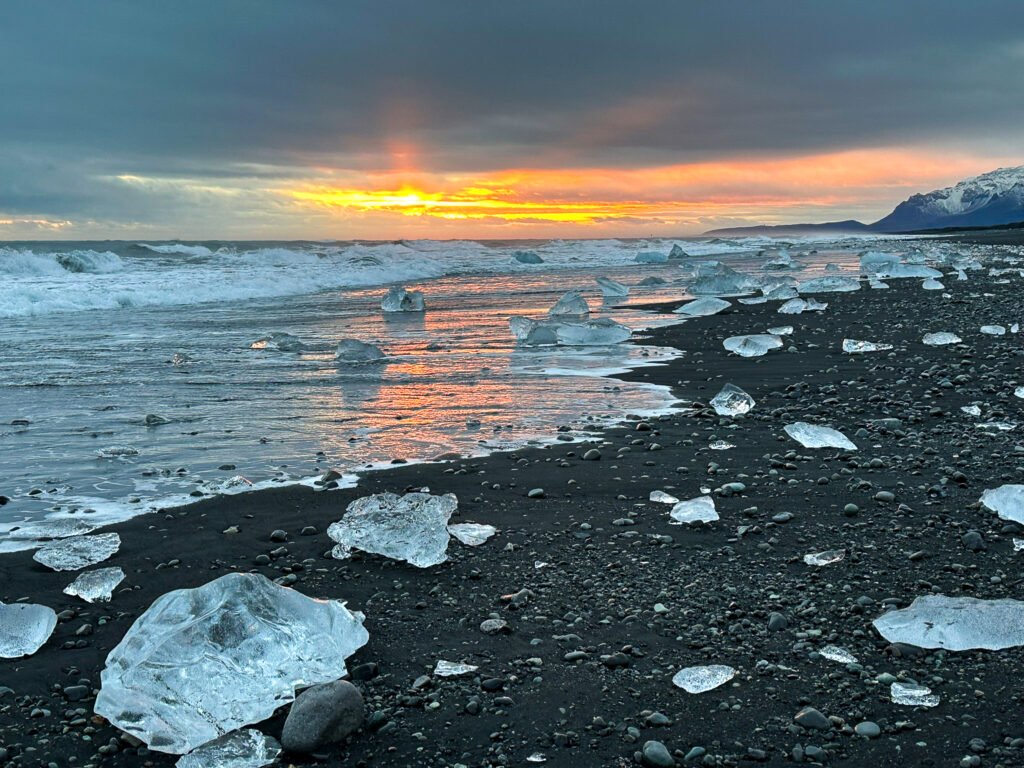
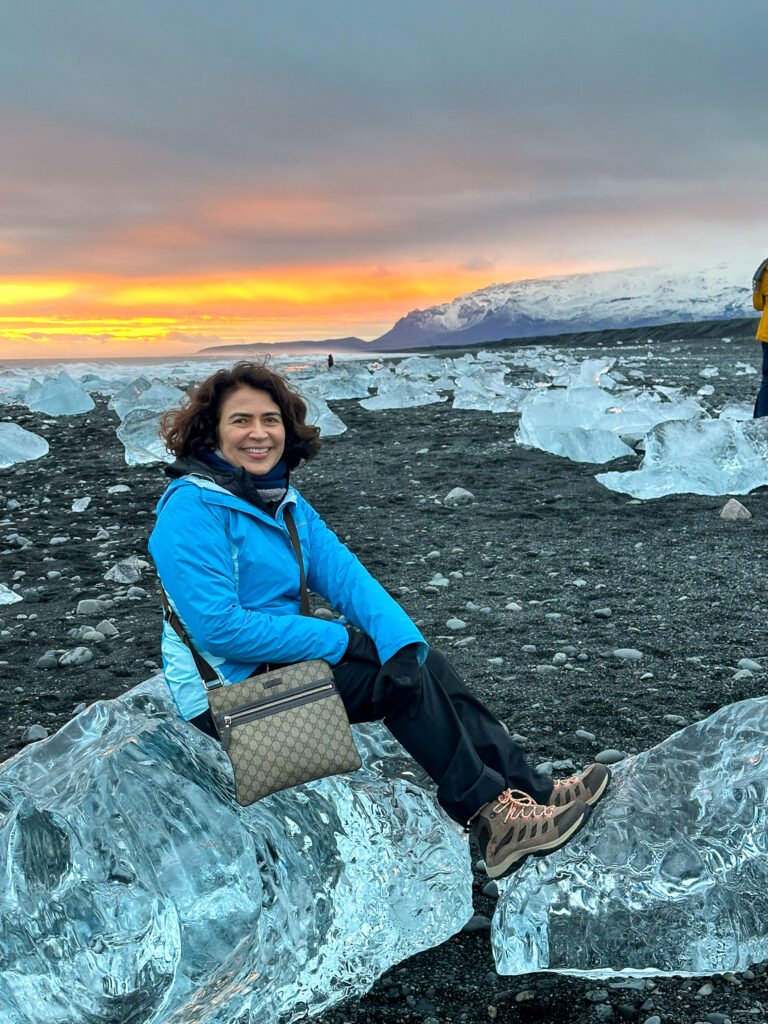
Then, out of nowhere, the bus stopped — and suddenly we were standing in front of a beach scattered with ice blocks of every possible size.
Diamond Beach.
Although the name is self-explanatory, it still falls short of evoking its real beauty and singularity. The contrast between the ice and the dark sand turns the place into something surreal.
Facing the ocean, the ice blocks looked as if they had been painted blue.
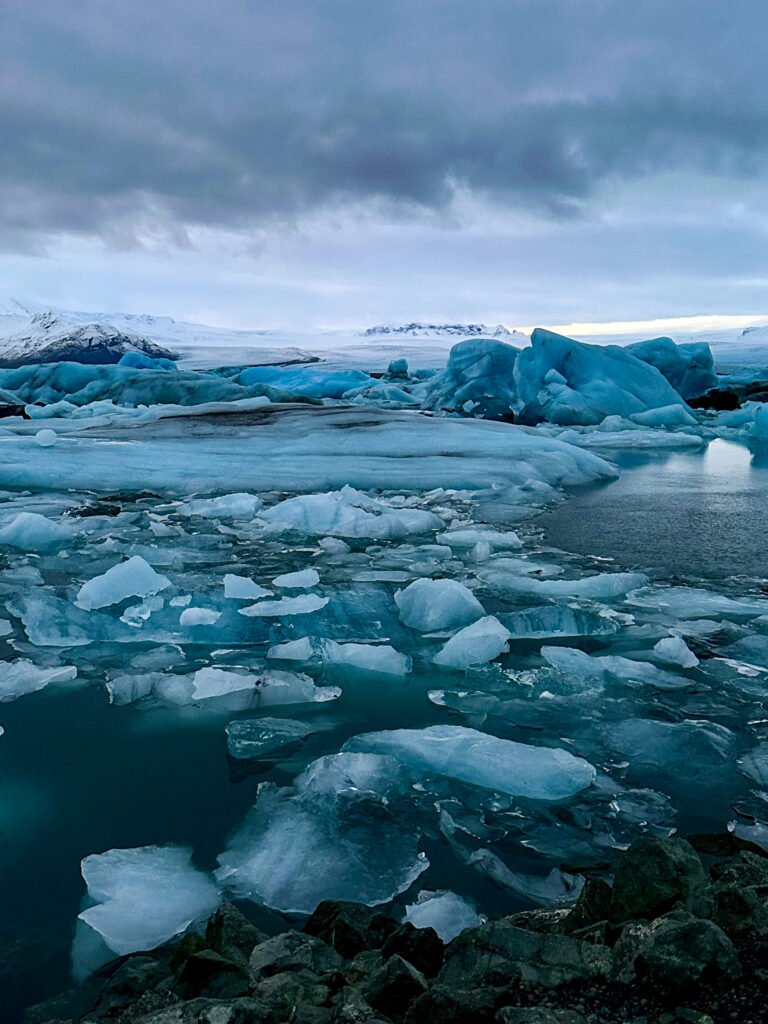
We walked along the shore for a long time, our eyes constantly undecided about what to focus on. Photos were taken — in every direction.
When the initial euphoria finally settled, and the photo session came to an end, we sat on the sand for a while, simply taking it all in.
When it was time to leave, we headed back to the bus with wet butts — proof that no one resisted sitting on the ice blocks for photos.
I boarded already knowing I would probably never see that place again, and quietly regretting it.
Later, we realized the Northern Lights had stood us up again.
Well, there was still time to make up for it.
Shades of Blue
The next day, we set off in special vehicles with wheels almost my size — not that it means much, but still, it felt like going for a ride in a monster truck.
Early in the morning, we arrived in a harsh, inhospitable landscape, where we left the trucks behind and continued on foot.
The day was surprisingly sunny, and feeling the sun’s rays on my skin felt like a gentle caress. I had missed that.
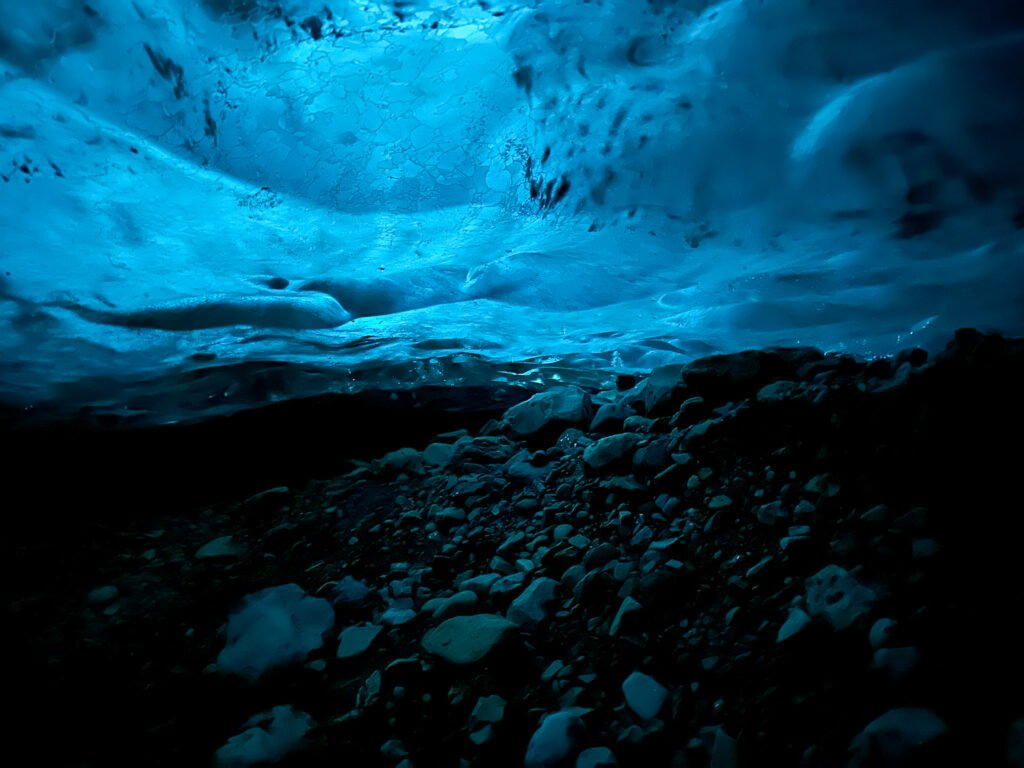
After a while, we reached the entrance of an ice cave. Before going in, we were given chains to attach beneath our boots — the same idea used on car tires, just on a smaller scale.
This wasn’t an artificial attraction, but a natural cave sculpted entirely in ice.
Beyond its unique formations shaped by nature, something else was truly mesmerizing: its vivid blue color.
I had never imagined ice could be so incredibly beautiful.
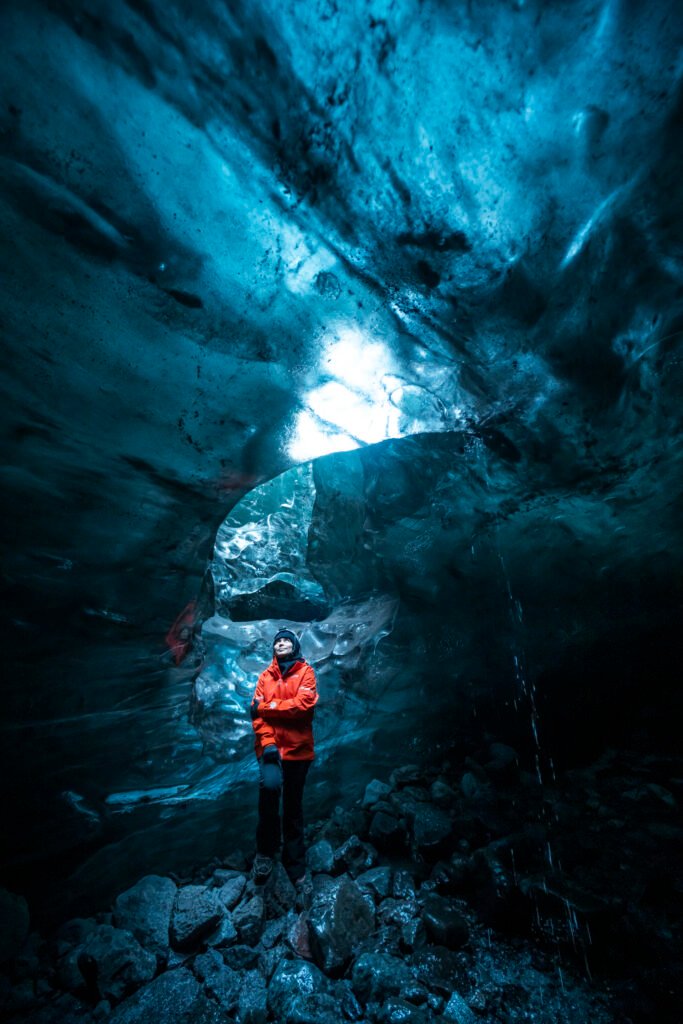
We stayed inside for a long while, completely forgetting about the freezing temperatures. We even lined up to take photos in what was clearly the most stunning spot of the cave.
It was an apotheotic start to the day.
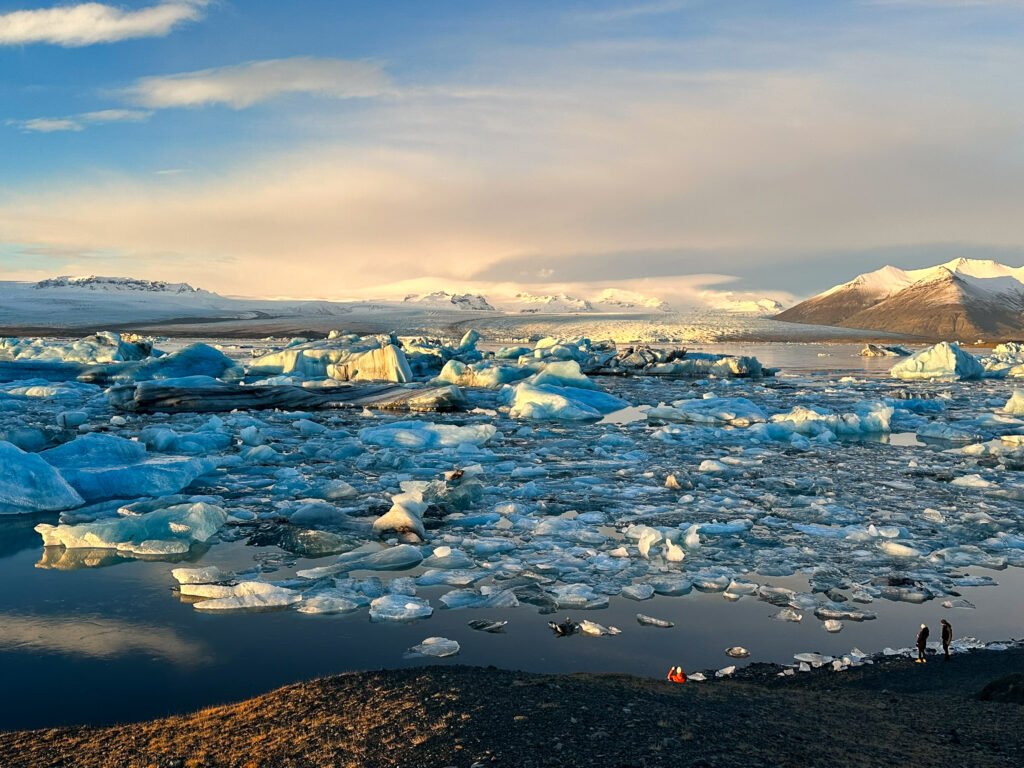
Back in our new toys, we were driven to a glacial lagoon formed by the melt of Vatnajökull.
Huge blocks of ice floated everywhere, and the stubborn blue sky, refusing to leave, framed the landscape perfectly.
Later
That night, after dinner, we were told once again that there were no Northern Lights.
I thought we would only have the next day. If it didn’t happen, I would go back to Brazil without ever seeing them.
A small crack formed in the wall of trust I had built to protect myself from disappointment.
Still, I stepped outside, needing to see it with my own eyes, searching the sky for any hint of color. There was nothing.
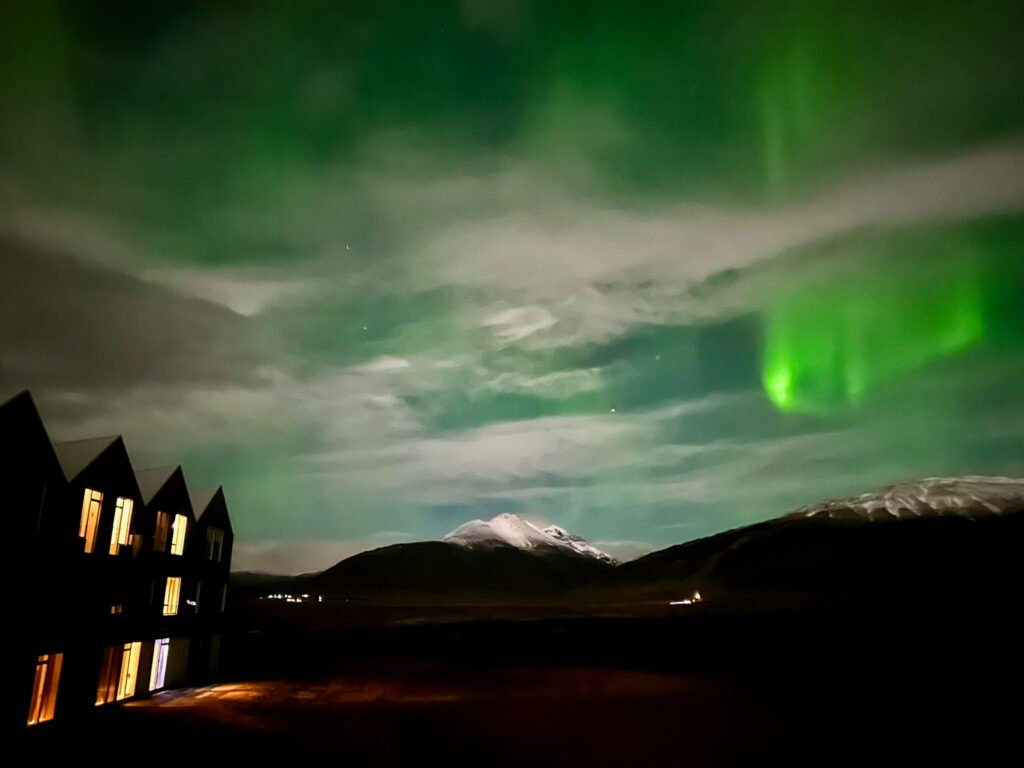
Sometime during the night someone started knocking on our door, and then on all the others. I couldn’t understand what they were saying. There was no need to. We knew exactly what was happening.
We pulled our heavy clothes over our pajamas and rushed outside.
And there it was.
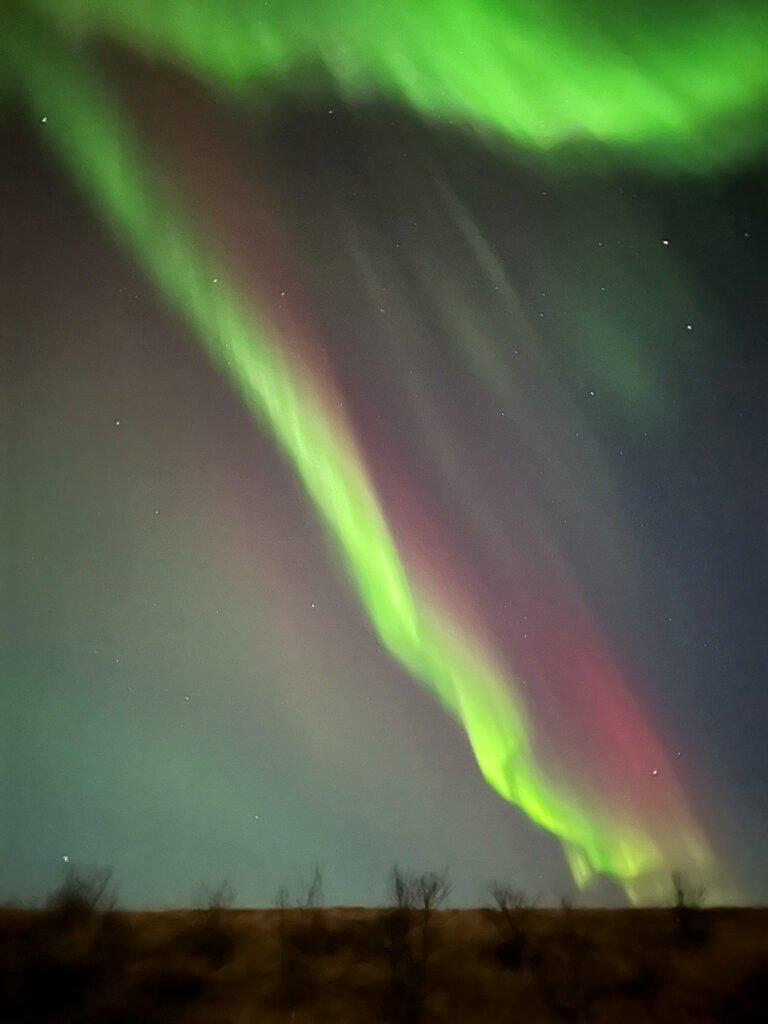
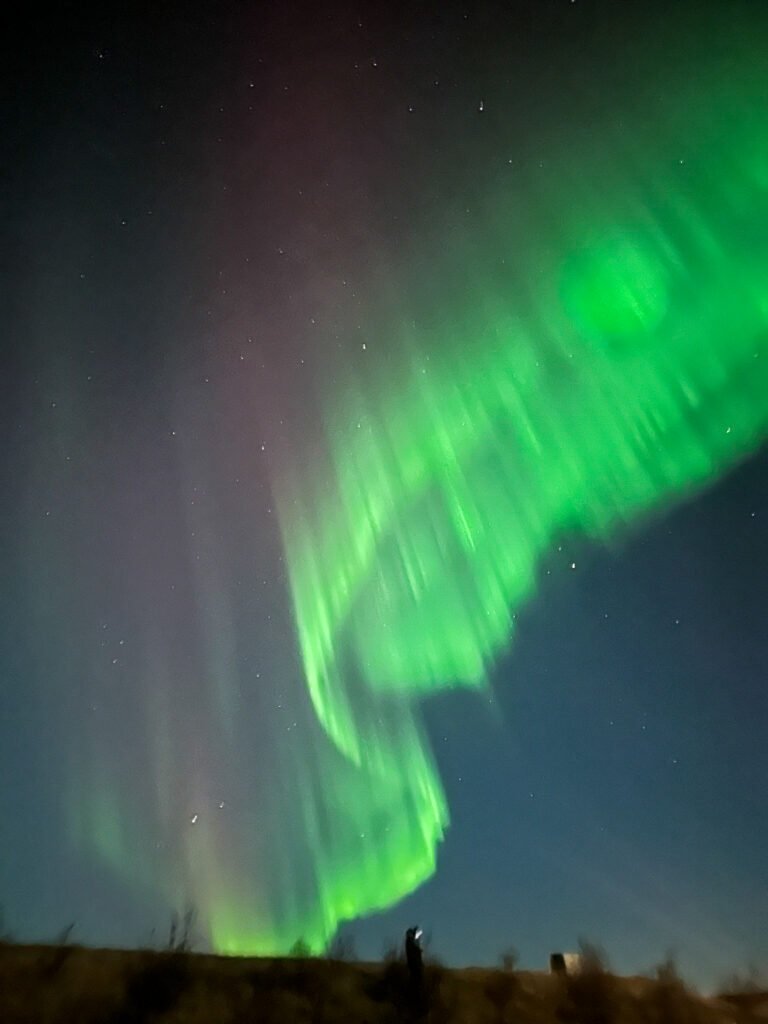
The sky had been brushed with green.
Nothing compares to seeing that. It’s pure magic. Your eyes register it, and yet your mind struggles to believe it’s real — a quiet battle between emotion and reason, heart and mind.
I had never felt so cold in my life, but I refused to go back inside and leave that behind.
Still, there came a moment when the cold nearly broke me. Others had already given up — and eventually, we did too.
The next morning, our necks sore from staring upward, it was almost impossible to listen to — or even understand — anyone at breakfast. Everyone was talking about it at the same time.
And yet, somehow, we understood each other perfectly. From the heart.
We had no idea what was still waiting for us.
Red
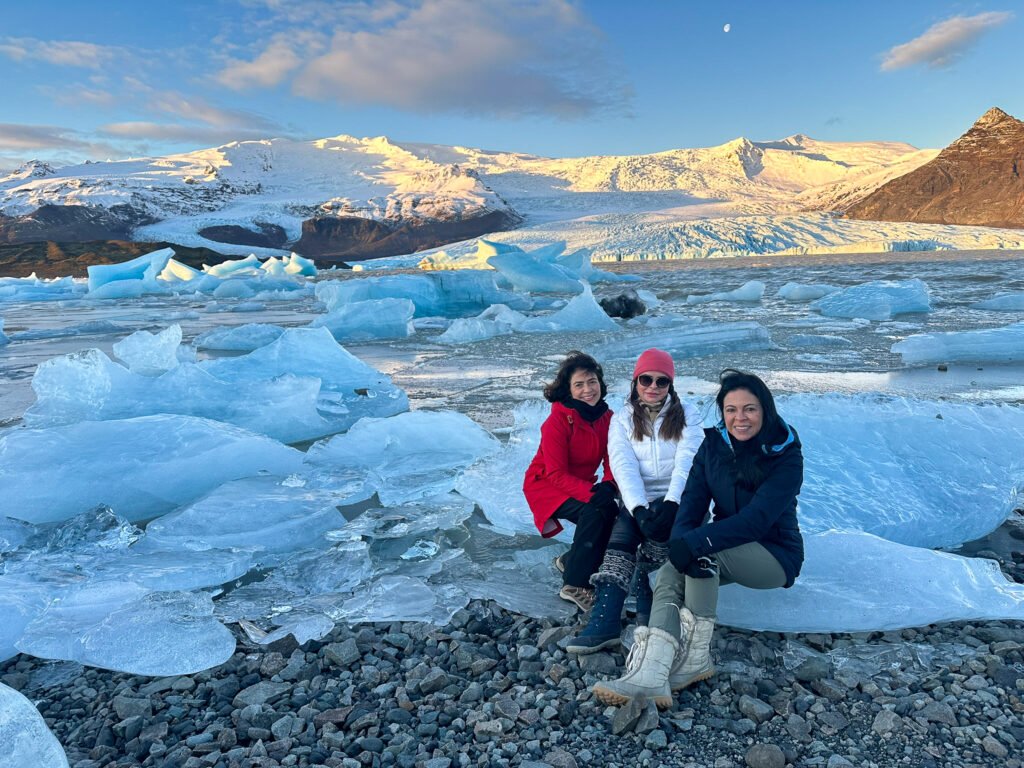
Walking along the shore of another glacial lagoon — Fjallsárlón — we were once again rewarded with a bright, sunny day.
Still under the spell of the night before, we couldn’t have been happier.
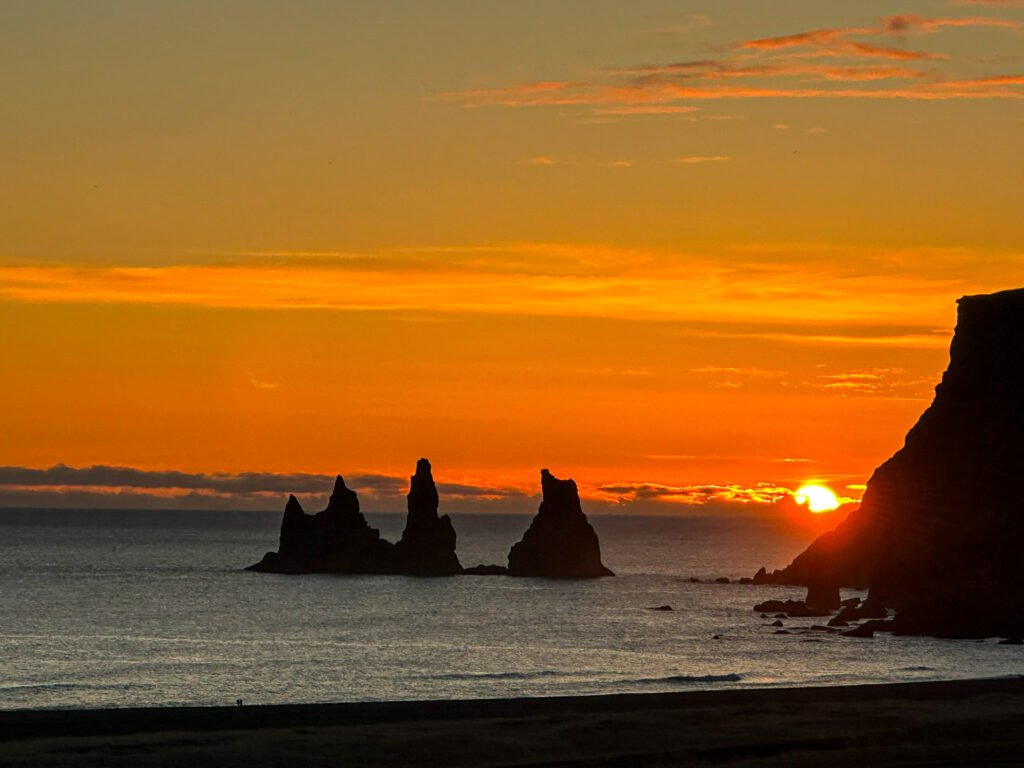
The rest of the day unfolded through quiet rural landscapes, and by late afternoon we were standing at a strategic viewpoint, watching the sun sink behind Reynisdrangar, setting the sky ablaze in vivid shades of orange.
Not even in my most optimistic dreams could I have imagined witnessing that at this time of year.
That night, we arrived at the hotel where we would be staying. As usual, we started unloading our luggage, heading toward our rooms.
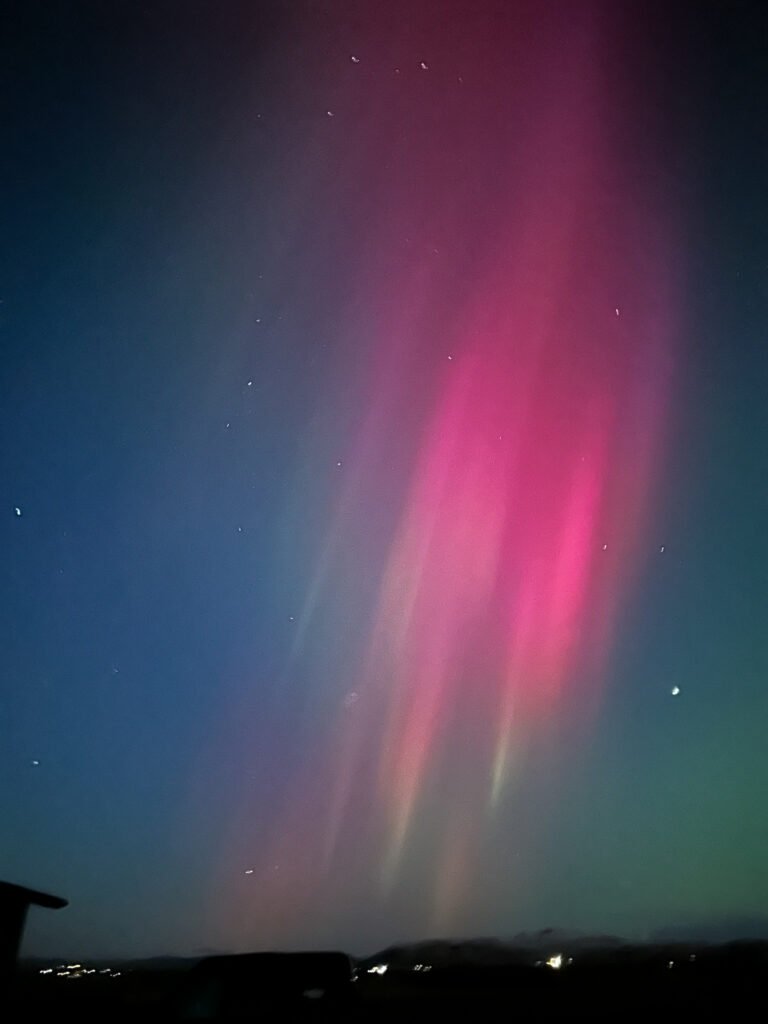
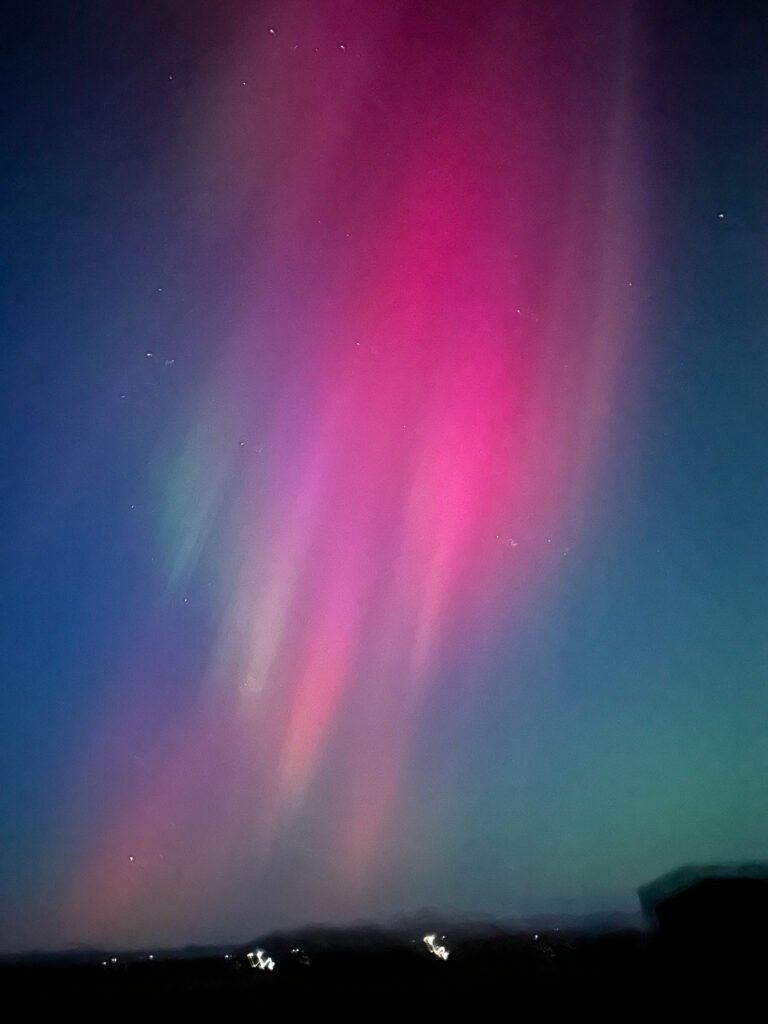
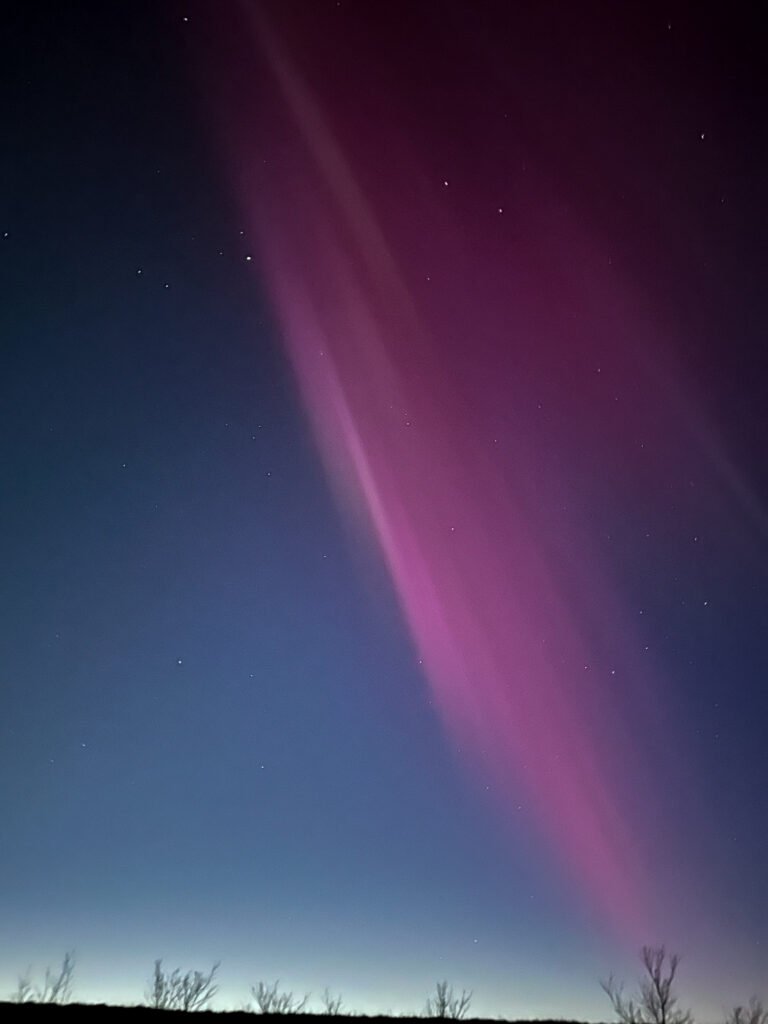
I don’t even remember who saw it first. The only thing I clearly remember is looking up — and realizing the sky wasn’t black. Or green.
It was red.
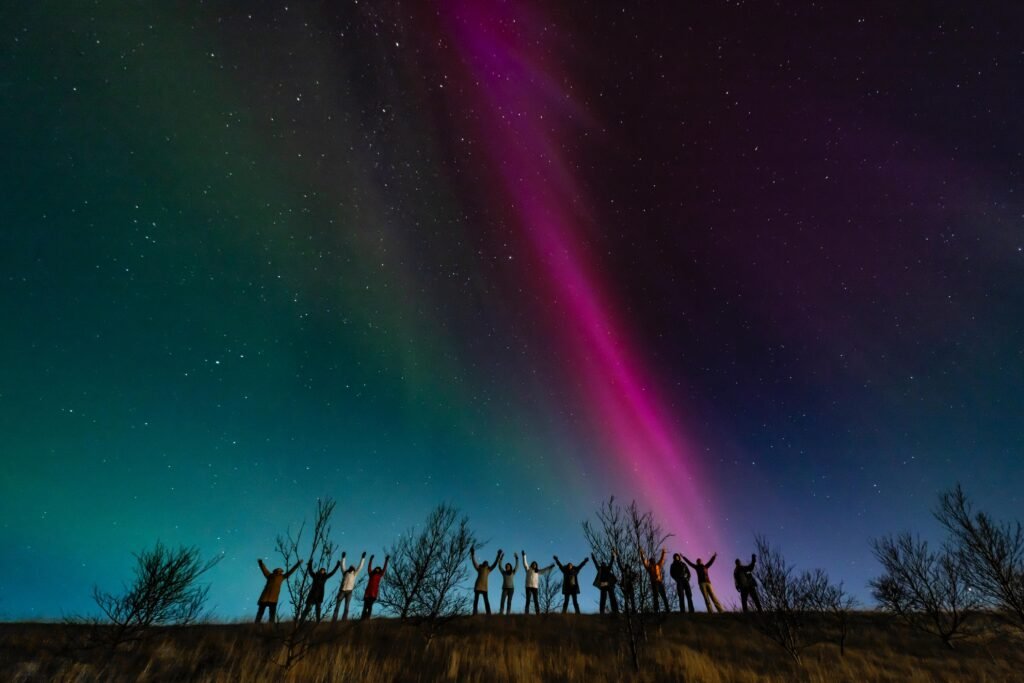
Not that smoky hue from the night before, but clearly defined red shapes — perfect brushstrokes painted across the sky.
Soon enough, green joined in, with touches of red still there for contrast, abstract and yet sharply defined forms dancing above our heads.
We took photos, shouted, laughed and filmed.
Without a single drop of alcohol, everyone felt a little drunk.
We stayed there for what felt like hours, caught in that shared madness.
The following day, Instagram confirmed what we had just witnessed.
Every aurora chaser I followed was talking about the same thing: the remarkably rare red Northern Lights from the night before.
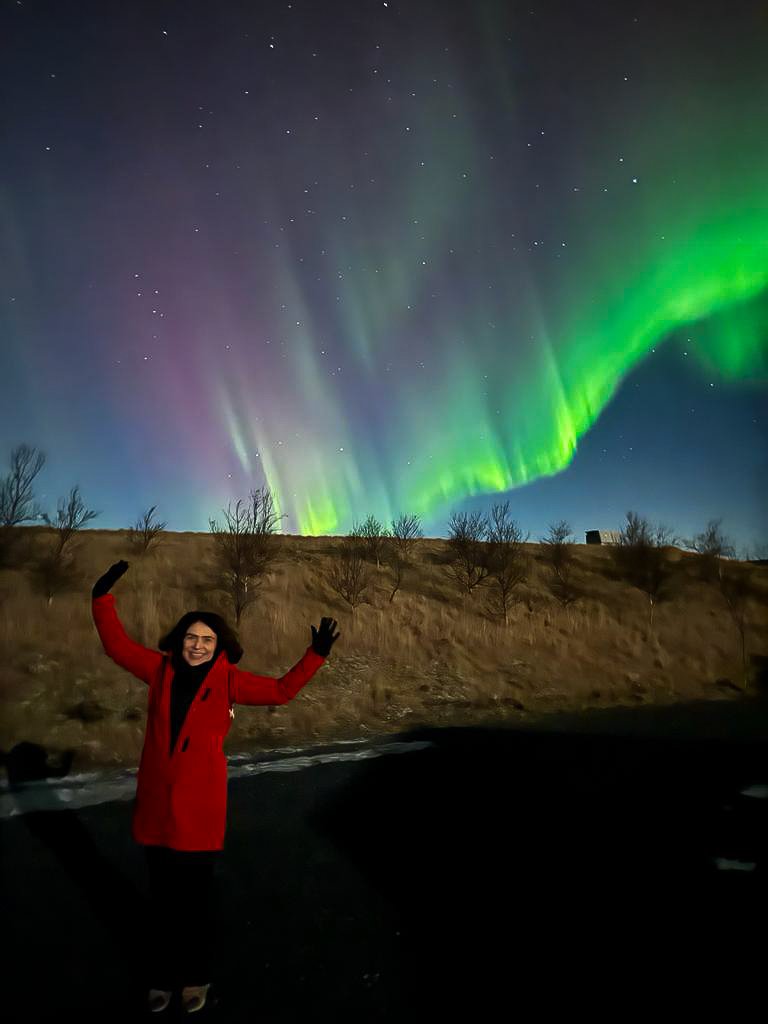
On the last night, I finally saw what I would call the perfect Northern Lights.
They made us wait until the very last moment.
But it was worth it.
And I was incredibly lucky to be there.
After the Cold
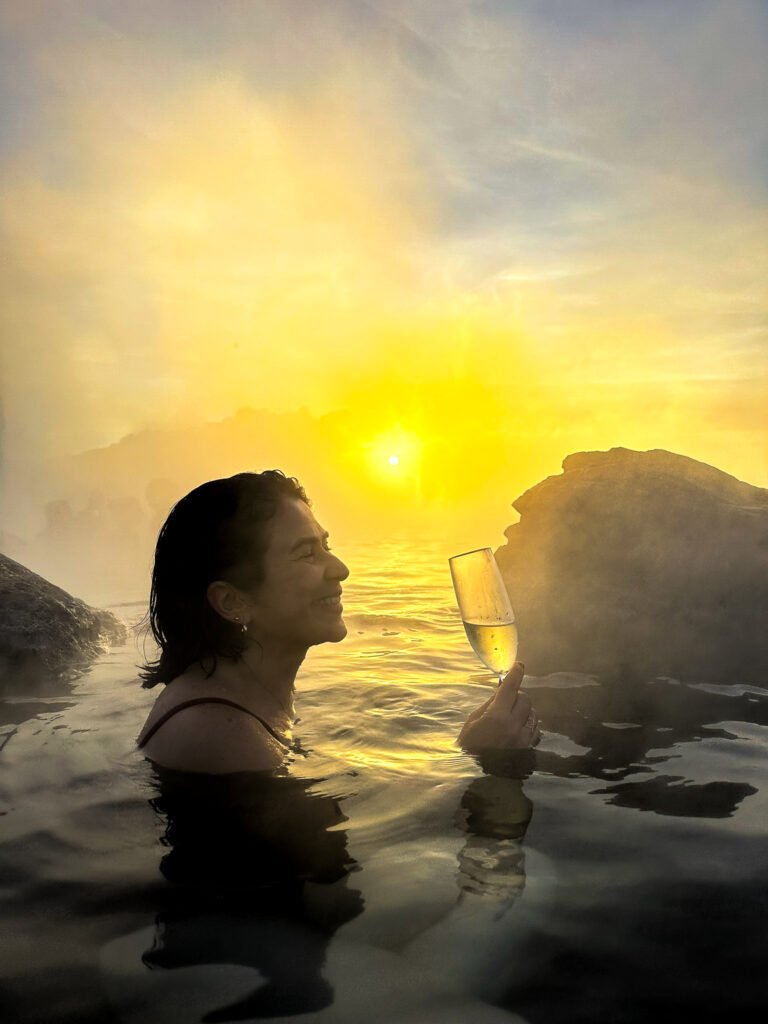
My last day in Iceland felt like the kind of ending you don’t dare to plan: soaking in a natural hot pool, convinced I might be the luckiest person in the world.
✦ Footnotes from Elsewhere
Geothermal spas use naturally heated water drawn from deep beneath the Earth’s surface.In Iceland, they’re part of everyday life — places where locals unwind, socialize, and move slowly through a ritual shaped by heat, water, and landscape.
As someone who hates cold water and adores a hot bath, this was something I had been looking forward to from the start.
First, a small ritual: lockers for personal belongings, a line of showers, and finally that first step toward the edge, where the steamy water quietly invites you in.
Just feeling the mineral-rich heat against my skin would already have been enough.
But leaving the edge behind and moving into the open pool, facing the sea, I noticed something else.
A bar — right there in the water.
There I was — glass in hand, sun on my face, wrapped in warm water and a striking view — thinking that, at that precise moment, the world couldn’t possibly be a better place.
After we had officially turned into plums, we headed to adorable Reykjavík.
We spent our time wandering its streets — less like exploring a capital, more like strolling through a small village.
Colorful houses, sometimes even painted streets — perhaps a way to contrast with the many grey days.
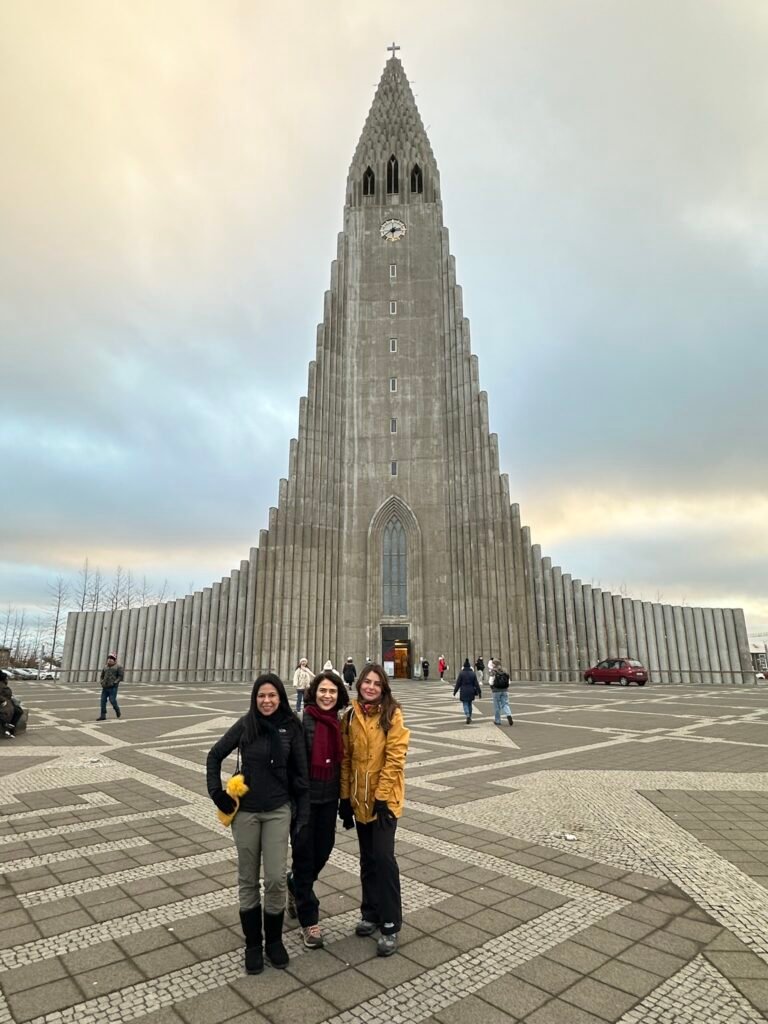
Grey, too, is Hallgrímskirkja, the city’s most striking landmark — a church inspired by basalt columns, formed when lava cools slowly.
Even here, geology finds its way into architecture. Reykjavík is filled with cafés, shops, and wonderful restaurants, serving food that makes you linger longer than planned.
And, in an effort to avoid controversy around eating cute animals, I can neither confirm nor deny that someone went looking for a puffin dish — and came back empty-handed.
“As the person who practically invented anxiety, I had promised myself — before even setting foot on the island — that I’d enjoy the days without obsessing over it. No plunging into icy lakes. No drama.” Hahahahahahahh! I’m dying because I know you …
“We took photos, shouted, laughed and filmed.
Without a single drop of alcohol, everyone felt a little drunk.
We stayed there for what felt like hours, caught in that shared madness.” 🥹🥹🥹🥹 I think is one of the cutest thing you ever wrote . We can exactly understand the sensation
Hahaha 😂🤍 only someone who really knows me would catch that. And it honestly made me feel so fulfilled knowing I managed to bring you into that moment too 🫶
This is one of those posts that makes you feel like you’re traveling along, and at the same time instantly adds a new destination to my wishlist.
I realized we have very different ways of choosing where to go. While you usually choose destinations for their human stories rather than landscapes, I’m kind of the opposite. I’m much more drawn to wild, dramatic landscapes, the kind that make you stop and just take it all in. And Iceland seems exactly like that… just unbelievably stunning.
The only thing I’d change is the timing. Winter is definitely not for me, I don’t think I’m built for that level of cold or for living in endless layers 😄
Honestly, Iceland was never really on my radar before, but now it’s definitely high on my list. Your description made me feel like I’d absolutely love it. Thanks for sharing 🥰