Part of my Bhutan travel stories, this journey unfolded through mountain paths, prayer flags, and a daily rhythm guided as much by spirituality as by landscape.
Some Journeys Begin with a Coincidence
In one of my favorite moments, I was there — staring at a map, my eyes fixed on Asia.
Where can I go now?
Among a few tempting options, there it was: Bhutan.
I looked at that tiny country and started thinking about everything I had ever heard or seen about it. It sounded exactly like the kind of place I would fall in love with.
After a while researching, I was already imagining myself exploring those remote villages nestled in the mighty Himalayas — with their unique architecture and monks in red robes walking through the narrow paths — and I became even more certain: Bhutan would be my next destination.
And then, the strangest thing happened.
I was waiting for my dance class when Mirela — a friend I met there — arrived. From the very first moment, we realized how much we had in common, and the connection was instant. Besides our shared love for Samba de Gafieira, we were both passionate about traveling, wine, food — and, above all, discovering new corners of this fantastic world.
So, I mentioned I was planning my next vacation to Bhutan.
“No way!” she said.
Then she opened her phone and showed me messages with a travel agent — about the exact same trip.
The only difference was the timing, just a few months apart. That detail was quickly solved — and we decided to go together.
Soon after, Marcia, another friend I had invited but who needed to check her work schedule first, called to say she could join us too.
A few months later, the three of us were landing in Paro.
None of us could have imagined we would witness so many different sides of this incredible world.
A Quiet Valley Hiding a Festival
The landscape during the landing immediately caught my attention.
From above, the mountains looked endless — rising and folding into one another — “disturbed” only by a few white houses scattered as if someone had gently dropped them there.
No buildings, no noise, no traffic. And — the strangest part — no one.
Although Bhutan isn’t exactly known for having a high population density, staring at that almost deserted town made my mind sprint through the most dramatic scenarios.
Had I missed a warning sign? An earthquake? A hurricane?
Had I just landed in the middle of an evacuation zone?
A few minutes later, the mystery solved itself: it was Paro’s Festival (Paro Tshechu), and the entire city was attending.
Soon, we would too.
Giving us a sample of our next days, we had a little welcome ceremony in which we were gifted a Tashi Khaddar, a white ceremonial scarf that symbolizes purity and good wishes. It’s a traditional way to welcome someone with respect and blessing.
We had just landed, and the country was already showing us its rhythm — calm on the surface, intriguing underneath.
✦ Footnotes from Elsewhere
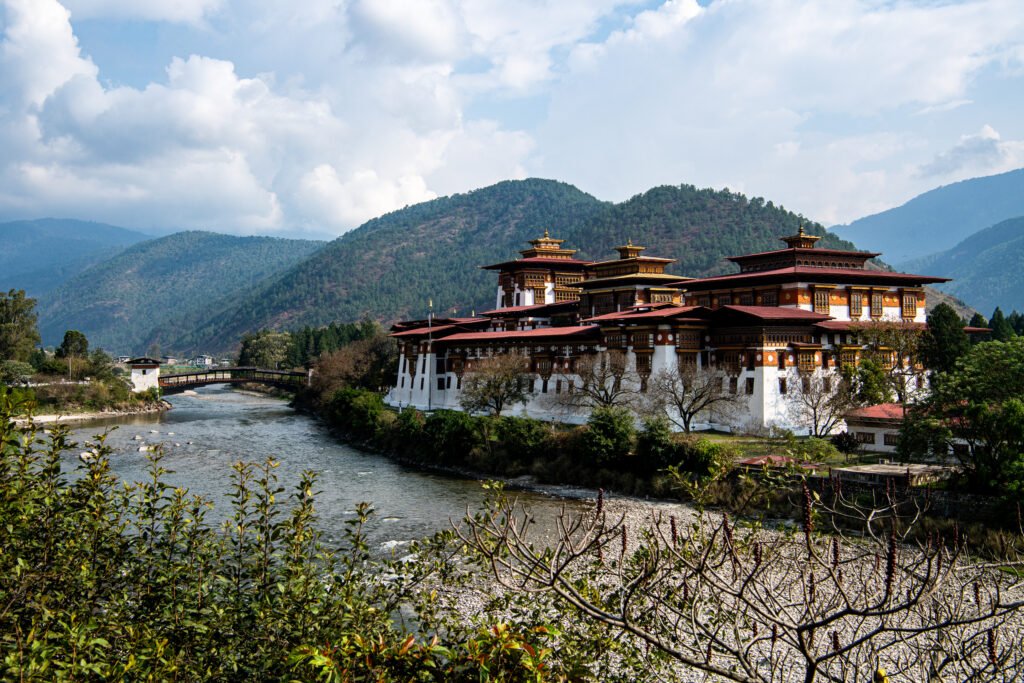
The Paro Tshechu is one of Bhutan’s most important religious festivals. Held at Rinpung Dzong, it honors Guru Rinpoche with days of rituals, sacred dances, and community celebration — a rare moment when the entire valley gathers in a vibrant display of color and spirituality.
My post about the Holi Festival is basically a love letter to festivals — the kind of immersion that teaches us about culture, religion, and rituals but, mainly, allows me to be part of a celebration — party girl here — where I can witness people strengthening their cultural ties.
And this time, there was no colored powder or water flying everywhere.
Which meant I could simply step into the middle of the crowd and watch everyone having a blast, dressed in their finest outfits — and not just any outfits.
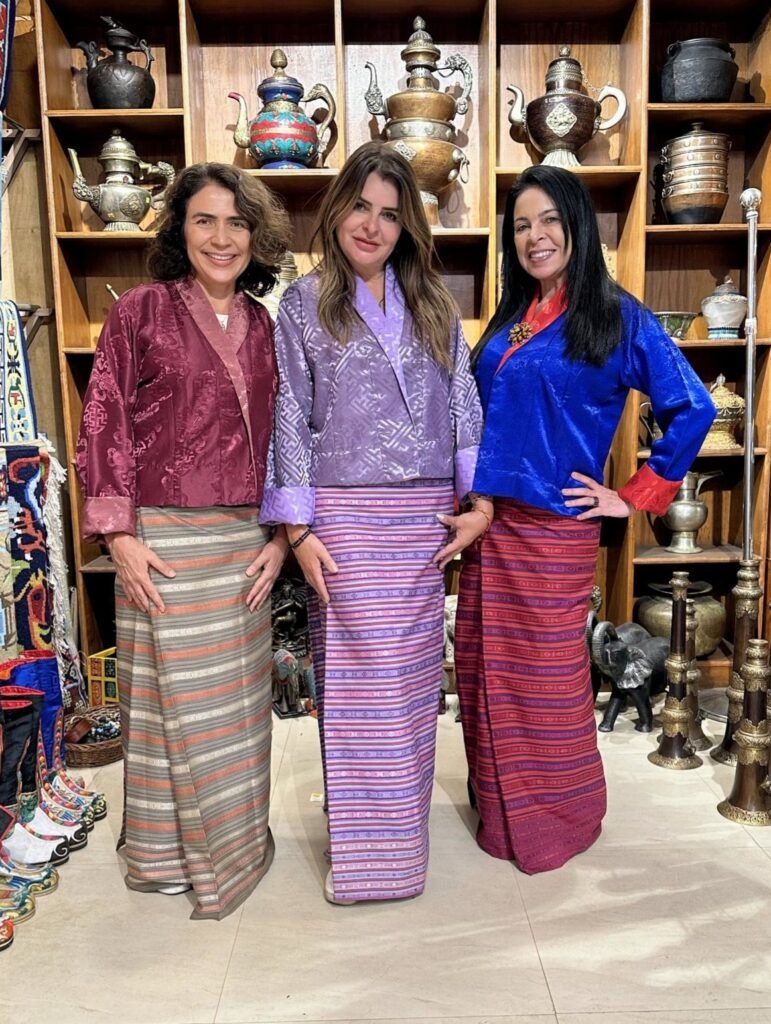
The traditional Gho for men and Kira for women.
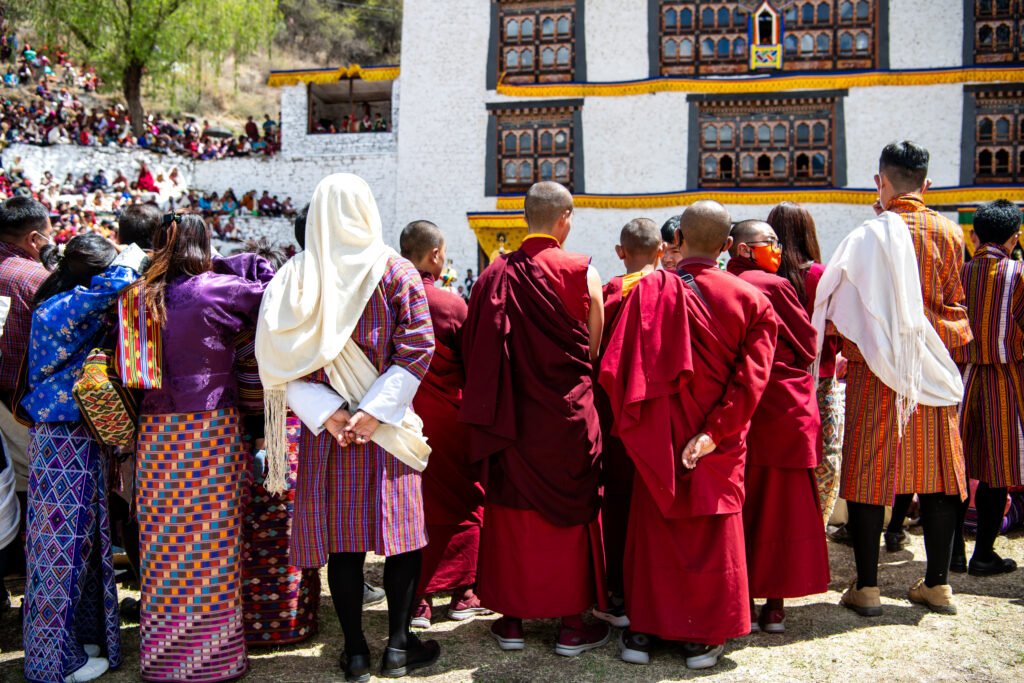
The weather couldn’t have been better for an open-air festival: blue sky, soft breeze, perfect temperature.
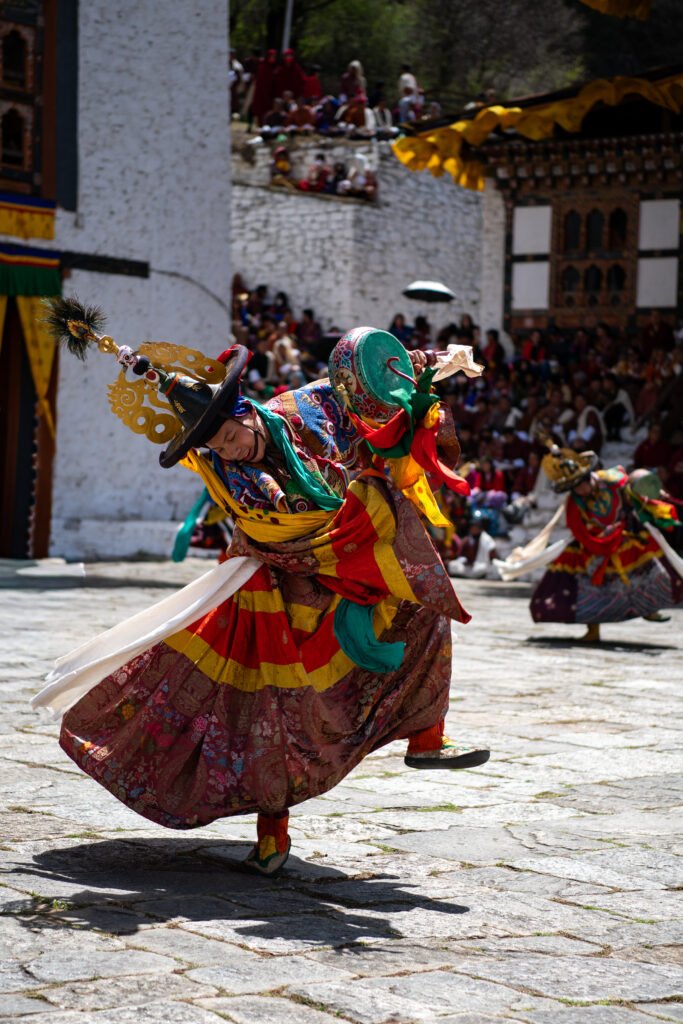
The dzong was alive with people, and performances unfolded in the courtyard as colorful dancers moved in wide, ritualistic circles.
Every step, every turn was part of a choreography deeply rooted in tradition, carried by a song driven by the marked beats of traditional drums.
This choreography was completely different from anything I had seen before, far more than colorful performances.
These were spiritual rituals — Cham dances — meant to purify, protect, and teach.
One masked figure caught my attention, and the crowd’s as well.
He kept walking around, teasing the dancers and joking with the audience.
He was the Atsara, the sacred clown — part jester, part protector — bringing humor to a festival that is otherwise deeply spiritual.
✦ Footnotes from Elsewhere
Cham dances are sacred Buddhist rituals performed by monks wearing elaborate masks and richly embroidered costumes. More than performances, they are spiritual ceremonies meant to purify, protect, and teach.They take place in festivals and monasteries across the Himalayan region, including Bhutan, Tibet, and Ladakh.
Experiencing the Dotsho
To match a perfect festival day, nothing beats a hot-stone bath — dotsho.
At least, in Bhutan.
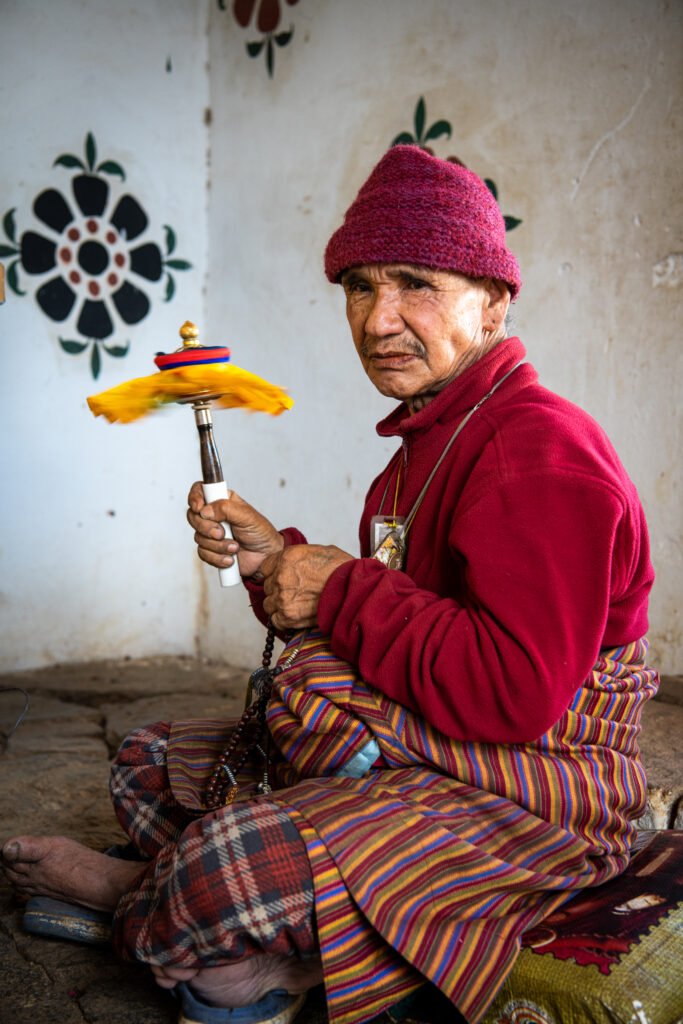
It’s considered a ritual of relaxation, purification, and healing.
Oh, come on. Who doesn’t need at least one of those?
It was our last activity that day. The place didn’t look anything like a nice hotel — quite the opposite. It was simple, modest, almost rustic.
When we arrived, it reminded me of a small farm: a main house and what had once been the old stalls, were now individual bath rooms.
The traditional method is uncomplicated. The stones are heated until they glow red, then placed in a separate compartment inside the tub — usually divided by a metal grate. To finish, they pour water over the stones, and the heat spreads through the bath. After that, they simply add more water or more hot stones to adjust the temperature to your liking.
And as someone who is a fan of hot water — and a sworn enemy of anything cold — as long as it was almost burning my skin, I was perfectly happy there.
And that relaxation was much appreciated — because the next day we had 900 meters of a steep uphill trail to reach Tiger’s Nest.
My most anticipated moment in Bhutan.
The First Sight of Tiger’s Nest
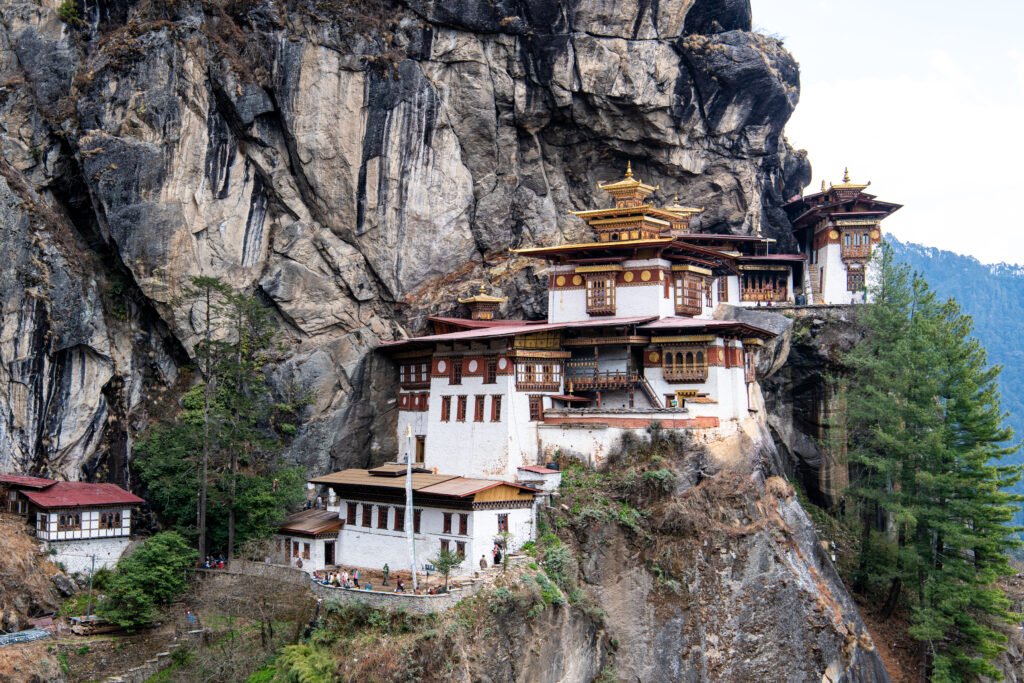
In the morning, I was filled with the kind of emotion I’ve become addicted to: that mix of anticipation and quiet anxiety right before heading to a place I’ve been dreaming of for a long time. And Tiger’s Nest had been at the very top of that list for a while.
Even the name feels poetic and mysterious. It comes from a Bhutanese legend: Guru Rinpoche is said to have flown to this cliffside on the back of a tigress before meditating in a cave for three months. That sacred moment gave the site its name — Taktsang, the Tiger’s Nest.
✦ Footnotes from Elsewhere
Guru Rinpoche, also known as Padmasambhava, is regarded as the “second Buddha” in Bhutan. He introduced Vajrayana Buddhism to the region in the 8th century, shaping spiritual teachings that still guide the country today — in its festivals, rituals, art, monasteries, and even in Bhutan’s sense of identity and harmony.
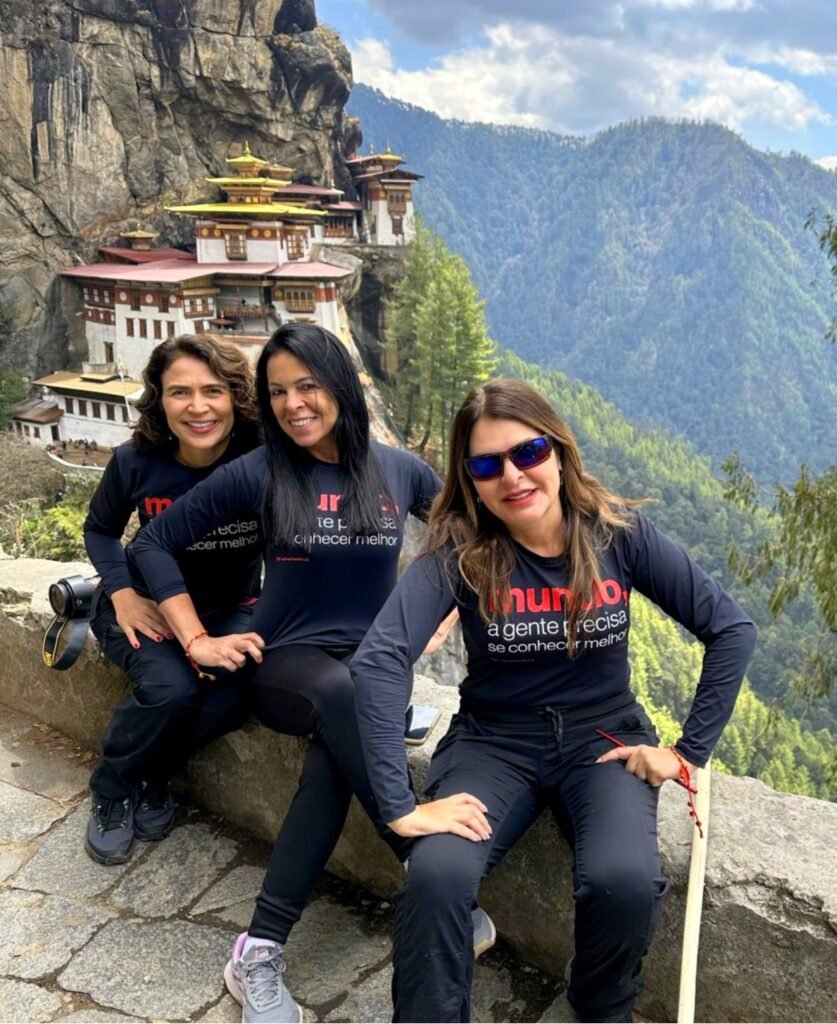
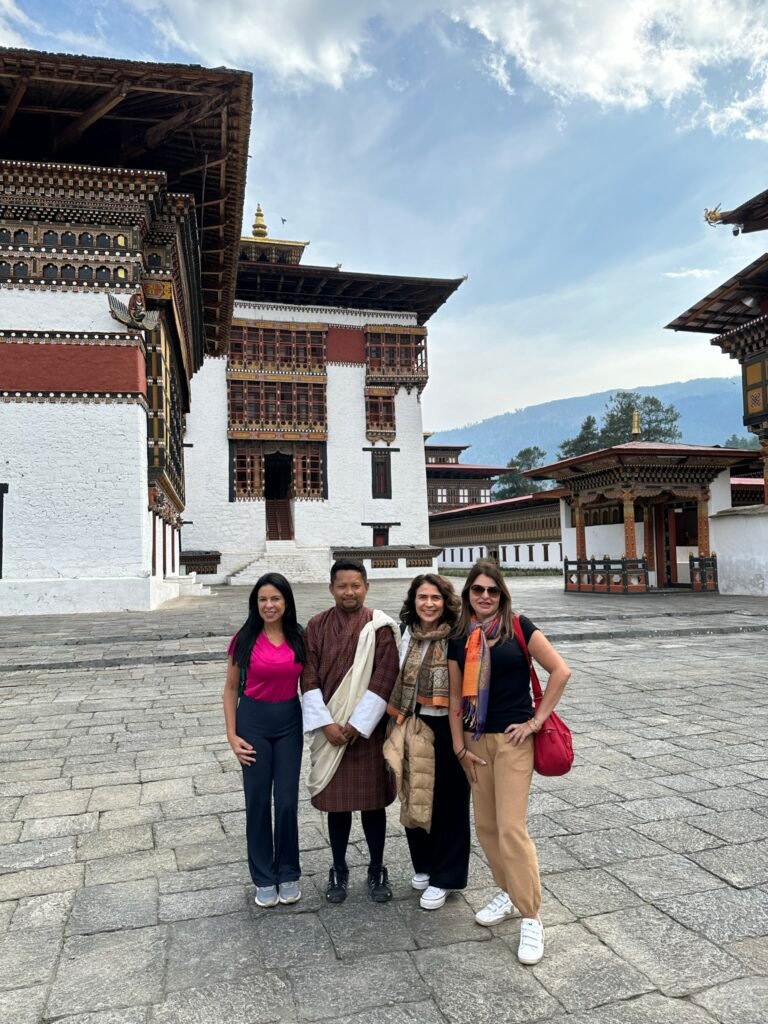
Early in the morning, the three of us — and our guide, Tshetrim, lovingly called Tim — stood at the trailhead at the bottom of Paro Valley, staring suspiciously at the temple hanging from the cliff.
Is it really only 900 meters?
Is it true we don’t actually climb the cliff?
How on earth did they build that up there?
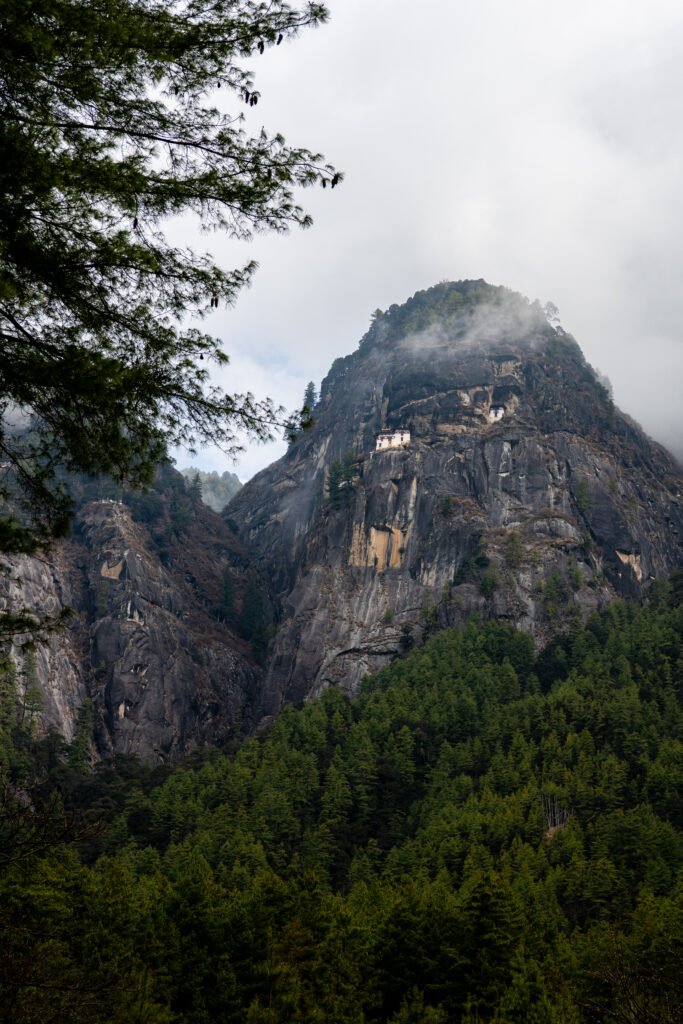
Without further hesitation, we stepped onto the trail — a sandy path marked by tree trunks acting as steps.
From time to time, the clusters of prayer flags appeared, hanging from the trees and adding pinches of color to the omnipresent green.
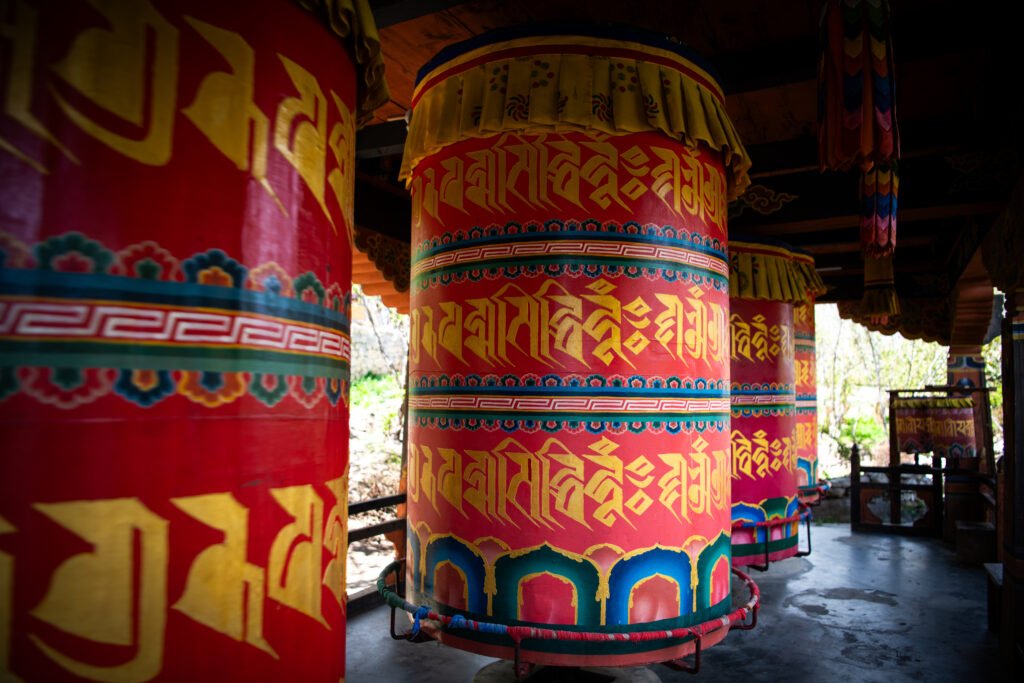
We also passed a few giant Buddhist prayer wheels. Their shape, their calligraphy that looks like painting, and the red and gold tones make them look like pieces of art to me. I just think they are so gorgeous.
Every now and then, I looked up at the monastery, and it still seemed impossibly far. I could almost hear it teasing us:
Catch me, if you can.
As Tim assured us there was no actual climbing involved, I was fully enjoying the challenge.
We kept making our way up, stopping for photos and soaking in the stunning views. And at a certain point, it was there — right in front of us. No longer a tiny white dot on the hill, but a majestic and imposing temple embedded in the cliff.
The scene was so powerful I had trouble moving forward.
The tree-trunk “steps” had now been replaced by real ones, and it was only a matter of minutes before we reached Tiger’s Nest.
The temple itself is simple, just like many others in Bhutan. The difference is how it rises in layers, adapting to the cliff as if it had always belonged there.
Although stepping inside was moving, the best moment was seeing it from the outside when we were almost arriving. That view is still printed in my mind. And I would walk the entire trail again, if I could.
Then it was time to begin our way back – and on the way down, everything works in your favor.
Whatever the reason — fulfilling a dream, visiting Bhutan’s most iconic site, overcoming a physical challenge, or simply praying in a sacred temple that felt unreal — whether one of them, several, or all at once, we were overwhelmed when we returned to where we had started.
The Spice Level? Himalayan. Literally.
After a morning of exercise and excitement, I was starving. Being hungry is my normal state, but at that moment I could have eaten an entire cow.
During the trip, we tried several Bhutanese dishes. The cuisine is quite simple — lots of vegetables and meat: beef, pork, chicken, and yak — almost like homemade comfort food. Nothing fancy at all.
Ingredients come straight from the fields, and because of the cold weather, they often use dried meat that lasts longer.
And here’s an important piece of information: they are absolutely crazy about chili peppers.
Not “they like it.”
No.
They are obsessed.
They can literally eat chili as the main dish. For them, it’s not a spice — it’s a vegetable.
I love spicy food and I usually handle it like a pro, but Bhutan humbled me. Indian and Mexican dishes suddenly felt… mild.
Like Mexicans, they add chili to everything — breakfast to dinner, sweet to savory.
More than once, Mirela, Marcia and I were red-faced and crying at the table. And I can assure you: none of us were sad about anything.
It’s cultural and also a question of self-preservation. Chili helps keep the body warm in freezing weather and also helps preserve ingredients.
But I didn’t give up and tried everything they served.
And — Catia being Catia — I casually mentioned to our beloved guide that I’d love to try the famous Bhutanese yak.
Being the sweetest, Tim managed to get me a yak dish for my last dinner in Bhutan.
Fatter than a cow and with a strong flavor, it was cooked as a stew.
And honestly?
I thought it was really good.
Patterns, Mountains and Red Robes
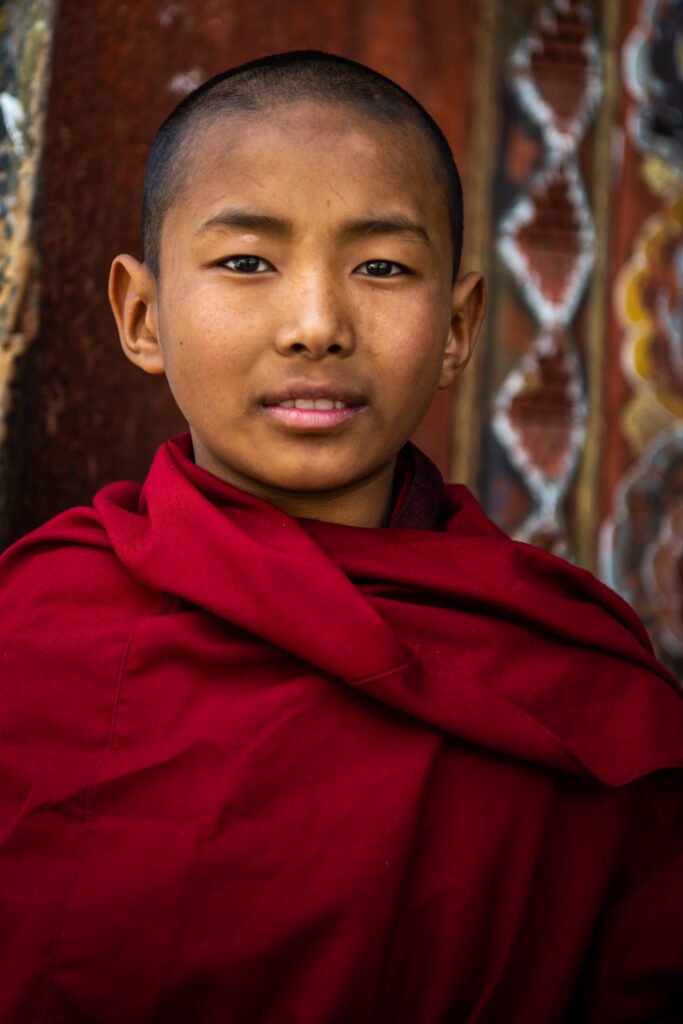
At this point, something else had already caught my attention: Bhutanese architecture.
Not only because of its unmistakable carved wooden windows, painted motifs, and traditional white facades, but for something even more distinctive — its homogeneity.
And that isn’t by chance. It’s by law.
✦ Footnotes from Elsewhere
Architecture is considered cultural heritage and a key element of national identity. As a result, the country follows strict regulations requiring all buildings — from homes to government offices to hotels — to be constructed in the traditional Bhutanese style.
These regulations are meant to preserve identity, protect cultural harmony, and ensure that modern development never overshadows the country’s heritage.
One architectural element stands out above all: the dzongs — monumental fortress-monasteries that combine civil administration and monastic life within the same complex.
When we arrived at Paro’s festival, the sheer scale of the Rinpung Dzong struck me. It felt like Bhutan’s version of a castle. If the small houses were already remarkable, imagine a massive version of them rising over the valley.
It’s not every day — or every trip — that I find myself looking at houses, dzongs, and temples that all look like each other and nothing like anything I’ve seen before. No “this looks like…” anywhere in sight.
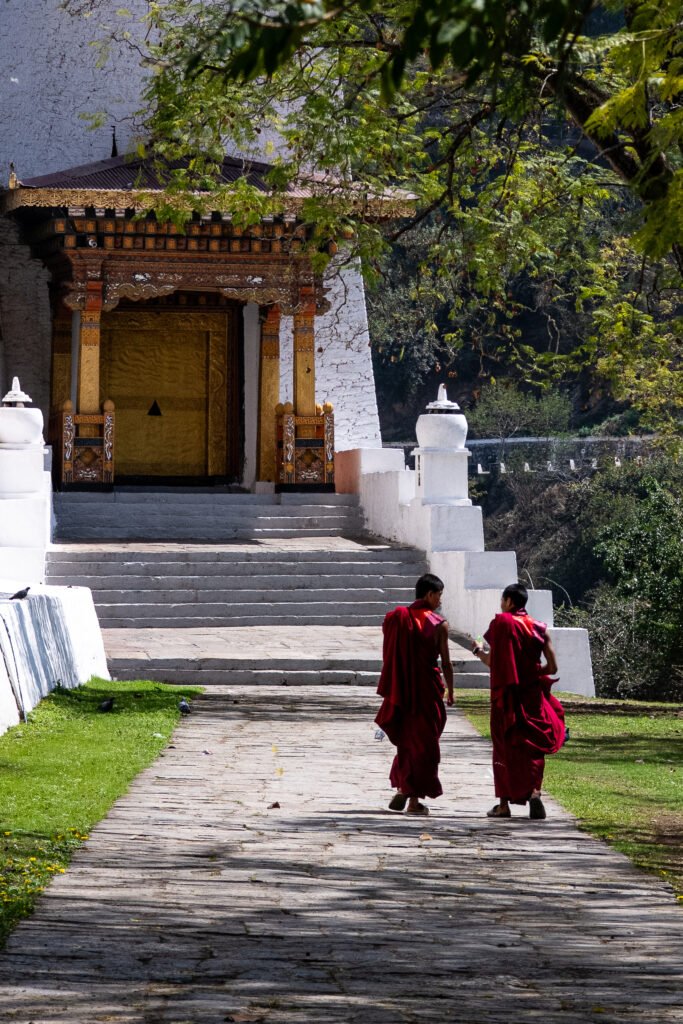
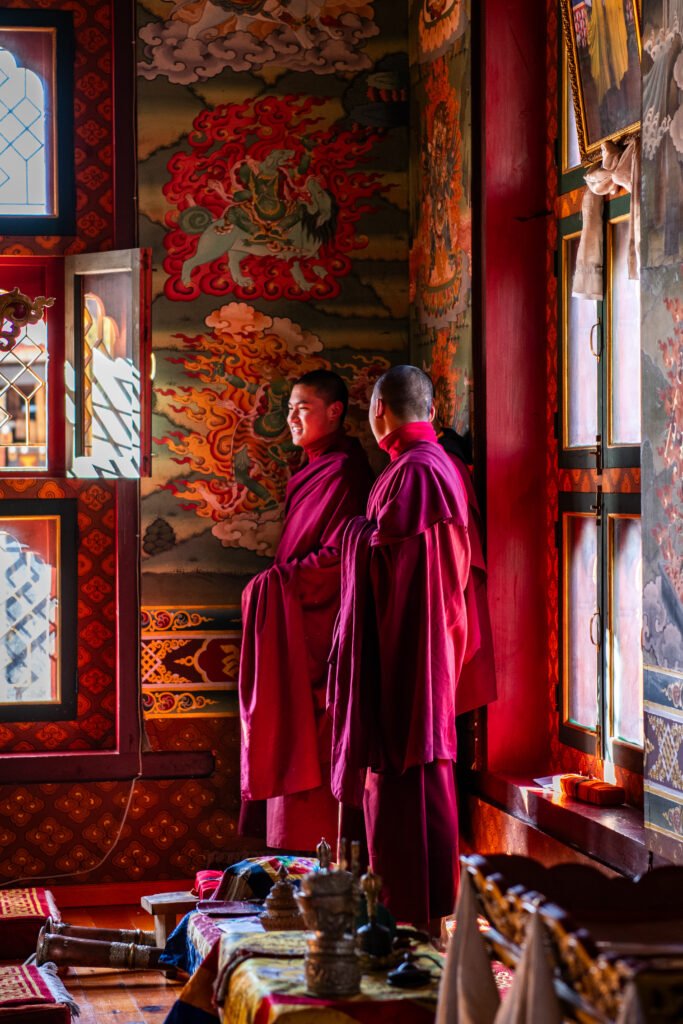
And then came the monks — moving through it all in their brilliant red robes, like brushstrokes of color across a perfectly composed landscape. I completely lost myself watching them in their routines. It honestly felt as if they had been made to be photographed.
And of course, the photographer in me was ready to start shooting nonstop.
The light, the colors, the harmony — it was all there.
But then I sensed something: the monks weren’t fully comfortable in front of the lens. When I asked Tim, he wasn’t comfortable asking either. And considering how kind and thoughtful he had been throughout the week, insisting would have felt unfair.
So I lowered the camera.
And I reluctantly accepted that I wouldn’t get all the portraits I wanted.
In a place so photogenic, walking away with fewer photos than I hoped felt strange.
But, just like the interiors of some temples, some scenes are meant to be kept only in our memories.
My Restless Mind Inside a Ceremony
On our last day, there was an optional ritual — with an extra fee — and we had to decide whether we wanted to go.
I was curious, and my friends not only shared that curiosity but also wanted to pray and receive the monks’ blessings.
As soon as we entered the temple, we were guided to the main hall, where a few monks were already waiting for us.
For a brief moment, I let my eyes wander around the room. Many temples share the same deep red interior, just like the monks’ robes — a color I can never resist.
Someone explained that the main monk would start the ceremony and that we should close our eyes and elevate our thoughts.
I tried. I really tried.
But after a while, my mind was boiling, and I couldn’t resist opening my eyes for just a second.
And that’s when I noticed a small movement:
white envelopes being quietly passed from hand to hand.
At that moment, I didn’t know what to think — part cultural practice, part donation ritual, part something I didn’t fully understand.
But I did understand one thing: the extra fee had found its path.
Prayers Released into the Wind
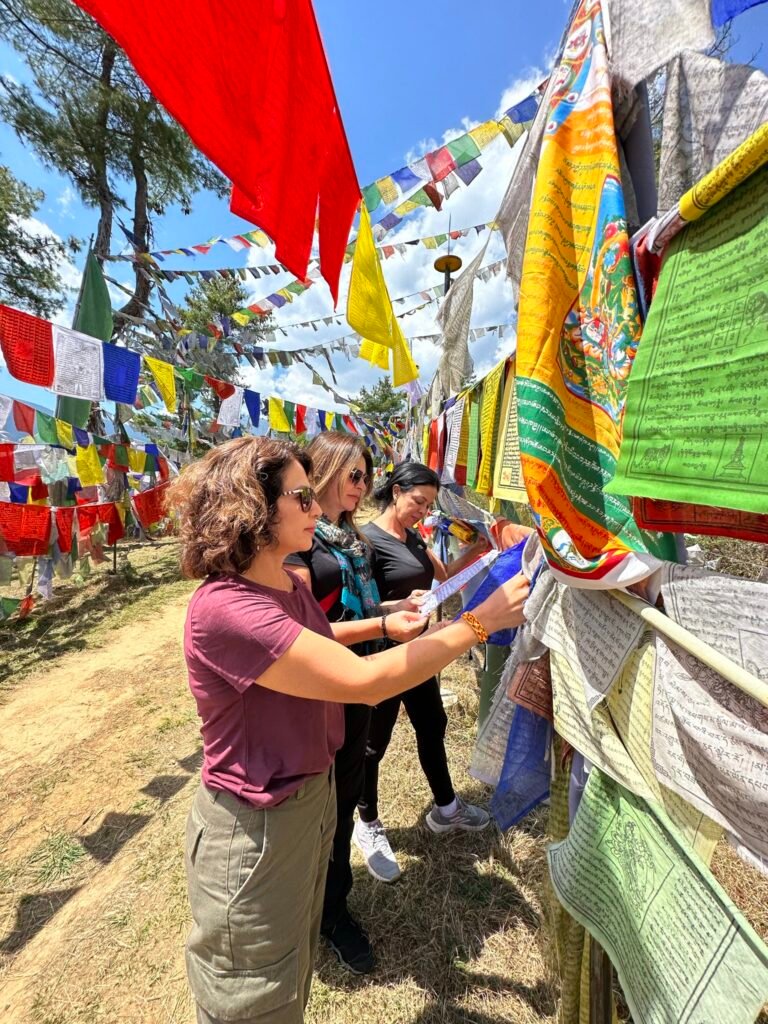
The first time you hang prayer flags, you never forget it.
After leaving the hotel, we were taken to a path high above the valley, a place filled with strings of colorful flags dancing in the wind.
The scene was both vibrant and peaceful, and I immediately slipped into a contemplative mood.
Tim explained that prayer flags carry a deep meaning.
They’re printed with mantras, prayers, and sacred symbols — and the moment the wind touches them, these blessings are carried across the landscape, reaching all beings — humans, animals, and the very environment itself.
Each color represents one of the five elements:
blue (sky), white (air), red (fire), green (water), yellow (earth).
That alone was beautiful, but what struck me the most was the generosity behind the act.
The blessings are not meant for the person who hangs the flag — they’re offered to everyone.
The symbolism was so perfect that it instantly went to the top of my list of the most beautiful forms of prayer I’ve ever seen.
It was one of the loveliest experiences of our trip. We had so much joy hanging ours as if our hope had been quietly recharged before we headed to our next stop.
Where Mountains and Monasteries Meet
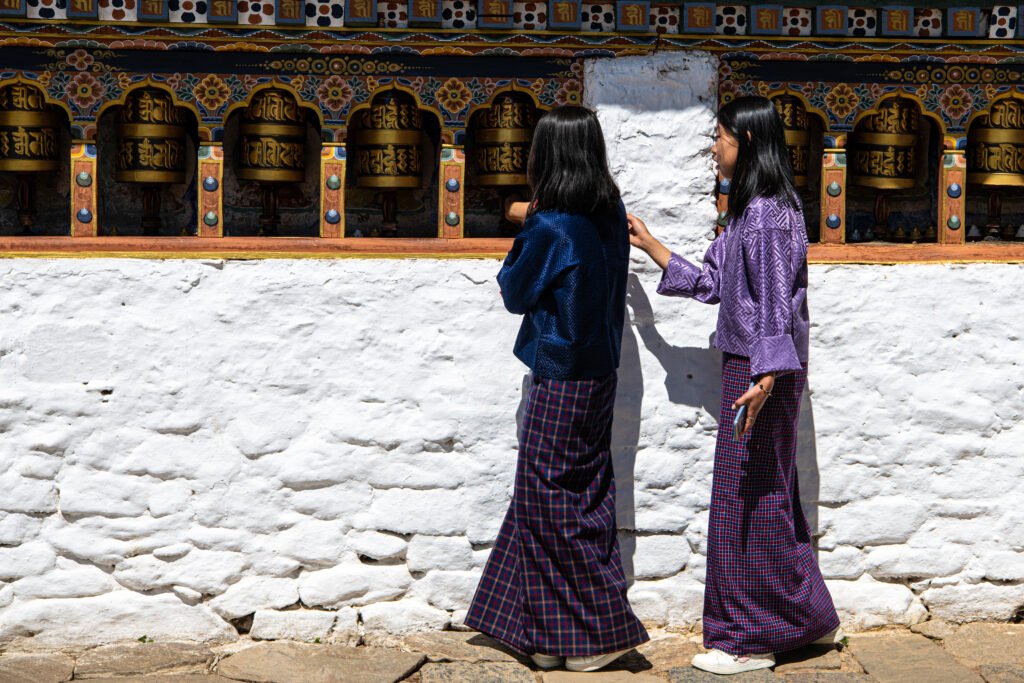
Spirituality is, indeed, spread across the country.
A single glance is enough to notice how religious architecture shapes Bhutan’s distinctive landscape.
✦ Footnotes from Elsewhere
Bhutan’s sacred architecture appears in three main forms: dzongs, the monumental fortress-monasteries that blend spiritual and administrative life; chortens — symbolic stupas built to bless, protect, and purify the land;and the more intimate lhakhangs and gompas, Bhutan’s classic temples and monasteries.
We visited dzongs that made us feel small inside their massive walls. Some had a vivid, almost tangible spiritual atmosphere — like Rinpung and Punakha, where monks crossed the courtyards in complete silence.
Others, like Trashichhoedzong, even sharing the same architectural DNA, felt entirely different — more like a government headquarters than a monastery, with guards and strict protocols replacing monks.
The smaller temples had a completely different personality.
Kyichu Lhakhang, a landmark of the arrival of Buddhism in Bhutan, carried the weight of history in its quiet interior and its row of five prayer wheels perfectly aligned in the courtyard.
And Chimi Lhakhang, surrounded by rice fields, brought a playful charm of its own. On the way there, we started noticing shops selling colorful, decorated wooden phalluses — a cheerful legacy of Drukpa Kunley, the “Divine Madman.”
And of course, there was no way each of us was leaving without bringing one home.
✦ Footnotes from Elsewhere
Phallic symbols in Bhutan aren’t sexual — they’re spiritual. Linked to the 15th-century “Divine Madman,” they’re believed to protect homes and shops from negativity and bring good fortune.
Some temples were perched so high that the landscape became part of the experience.
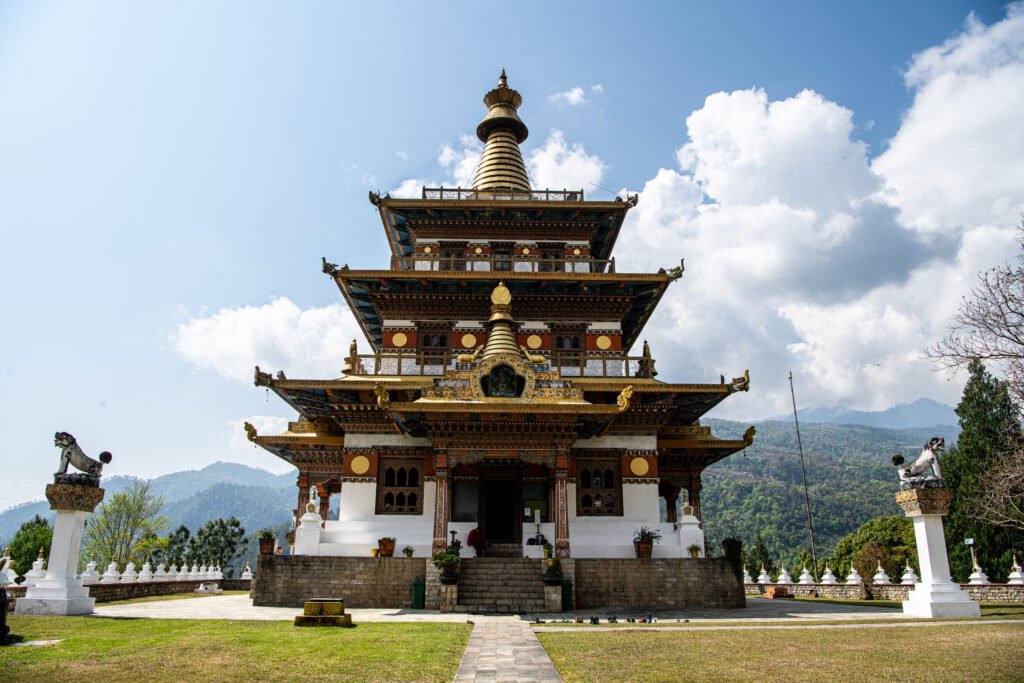
Khamsum Yulley Namgyal Chörten stood above the valley like a guardian, reached only after crossing rice fields and forests — a view that made it hard to decide where to look first.
And then there were the chortens themselves.
I already knew them from Nepal, but in Bhutan they’re almost omnipresent — appearing everywhere you turn. Their square base, rounded body, painted eyes or protective symbols, and golden spire are impossible to miss.
The Dochula Pass took this to another level: 108 chortens spread across a hilltop, surrounded by an open view of the Himalayan range — landscape, memory, and spirituality woven together.
But the place that felt truly singular wasn’t defined by its architecture.
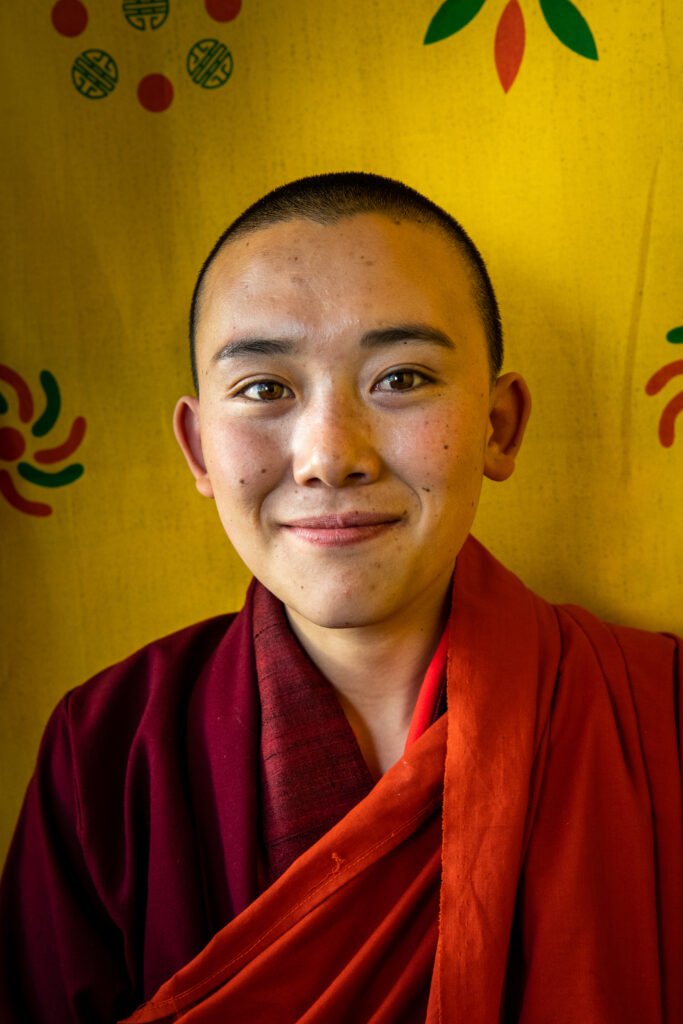
It was Sangchhen Dorji Lhuendrup Lhakhang, a monastic training center for women.
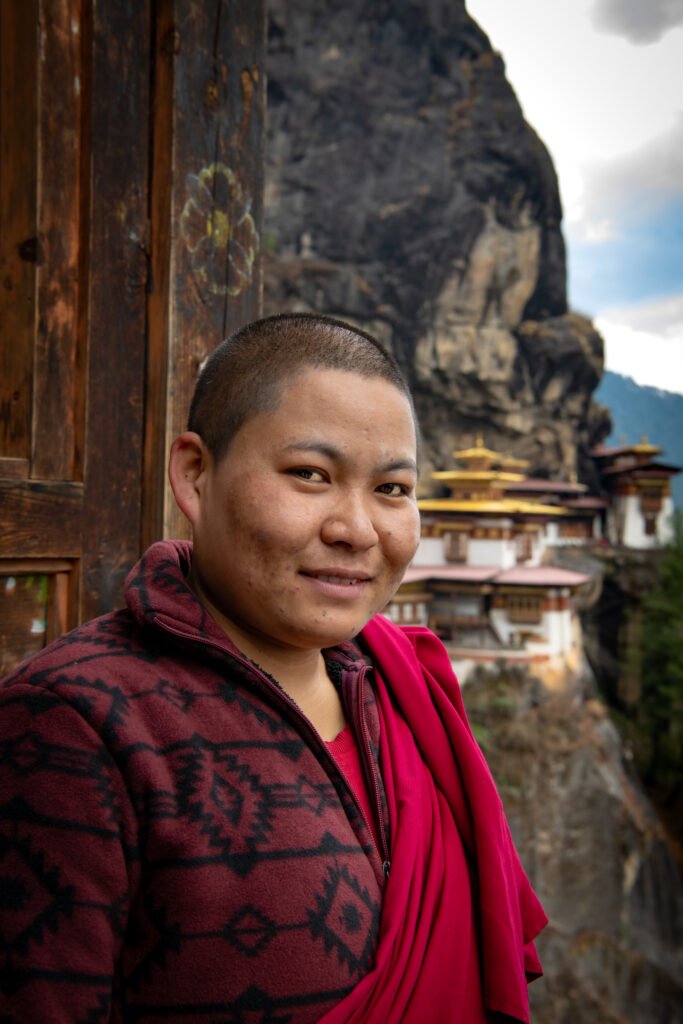
The building was larger than many temples and stood high on a vast mountain, but what made it unforgettable was the presence of the women themselves — moving in their traditional robes with a quiet strength that was both sacred and deeply human.
I even had the chance to photograph them — women being women, even when they are “monks.”
Grace and Rhythm at the Crosswalk
Bringing décor pieces back from my trips is something I absolutely love.
One day, we were walking around Thimphu looking for a few — and probably driving Tim a little crazy — when we stopped at a street corner to cross.
I looked straight ahead and froze.
There he was.
I immediately turned to Tim: “What is he doing?”
Poor guy. By then, I think he was relieved our trip was almost over. Three energetic women who couldn’t stop asking questions is not an easy job for anyone.
He just smiled and answered, casually: “He’s controlling the traffic.”
I couldn’t believe it.
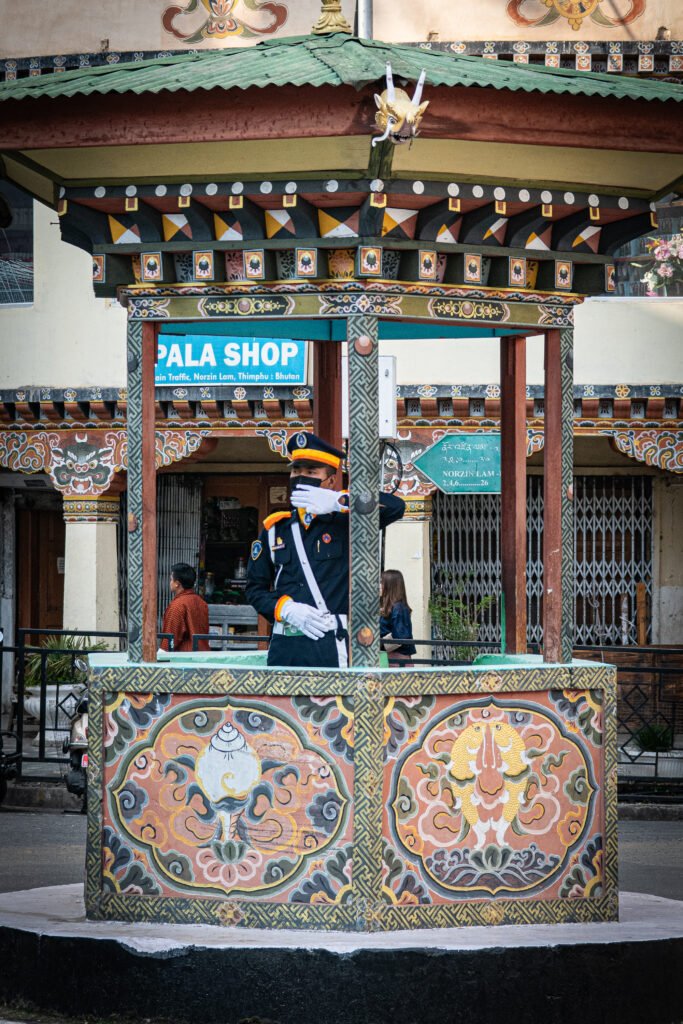
A traffic guard, in a formal uniform — including white gloves — standing inside an ornately painted wooden booth and performing an intricate hand choreography to direct the cars.
The way he moved looked almost like a professional dancer: full of grace, rhythm, and precision.
And honestly, it matched perfectly with the overall atmosphere.
A boring, charmless traffic light simply wouldn’t fit Thimphu.
It turned out to be the longest street crossing of my life.
And without a doubt, the only one I’ll never forget.
A Young Country in the World of Tourism
Bhutan was closed to tourism until the 1960s–70s. And although things have changed over the years, tourism is still meticulously controlled to preserve both culture and environment.
According to my travel agent, it’s mandatory to hire a Bhutanese agency, and only two national airlines fly into the country. There is also a daily tourism tax to enter.
During our trip, we clearly saw a country still in its early stages of tourism. Only a few five-star hotels, and an even shorter list of fancy restaurants — none of them, I suspect, with chili levels adapted for non-locals.
✦ Footnotes from Elsewhere
Bhutan doesn’t measure progress by economic growth alone, but by “Gross National Happiness” — a philosophy created in the 1970s by the Fourth King, Jigme Singye Wangchuck. Instead of focusing only on wealth, it evaluates the country through four pillars: sustainable development, preservation of culture, environmental protection, and good governance. The idea is simple and profound: a nation is truly successful only when its people — and its values — thrive.
We were warmly welcomed by our guide, by the restaurants, and by the hotels. At times, we also sensed a mix of formality, shyness, and inexperience — after all, they are still learning.
Never impoliteness.
The language barrier added another layer. Maybe it’s easier for Americans, but for non-native English speakers, understanding and interacting could feel a bit challenging.
I’ve improved over the years when it comes to understanding English spoken by Asian communities, but it’s still not easy — and Marcia and Mirela were really struggling.
During one of our transfers between cities, we were running a little late. Tim apologized profusely — with the seriousness of someone announcing a major crisis — and told us that we wouldn’t go to the hotel first. Instead, we’d visit the sights and check in later.
Mirela: “I didn’t understand. Did something happen to our lunch? I heard something about chicken.”
For a second, I was completely lost. Then it hit me, and I answered — almost crying with laughter:
“He said check-in. Not chicken.”
And we laughed until we could barely breathe.
Including Tim.
Your note truly touched me! It warms my heart to hear you found Bhutan so wonderful, from the serene landscapes to the inspiring culture and traditon. Thank you for sharing your beautiful experience, and we hope you carry that peace with you.”
With Warm regards
Yours sincerely
Tim
Bhutan was far more than a destination — it was a life experience, and you were a fundamental part of that journey. Your kindness, care, and the way you shared your country’s soul with us made every moment even more meaningful.
I will absolutely carry that peace with me — and so many beautiful memories as well. Thank you for everything.
With warmest regards,
Catia
Pingback: Iceland Travel Stories — Fire, Ice and Blue Light
I really loved reading this note. Through your words I felt completely transported to a place that seems truly magical. Full of spirituality and quiet beauty. Bhutan sounds like a rare gem, a country that the world hasn’t fully discovered yet, and I hope it stays that way. It’s inspiring to see how carefully they protect their traditions and values, and how thoughtfully they manage tourism so that this spirit isn’t lost. Your story made me dream of visiting one day and experiencing this magical world exactly as you described it. ✨
I’m so glad the story transported you there. Bhutan really is a remarkable place, like no other. An itinerary for you would require a few adjustments, but it’s absolutely worth the effort. I just hope it manages to preserve this spirit for a long time.