Uzbekistan travel stories through Silk Road cities, turquoise mosaics, desert heat and architecture that refuses to be forgotten.
Rebuilt, Reimagined, Blue
There I was staring at the departure board: Tashkent, having just visited the first stop of my Silk Road trilogy — Kyrgyzstan.
Not long before that, I had barely heard of the place.
Once again, it was social media that pulled me in. Those endless images of madrassas, mausoleums and mosques bathed in every imaginable shade of blue were irresistible to someone deeply drawn to Islamic architecture. A quick search was enough to send Uzbekistan straight to the top of my wish list.
Tashkent turned out to be a collision of worlds. Old Islamic silhouettes rising next to glass towers glowing with more neon signs than I ever expected, as if a Las Vegas in its infancy was sharing the same streets with a city from another era altogether. Soviet blocks still linger in the background — adding yet another layer left by history to the architectural landscape.
That “other era”, however, is not as straightforward as it seems.
✦ Footnotes from Elsewhere
Few places along the Silk Road were reshaped as many times as Uzbekistan. Cities like Samarkand, Bukhara and Khiva were repeatedly devastated by invasions — from Genghis Khan in the 13th century to later regional wars — as well as by powerful earthquakes. In the 20th century, Soviet urban planning added yet another layer, replacing large sections of historic fabric with vast avenues and concrete blocks, before many landmarks were later reconstructed.
The Moment MMM Made Sense
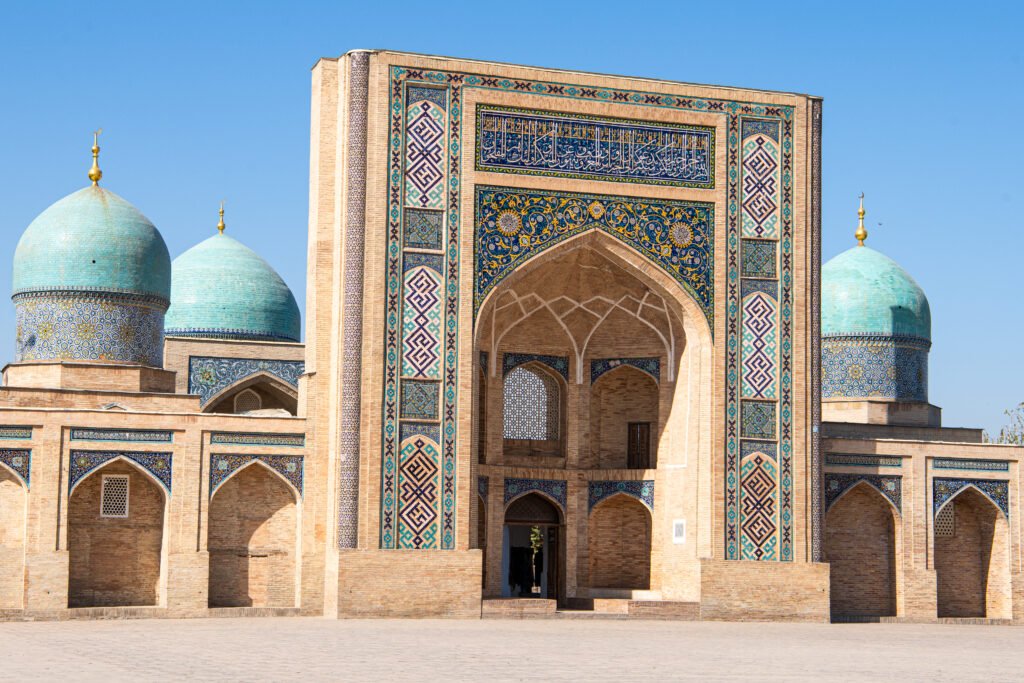
In my case, the debates between reconstruction and authenticity were completely left behind the moment I set foot in the Hazrati Imam Complex.
It became hard to dwell on such intellectual questions while standing in front of the iwan — a deeply recessed arched portal — framed by earth-toned walls, punctuated with blue details and crowned by even bluer domes shining relentlessly under the unforgiving sun.
Up close, it becomes even more impressive. Inside the iwan and along the walls, a perfect balance of arabesques, calligraphy and the unique muqarnas unfolds — a cascade of geometric cells, as if the dome itself were slowly breaking into light.
The complex marked my first of many encounters in Uzbekistan with what Mahmoud, my guide, kindly called an MMM — madrassa, mausoleum and mosque.
✦ Footnotes from Elsewhere
Madrassas were Islamic schools where students studied theology, law, philosophy and science. Along the Silk Road, they also functioned as cultural and intellectual hubs. Today, many of Uzbekistan’s madrassas no longer serve an educational role — instead, they house museums, artisan workshops and exhibition spaces, preserving their architectural grandeur while taking on a new life.
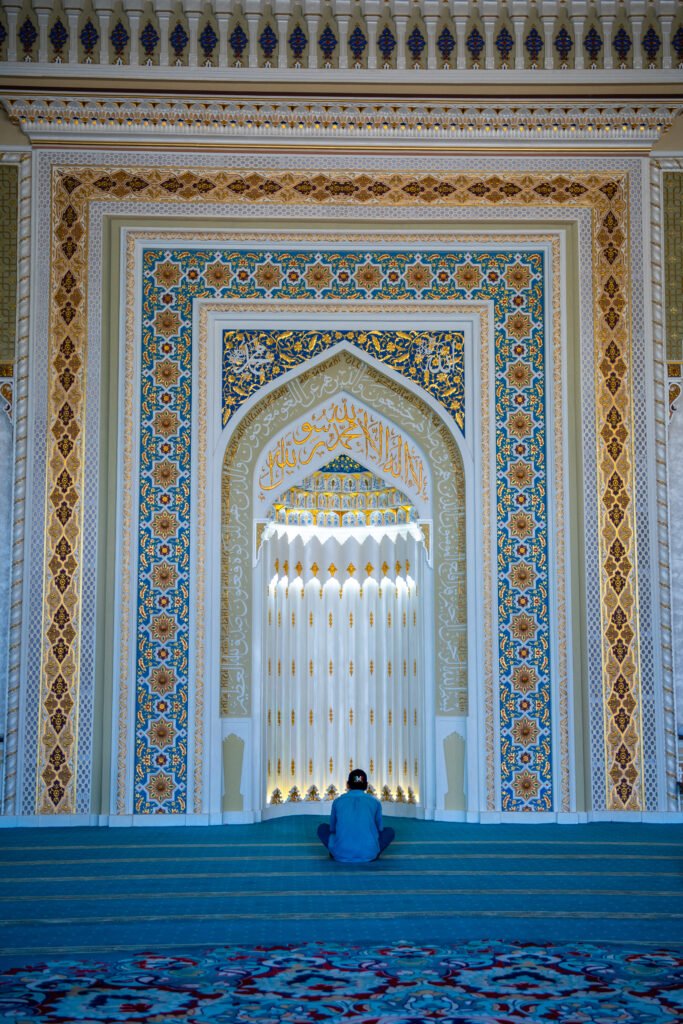
Blue continued inside the mosque, with a bright-blue carpet stretching across the enormous prayer hall. The decorated walls were accented with gold — a detail that delighted me, as gold has always been one of the colors I’m instinctively drawn to.
A Colossal Pan of Rice
Besides the Islamic architecture, something else was different from Kyrgyzstan – the weather. I left the alpine climate and the greenish surrounds of the Issyk-Kul lake and went straight to the dry and hot desert climate.
Sometimes, when the heat is brutal in Rio de Janeiro, we say jokingly: “Today there is one sun for each one of us”. That was the feeling when noon approached.
Escaping the sun at Chorsu Bazaar felt like the perfect plan. The moment we arrived, the aroma of spices instantly awakened my appetite. We wandered through the alleys, picked up a few typical snacks, and climbed to an elevated viewpoint on the second level, where the market unfolded beneath us.
Even Chorsu Bazaar has a distinctive architectural identity. From the inside, a vast white metallic dome rises above the stalls, flooding the market with light. Outside, however, the same dome abandons its monochrome restraint and reveals a striking blue ornamental façade.
But the best was still to come.
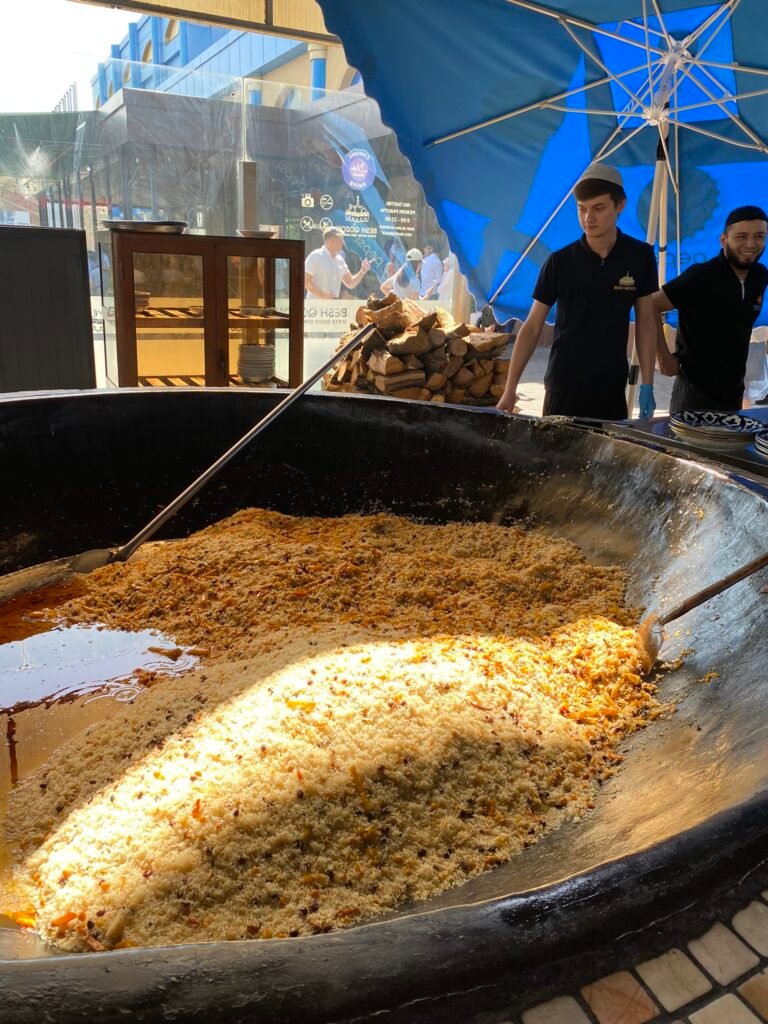
In an open area, we approached a man slowly stirring a colossal, cone-shaped pan — so large it could easily fit a man lying inside — filled with an unimaginable amount of golden rice and chunks of meat. Plov.
The scene was impossible to ignore — and the smell, irresistible. Of course, I wanted to try it.
That’s when I learned that plov can be made with beef, lamb or horse meat. Mine came with the traditional horse sausage, kazy.
It was packed with flavor — probably helped by the fresh spices from the surrounding market — and although the portion looked suitable for someone who had been fasting for days, it somehow felt perfectly appropriate for me too.
✦ Footnotes from Elsewhere
Plov (also known as palov or osh) is Uzbekistan’s national rice dish, traditionally cooked in a large cauldron (kazan). Depending on the region, it is prepared with beef, lamb or horse meat, reflecting Central Asia’s nomadic heritage, and is served both as everyday food and at celebrations such as weddings and communal gatherings.
By then, I didn’t know that a few years later I would try another rice dish with the same roots, this time in Azerbaijan — Shah Plov. Both are rice-based dishes, yet the way they are prepared and served could not be more different.
While shah plov is visually refined and ceremonial, plov is rustic and unapologetically communal.
Gallery Beneath the Streets
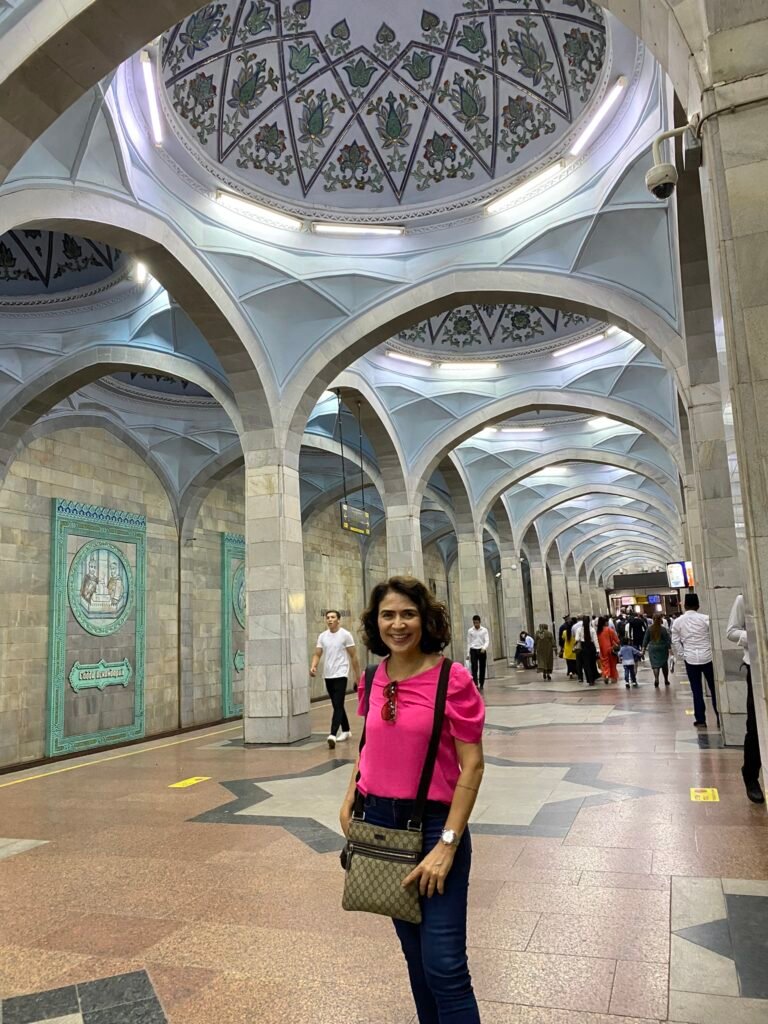
Who would have guessed that moving between the complex, the market and our next destination would involve anything but an ordinary subway station?
Instead, we found ourselves descending into stations carefully designed and richly decorated, each one with its own distinct identity.
Some felt like art galleries, others echoed the geometry of a madrassa or the grandeur of a palace. Every station seemed to tell a story of its own — science, Uzbek history, literature, and even Soviet conquests were among the themes woven into their design.
In Tashkent, the subway is not just a way to get from one place to another.
It is an attraction in its own right.
✦ Footnotes from Elsewhere
Designed during the Soviet period, the Tashkent Metro was conceived as a statement of urban pride and cultural ambition. Each station was carefully decorated around a specific theme, transforming public transport into a space where architecture, identity and everyday life deliberately intersect.
After roaming around for a while, I decided it was time to explore something I was genuinely curious about: Uzbek wine. Yes, it’s true — they do make wine.
The wines may still need time to mature, but I admired the boldness of producing them in such an unexpected place.
Besides, the next day we had a domestic flight ahead of us, taking us to one of the most anticipated destinations of the trip: Khiva.
A Solution Pushed Too Far
Khiva has always lived on the edge of heat and water scarcity.
Since ancient times, it has survived as an oasis thanks to the human ability to redirect water and bend nature just enough to make life possible. That same ingenuity, however, would later be pushed too far — what was once a solution would eventually become part of a much larger problem.
During Soviet times, rivers were diverted to irrigate vast cotton fields, draining what had once been the world’s fourth-largest lake — so vast it was known as a sea: the Aral Sea. The result was catastrophic: most of the lake disappeared, leaving behind a desert where water once defined the landscape.
If I ever used emojis in my writing, this is exactly where one of shock would belong.
Khiva was always hot — that was never in question. But with the loss of its natural thermal balance, the heat feels more intense, more relentless. Standing at the hotel door, staring into the blinding light outside, I had to gather the courage to step out.
I’m glad I did.
Khiva was far beyond anything I had imagined.
Inside Khiva’s Walls
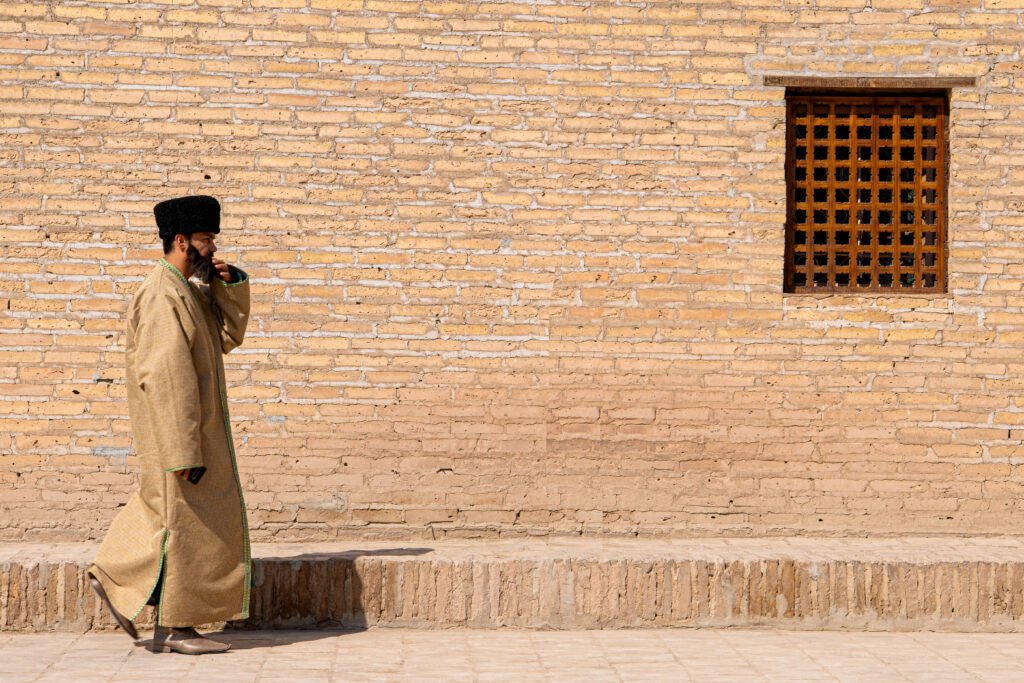
The ancient walled heart of Khiva is called Itchan Kala. A UNESCO World Heritage Site, it stands as one of the most iconic examples of a largely restored historic city in Central Asia.
Walking inside Itchan Kala feels like exploring an oasis of MMMs in the middle of the desert. The sheer number of madrassas within such a compact walled area is hard to ignore — together with towers, palaces and courtyards, all layered within the same space.
Just as hard to ignore is the Kalta Minor Minaret. Its massive, unusual structure is wrapped in bands of blue tiles, forming horizontal stripes that shimmer against the light.
The original plan was ambitious: the minaret was meant to rise 70 meters high, becoming the tallest in Central Asia. That ambition explains its unusually wide base, designed to support both the height and weight of the structure.
History, however, had other plans. The khan who commissioned the project died in battle, and the minaret was left unfinished, reaching only 29 meters.
Not that any of this diminishes its beauty. Quite the opposite — Kalta Minor remains one of the most intriguing and memorable landmarks inside Itchan Kala.
The streets inside Itchan Kala have retained their narrow, centuries-old proportions. But the heat made wandering a luxury best postponed. At that hour, all we could do was move directly from one landmark to the next.
That’s how I found myself inside the Juma Mosque, surrounded by its ornately carved wooden columns. It felt like a much-needed reboot after the visual overload — a moment to pause, breathe, and allow everything seen so far to slowly settle.
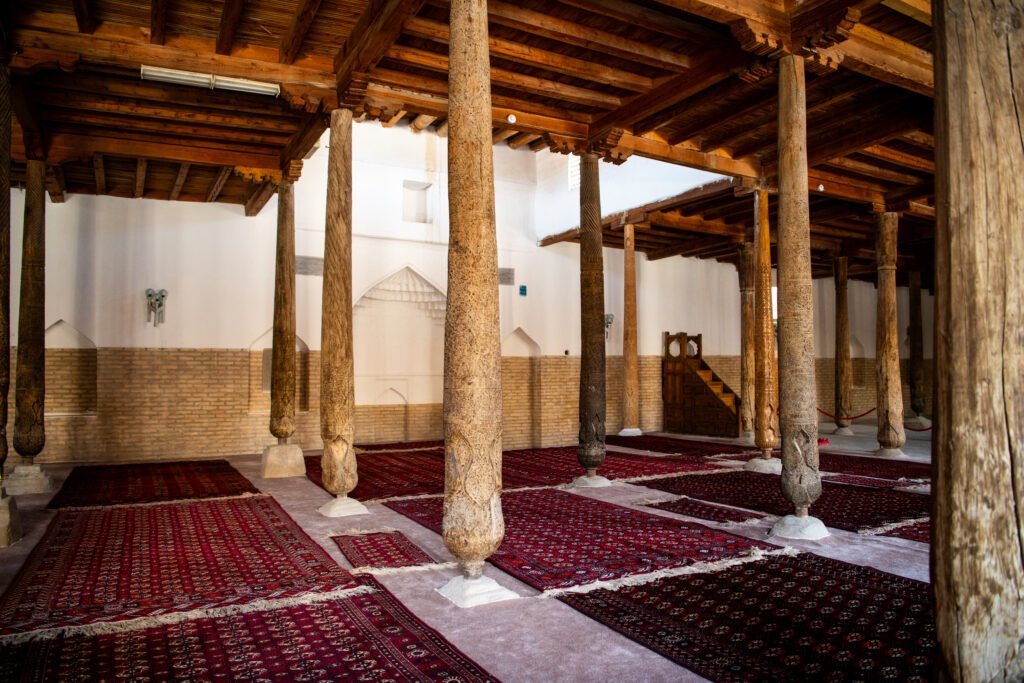
I wandered quietly among the columns, grateful for the dim light and the calm, shaded refuge from the sun. When we stepped back outside, I felt renewed — and ready for more.
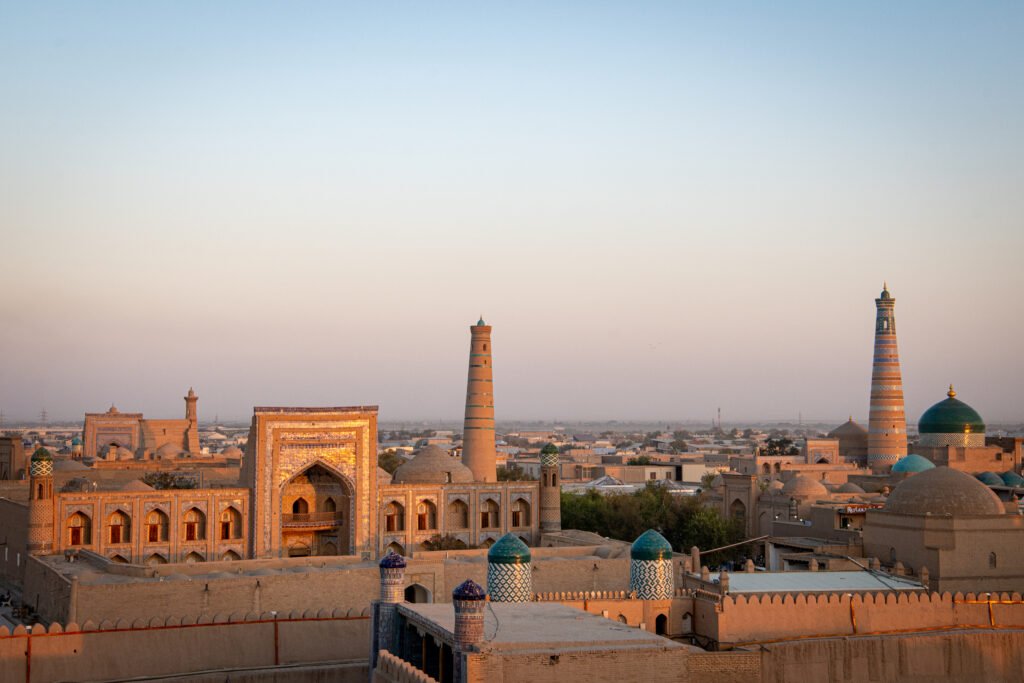
By the end of the afternoon, I was sharing a rooftop with other travelers, watching a sunset straight out of a film, turning the already dramatic silhouette of madrassas and minarets into a golden masterpiece.
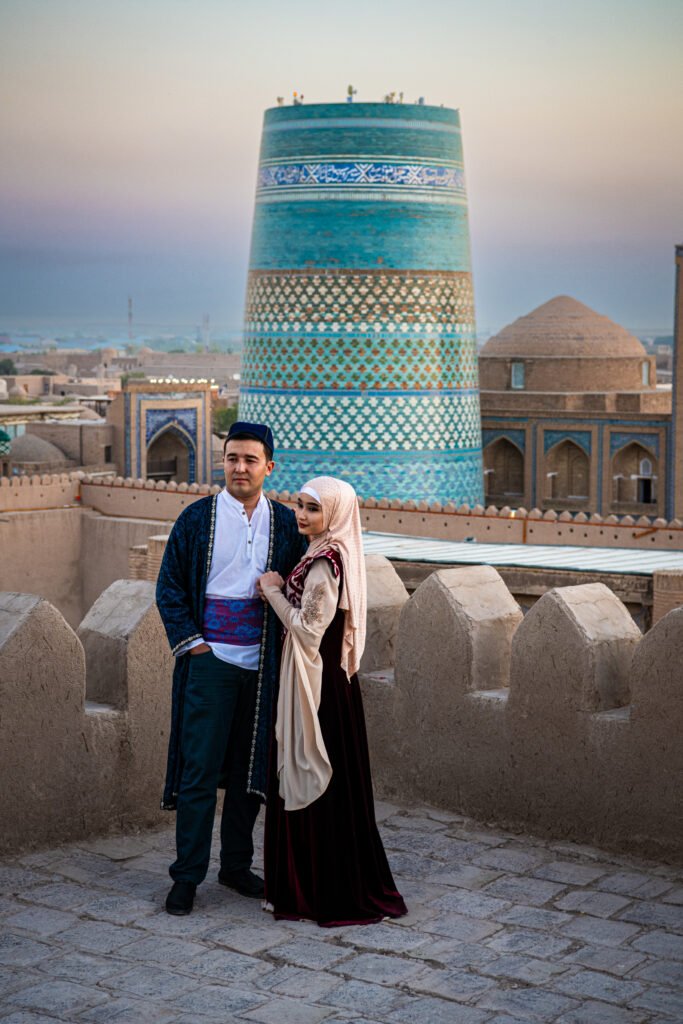
As if that weren’t enough, two couples were taking advantage of the same view for their wedding photos. The best part? They were dressed in traditional outfits, and together everything felt like a scene lifted from a period drama.
After soaking in that view for as long as it lasted, we found a place for dinner at a small spot right across from a softly illuminated minaret. I didn’t hesitate. The food didn’t even matter — which is rare there — but the chance to sit quietly and admire that minaret without the usual crowds was simply too good to pass up.
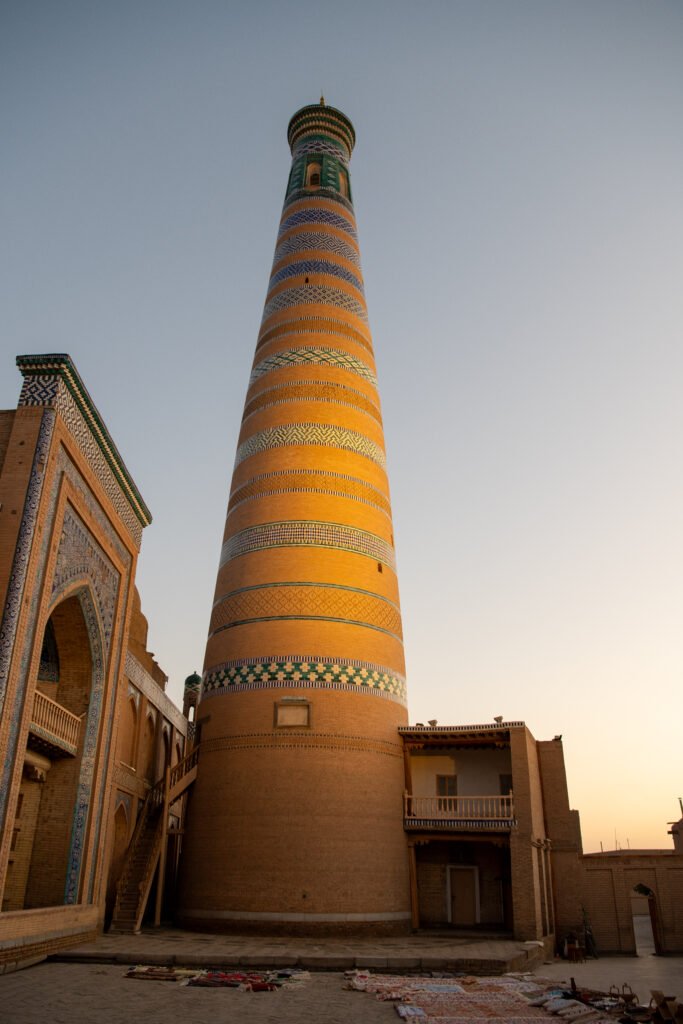
The next morning, grateful that the hotel was located inside Itchan Kala, I stepped outside before breakfast, searching for the city hidden behind the bustle and noise of later hours.
It felt like walking onto the set of Arabian Nights. Without the rhythm of modern life, and wrapped in a quiet atmosphere, the city appeared even more ancient.
Yet, because of the extensive restoration, it also felt curiously frozen in time — a place that seemed untouched by the passing centuries, as if preserved beneath a glass dome.
I wandered through spaces I had seen the day before — now transformed by a softer light — while also discovering new, overlooked corners.
That fragile stillness had already faded by the time we reached the Tash Hovli Palace, once the residence of the khans, and stepped into its inner courtyards — the harem, ceremonial spaces and areas reserved for official audiences.
My hours in Khiva were running out.
Bukhara, Without So Much Makeup
As Khiva, Bukhara also emerged as an oasis and played a key role along the Silk Road. But these cities are not defined by similarities alone. When it comes to restoration, they reveal very different approaches.
Bukhara went through more restrained, punctual restoration, allowing the city to age without so much makeup, while still preserving its charm and quiet majesty.
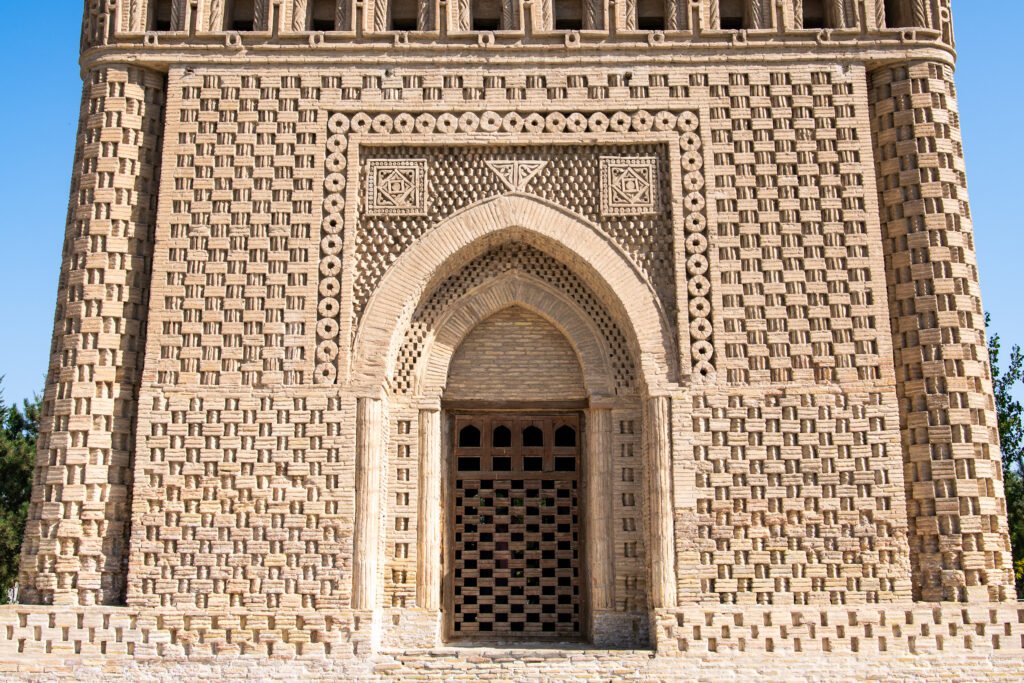
That difference was immediately clear at my first landmark in Bukhara: the Samanid Mausoleum. A square-based domed structure where blue exists only in the sky framing it, the mausoleum stands apart from anything I had seen so far.
Rendered entirely in warm earth tones, its intricate exposed brickwork unfolds in countless variations — shaping geometric patterns across windows, corners, walls and even inside the dome. So rich and precise that it leaves no room to miss colored tiles — or anything else.
✦ Footnotes from Elsewhere
The Samanid Mausoleum survived because it remained out of sight.
For centuries, the building lay partially buried under layers of sediment and urban abandonment, escaping invasions and reconstructions. When it was rediscovered in the modern period, it emerged almost intact — as if time had passed over it without leaving a trace.
The Chasmai Ayub Mausoleum followed the same “less is more” philosophy. There is undeniable beauty in this restrained style, and it felt good to pause and breathe before the extravagance of Samarkand. Still, I won’t deny that I hadn’t quite had enough of blue yet.
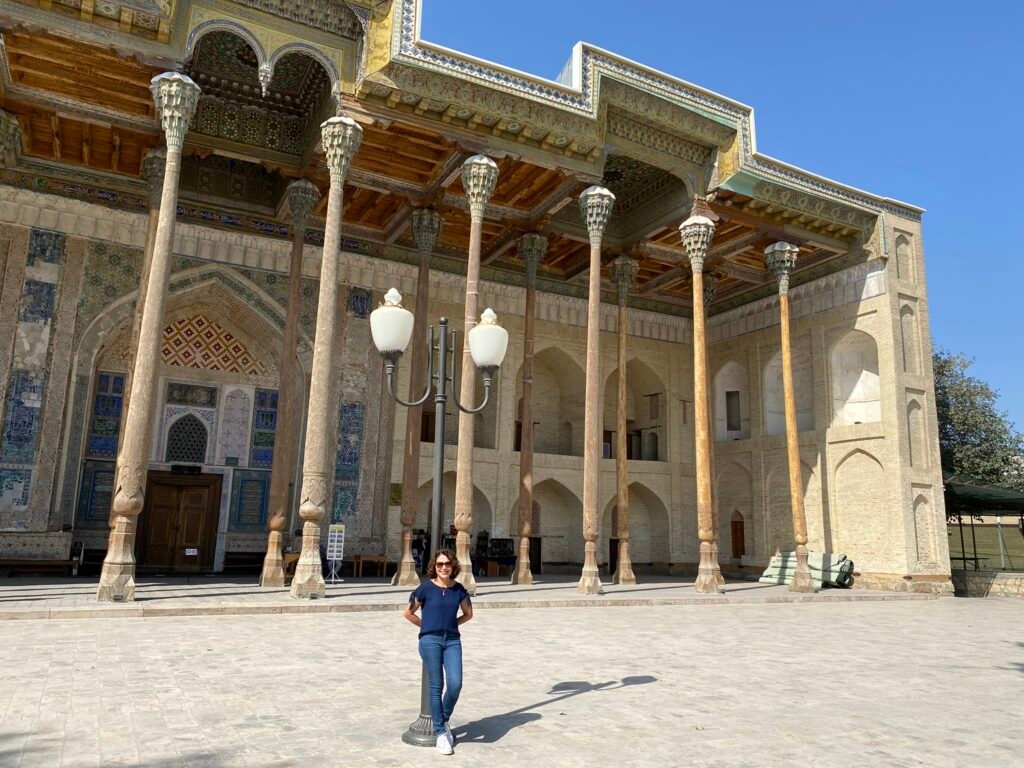
That introduction to Bukhara’s cleaner architectural language wasn’t over yet. The Bolo-Hauz Mosque is famous for its finely carved wooden columns, supporting a remarkably high roof that shelters the iwan — elegant, measured, and quietly confident.
By then, Marmoud had clearly realized I was hungry — for architecture, history, art, and food itself. He also knew I had zero interest in Western cuisine and was more than happy to dive into local flavors. So he casually asked:
Do you want to eat at a tourist restaurant, or would you rather try a simple local place?
I’ll let you guess my answer.
Minutes later, I was stepping into a modest house where the smell alone seemed capable of grabbing you by the hand and pulling you inside, into a shaded, tree-filled courtyard where traditional Bukhara dishes were being served. No tourists in sight.
After so much food, it took a serious effort to stand up — and an even greater one to step back outside and face the sun once again.
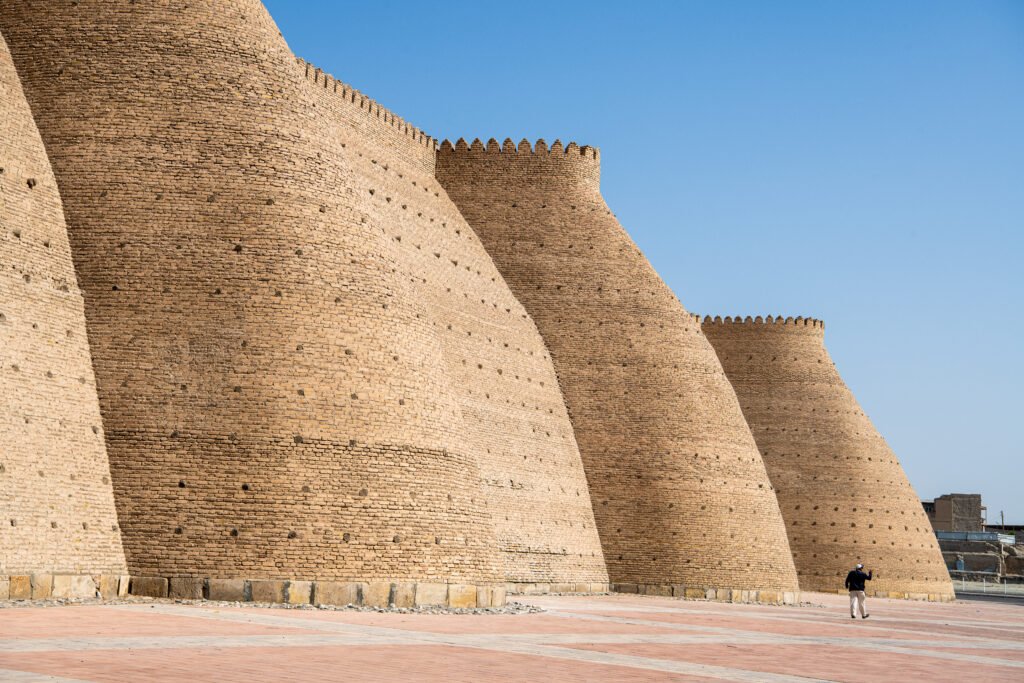
Just a few steps from where we stood was the entrance to the Ark Fortress, a fortified citadel that, much like Itchan Kala, once concentrated power behind thick walls.
Those walls alone had already caught my attention — imposing yet unexpectedly graceful, shaped by massive rounded forms rather than rigid straight lines.
Leaving minimalism behind once again, the Po-i-Kalyan Complex brought me straight back to color, scale and ornamentation. A dominant MMM arranged around a wide square and a single tree standing quietly at its center, it restored the full richness of Islamic architecture to the scene.
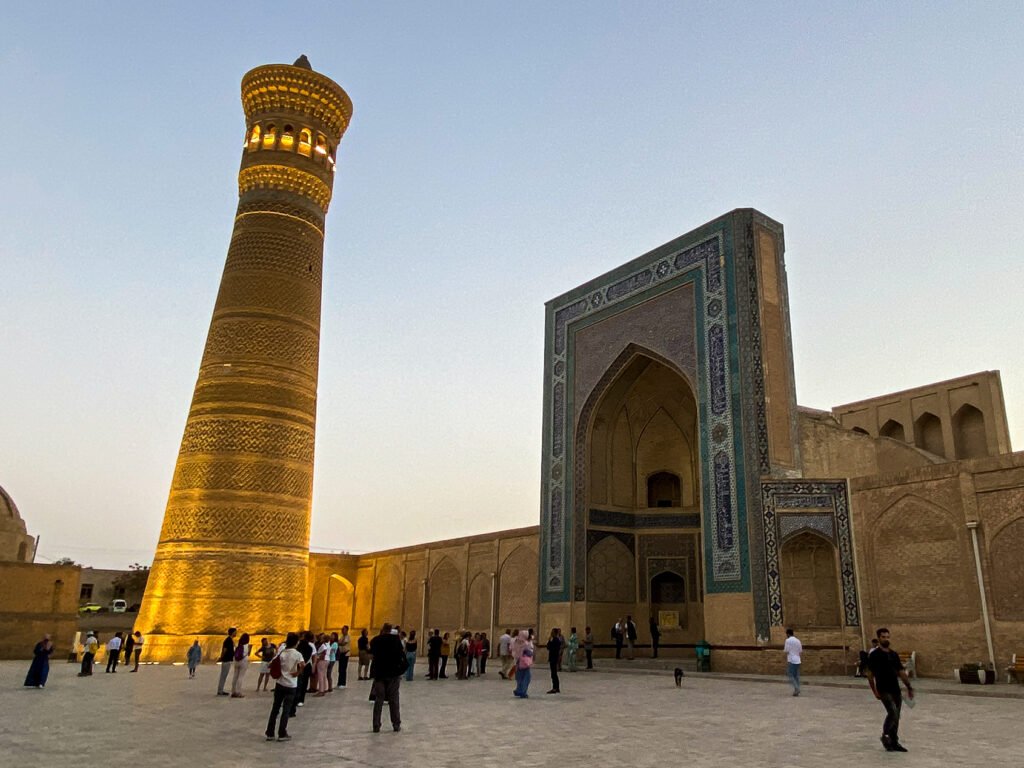
And if I’m being honest, when it comes to Islamic architecture, I firmly belong to the more is more camp.
That night, we went out for dinner and found a lively restaurant near the hotel. The place was buzzing with energy — loud voices, bursts of laughter, and the unmistakable smell of spices filling the air. I loved the festive atmosphere and walked right in.
Between wine and vodka, conversations flowed freely — touching on topics that are often seen very differently by a Western woman and an Islamic man. And yet, those exchanges felt open and respectful. It’s a rare and satisfying thing when dialogue actually happens.
I returned to the hotel content, already looking forward to another day in Bukhara — and, above all, to my first encounter with Registan Square in Samarkand. From everything I had heard, whatever opulence and ornamentation I had seen so far was only a prelude.
The next morning, I set out on another solo exploration, just as I had done in Khiva. That familiar paradox: a tourist trying to escape other tourists.
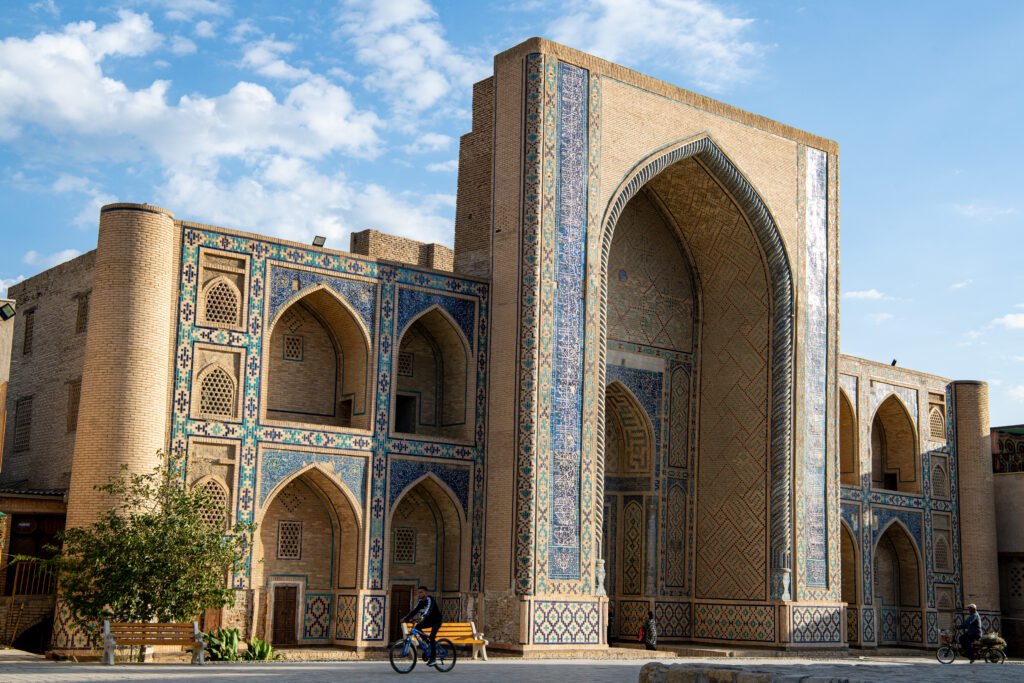
Bukhara still had a few treasures to reveal before my final destination: the calm pool of Lyabi Hauz, the Ulugh Beg Madrasa and the Abdulaziz-Khan Madrasa.
Time to move on. Samarkand was waiting — and we still had a train to catch.
Samarkand, Where Opulence Has No Limits
As it turned out, the train journey was nothing like I had imagined. Not modern, not particularly comfortable, and certainly not air-conditioned — or at least not effectively so. Which of the two, it was hard to tell.
At some point, I opened the itinerary and froze. Registan Square wasn’t scheduled for that day — only for the next one.
The problem? By the end of the following day, I would already be heading back to Tashkent: “How am I supposed to see the square at sunset?”
I immediately spoke to Marmoud, and he understood at once. From that moment on, the plan changed — and we launched into a frantic race against time, determined to reach Registan Square before the sun disappeared.
Fueled by panic and anticipation, the train ride somehow felt even longer.
We barely waited for the train to come to a full stop before jumping onto the platform, already scanning the street for a taxi. Leaving the luggage at the hotel was mandatory — suitcases aren’t allowed inside the enclosed square.
Traffic, of course, was far from ideal. Still, we dropped everything off and rushed back out, time clearly not on our side.
All the stress vanished the moment I stepped out in front of the Registan Square — and the light was still there.
We made it!
I snapped a few photos from outside the gates and hurried straight to the ticket booths.
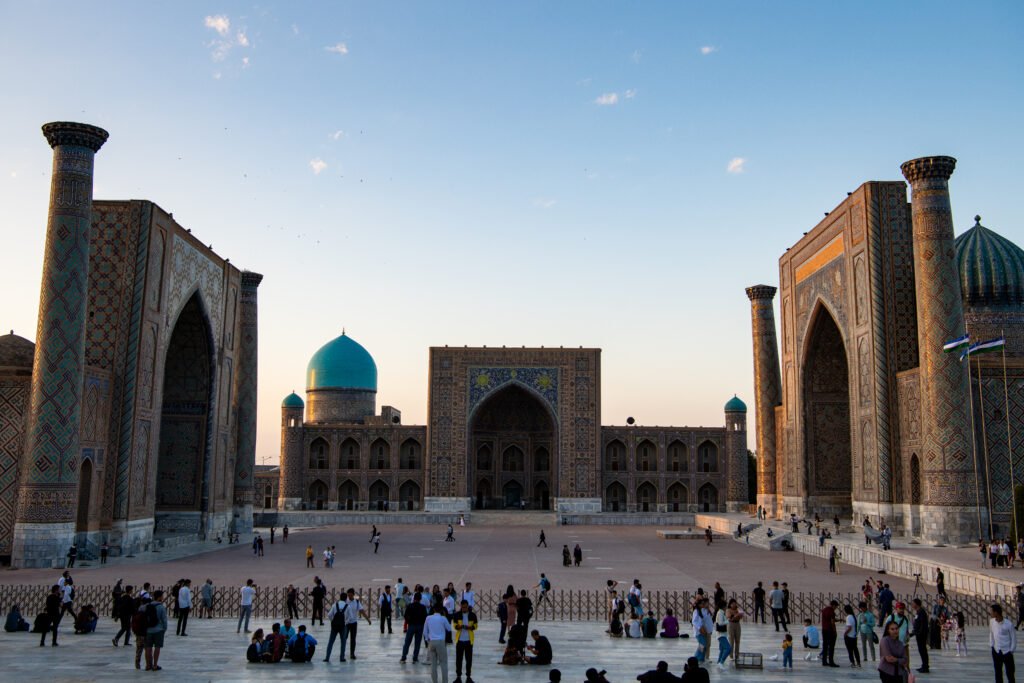
When I finally stepped inside, the relief hit all at once. Without a single doubt, it was one of the most beautiful human creations I have ever seen.
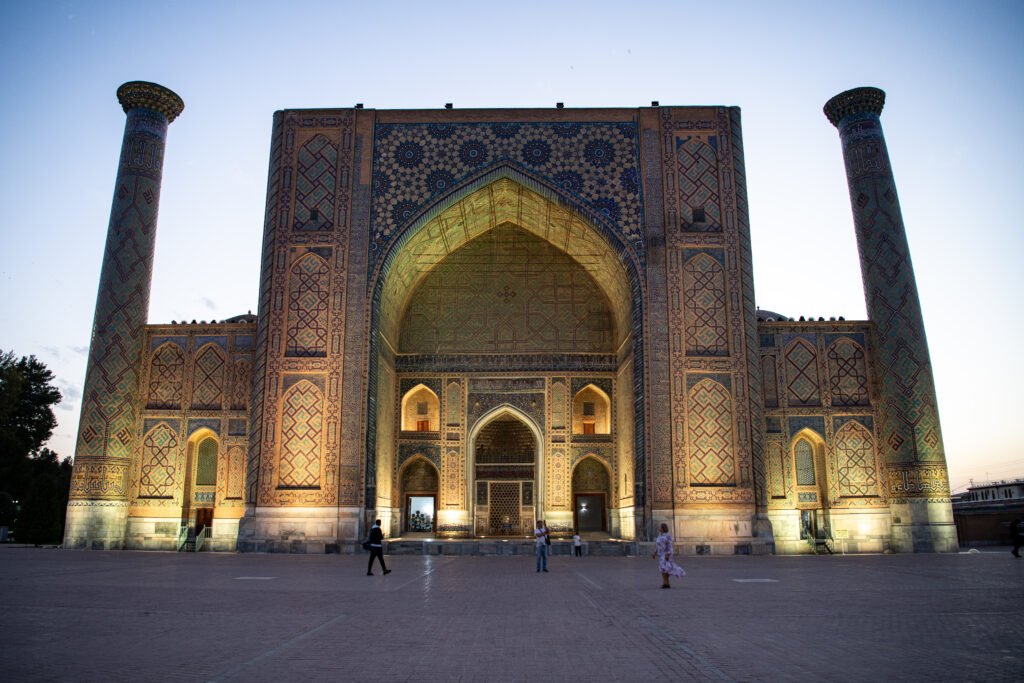
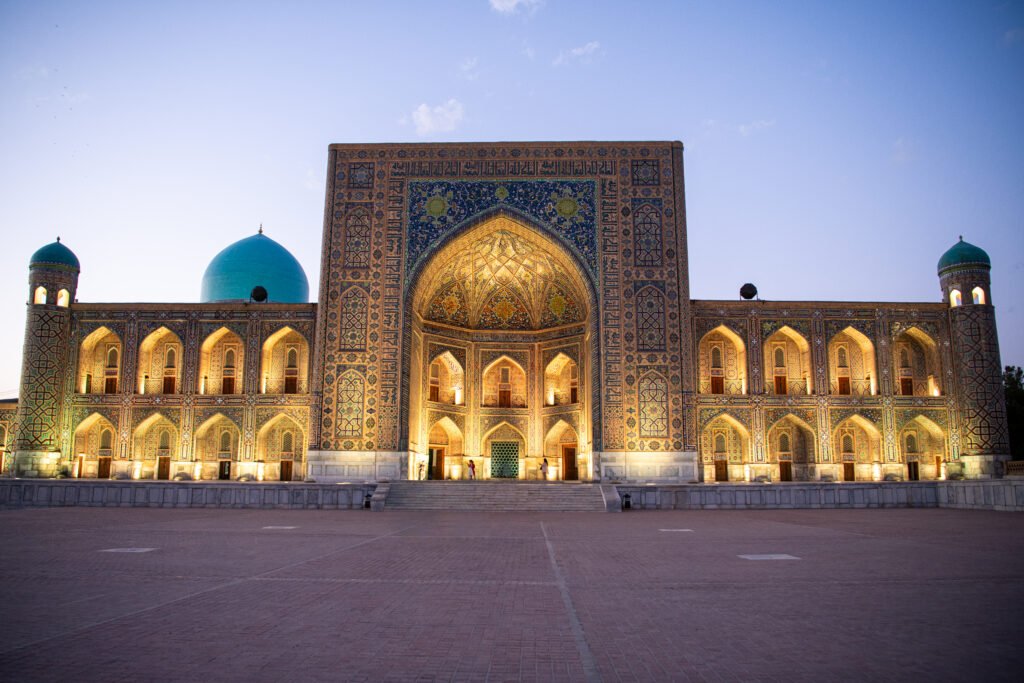
Even from outside, Registan Square is overwhelming. The sheer scale of the three monumental madrassas facing one another, enclosing and guarding the square, feels deliberately designed to impress.
As you move closer and the details slowly begin to reveal themselves, admiration quickly gives way to something closer to shock. More gold layered onto blue and turquoise — as if that were even possible.
The hardest decision was choosing where to focus — which façade to admire first, or whether to simply start photographing without thinking too much.
And just when I thought the fading light would make the experience less intense, the opposite happened. As daylight disappeared, artificial light — carefully placed, deliberately dramatic — transformed the square once again, offering an entirely new perspective. It was just as breathtaking.
I must have walked the equivalent of an entire country inside that square. Standing still felt impossible. I needed to move, get closer, photograph from different angles, under different light.
And I still hadn’t stepped inside yet.
✦ Footnotes from Elsewhere
The extraordinary richness of the Registan Square reflects Samarkand’s peak of power and wealth under Timurid rule. Located at the crossroads of the Silk Road, the city accumulated vast resources through trade, taxation and imperial patronage. The madrasas were deliberately built on a colossal scale and lavishly decorated with glazed tiles, gold leaf and complex ornamentation to project political authority, religious legitimacy and cultural supremacy — architecture used as a statement of power rather than restraint.
The interiors of the madrasas kept raising the bar even higher.
It was so overwhelming that people could hardly avoid bumping into one another, too absorbed in details that felt almost impossible to be real.
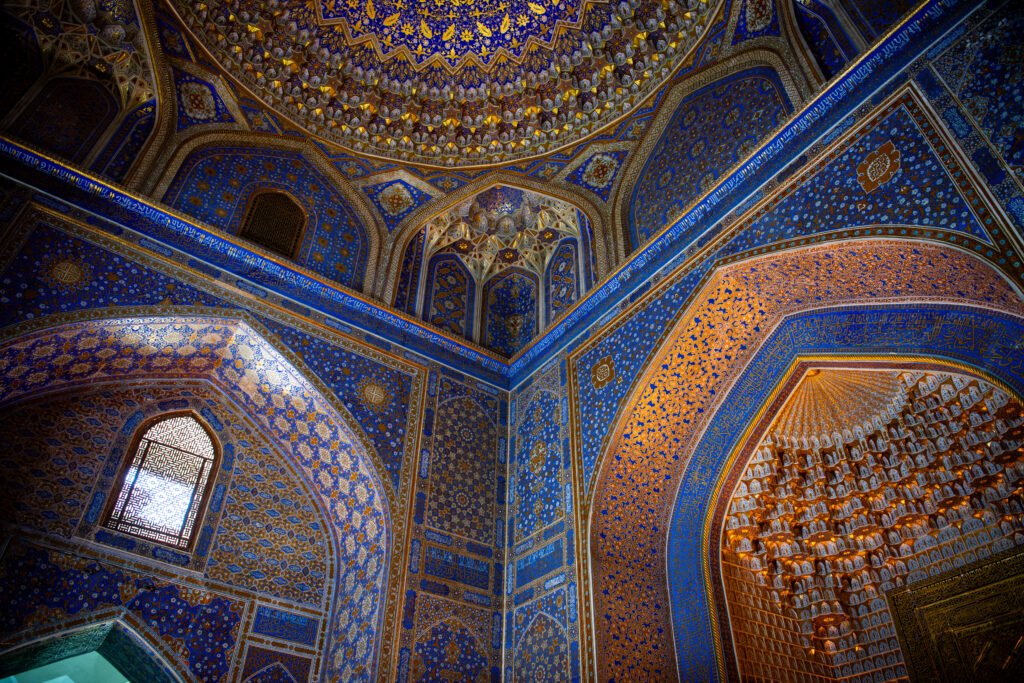
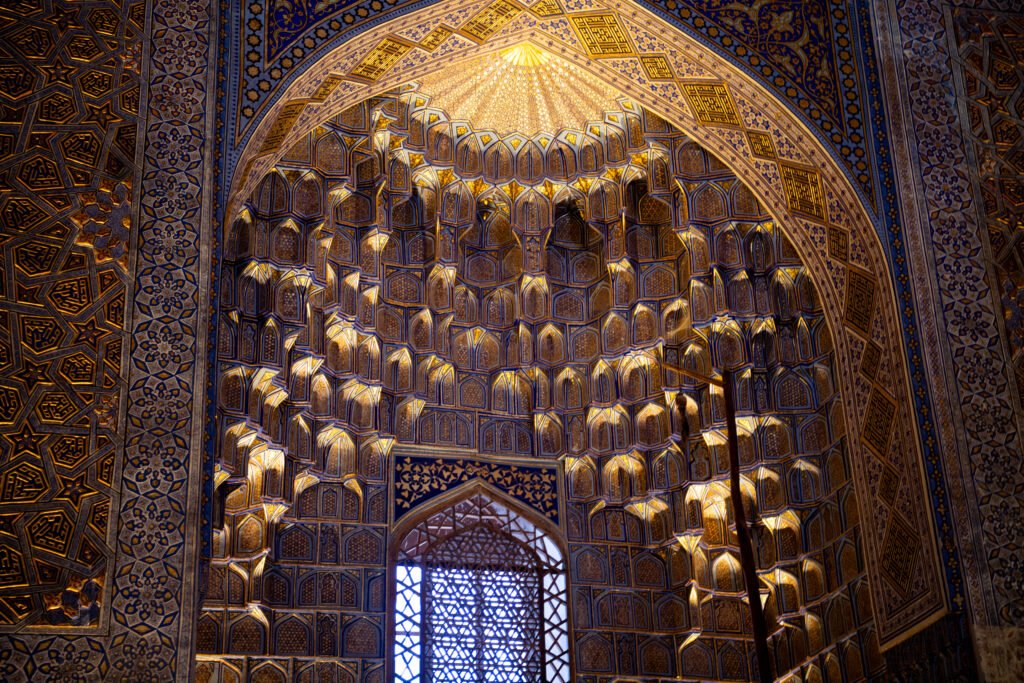
The visit that evening hadn’t even been part of the original plan — it was only because I had caught the mistake in time that we managed to reach the Registan Square before sunset. Still, even after seeing it at golden hour, I chose to return the next morning.
The light was already harsher than the evening before — more direct, less forgiving — but I wanted to see it again anyway. And had I stayed longer, I know I would have gone back yet again.
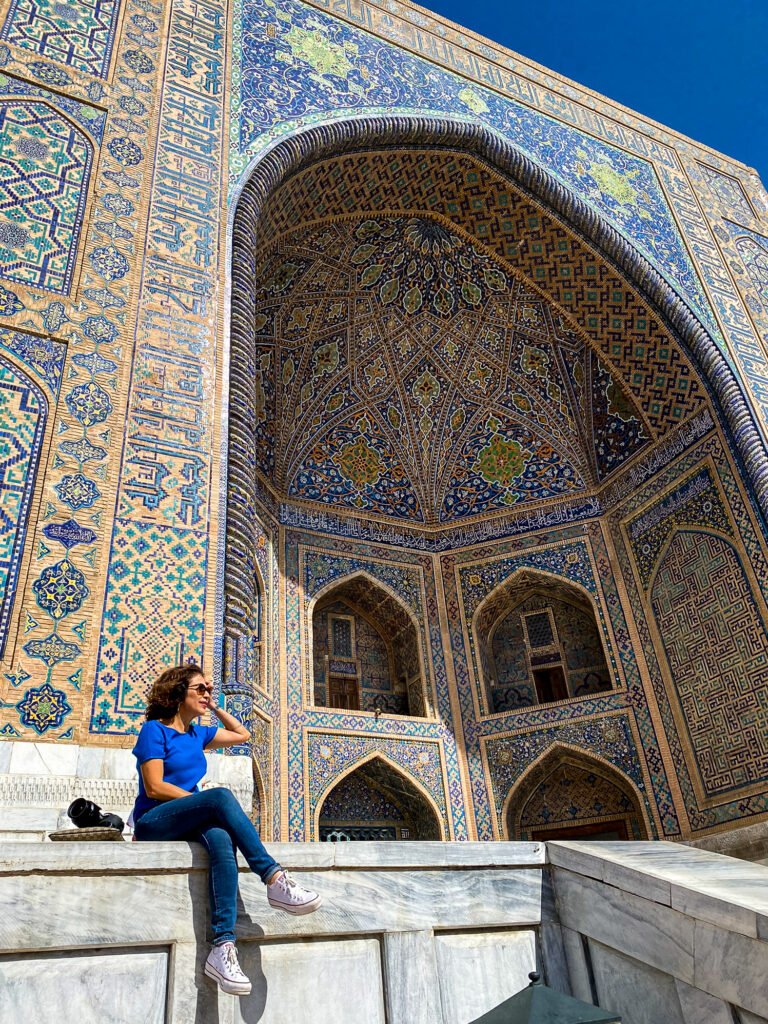
Some places demand to be seen twice. The Registan was one of them.
After the Registan Square, I was convinced that nothing else in Samarkand could possibly impress me.
I was wrong.
We walked for a while and, minutes later, began climbing the narrow stairs of a pathway lined with buildings — surprisingly modest when compared to the vast scale I had seen elsewhere — yet clearly competing for the title of most opulent: the Shah-i-Zinda.
Far from feeling like a cemetery, it resembled an architectural gallery — turquoise tiles, carved calligraphy, muqarnas, geometric mosaics — lining a narrow path rather than standing as a single standalone monument.
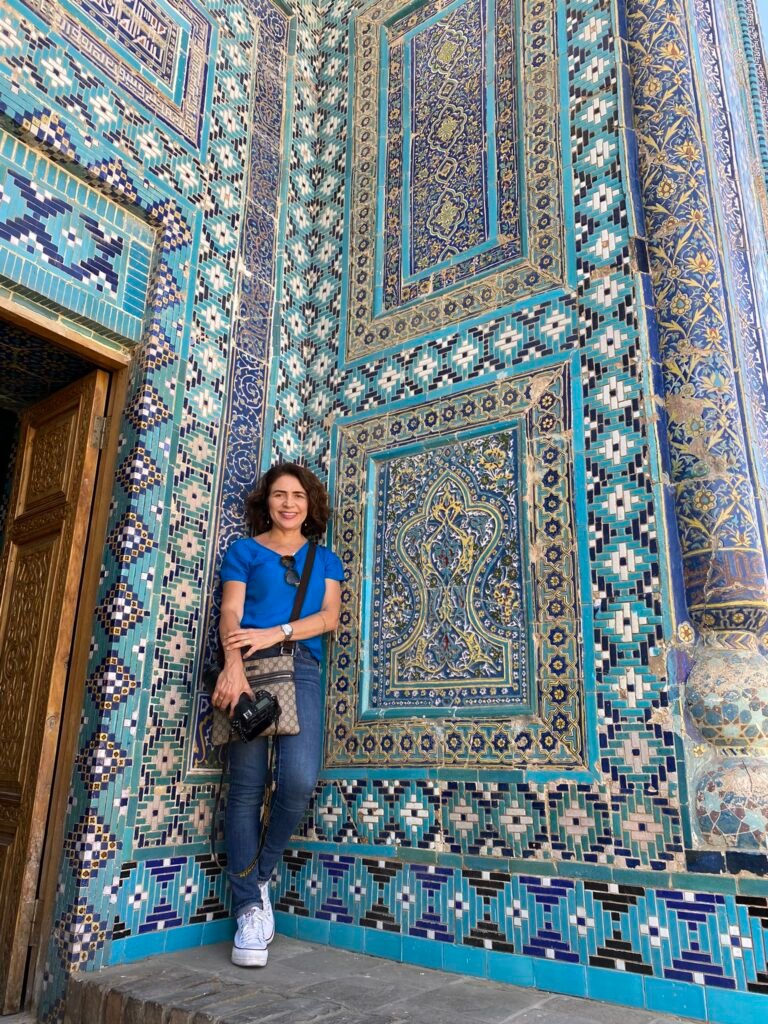
On our way out, we stopped by the gate for ice cream. Seated under a tree, I found myself in conversation with a group of men. Once they learned I was Brazilian, the next predictable topic emerged: soccer — Pelé, Ronaldo, Neymar — a subject I truly couldn’t care less about, and one I’m already used to, after all, I’m Brazilian.
Sooner or later, the conversation always reaches the same point: why I’m there alone — and where my husband is.
The kind of exchange that simply comes with the destination.
To close the Uzbekistan chapter, there was the grand Bibi-Khanym Mosque, proving that “smaller scale” has its limits, and the Gur-e-Amir Mausoleum, making clear why it became an architectural reference — even for the Taj Mahal.
I had perfect days in Uzbekistan, discovering and witnessing the astonishing beauty human hands are capable of creating. I felt genuinely sad it was time to leave.
Kazakhstan was waiting.
Continue the journey
This story is part of a broader journey across the Silk Road — from the stillness of Kyrgyzstan to the monumental cities of Uzbekistan and the vast landscapes of Kazakhstan.
Pingback: Kyrgyzstan Travel Stories | Notes From Elsewhere
This text make me travel with you and I’’m totally in shock with the places . The closest I get to Islamic architecture it was Andalusia and I thought it was beautiful
Yes, I think both are gorgeous and unique in their own characteristics. Exploring the architecture in Uzbekistan was truly a special experience.
Pingback: Kazakhstan Travel Stories | Notes From Elsewhere