The taxi dropped my guide and me off at the corner of a narrow street. From there, we continued on foot.
Looking around, everything seemed like a modest residential neighborhood. Still, I kept walking, expecting that at any moment the hotel would finally appear in front of me.
Suddenly, he stopped and said: “Here we are.”
I looked around. All I could see were houses.
Where?
He pointed to the building right in front of us.
Still confused, I stepped inside. A man introduced himself, saying he had been expecting me. He confirmed I’d be staying just one night, asked a few more questions, headed for a staircase and invited me to climb it.
The staircase ended directly inside a room. Mattresses were spread across the floor, and a family was resting on them, chatting. There was no door between the stairs and their space, and no one seemed surprised to see me. I was the one in shock: I was walking through someone’s bedroom.
The man kept climbing, so I said “Namaste” and followed him.
One floor up, a couple. “Namaste” again.
On the top floor, he opened a door and helped me bring my luggage inside. Then he pointed to a small door on the other side of the room.
“Whatever you do, don’t open it.”
It was the kind of door an adult had to stoop to get through. My attention was on the padlock hanging on it: huge.
Back to India
That Sunday morning, I had landed in Delhi after thirty hours of travel. This time I had come for a photography workshop during the Holi Festival, but it would begin only on Monday night, and that free day made me restless. Could I get to Varanasi?
Runa, the German photographer leading the workshop, had lived in India for six months. So when I asked her opinion, her answer came immediately: “Go!” She even gave me the contact of a guide and the place where she had stayed.
It all happened so fast that I didn’t check anything. I just boarded the first flight to Varanasi, so excited that I couldn’t feel any trace of tiredness.
Now I collapsed on the bed (yes, an actual bed!), so relieved not to be sharing a floor mattress in a room people walked through freely that, for the moment, I forgot about the door.
Even if I had been completely exhausted, that bedroom wouldn’t have invited an afternoon of relaxation. Instead, I just took a shower and left right away. Time was short, and I was counting every second.
The moment I said I was ready, Vikkiy, my guide, literally threw himself into a tuk-tuk. He was a young man with bright, watchful eyes.
My first time in India was in 2017, and I was truly happy to see again the colorful saris on the streets, the smell of curry on my plate and from food stalls, and even the chaotic, noisy traffic. What had felt strange back then now felt familiar, and I realized I had missed it.
When the Sun Sets, the Ganges Lights Up
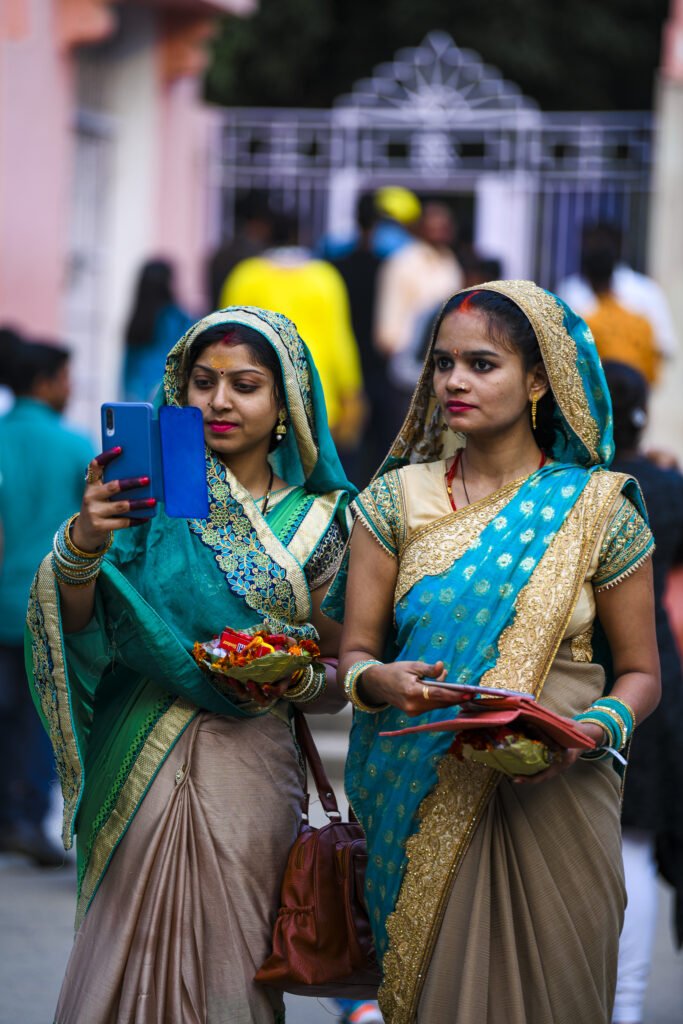
Our first stop was the New Vishwanath Temple, inside the university campus. Wide streets lined with trees were not exactly the image I had of Varanasi, and I was eager to get to the banks of the Ganges.
Still, the blessing I received there felt like a good way to begin. I left proudly showing my three signs of it: a marigold garland around my neck, a red tilak on my forehead and a red thread, the kalava, tied around my wrist, to be worn until it fell off on its own.
I ate something quick at a simple place, without even noticing what. Time was short, and my mind was already on the ceremony that would take place by the river at sunset.
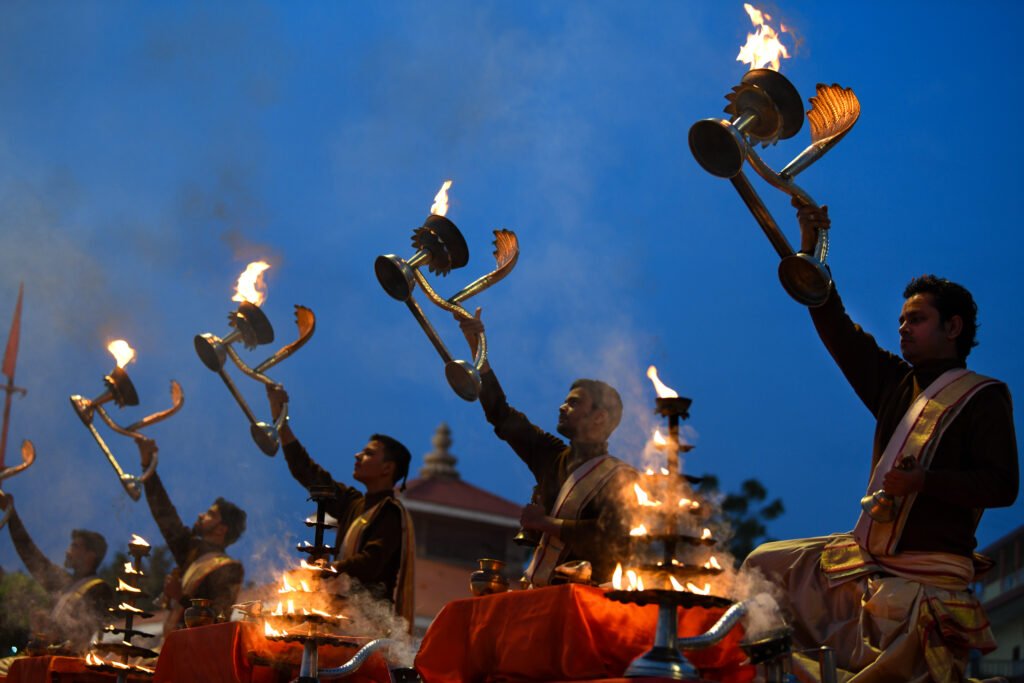
When the sun was almost gone, the evening Ganga Aarti began. Assi Ghat was full of people, seated on the steps facing the river or crowded into boats.
✦ Footnotes from Elsewhere
For Hindus, the Ganges is not only a river but a goddess, Ganga. Legend says King Bhagiratha spent long years in penance to bring her down from the heavens, so that her waters could free the souls of his ancestors, who had been reduced to ashes. Her descent was too powerful for the earth to bear, so Shiva caught her in his matted hair and released her gently. That is why Shiva is so often shown with a river flowing from his head.
Every day at dusk, the river itself becomes an open-air temple.
The priests, in red and yellow robes, stood on individual platforms facing the river. To the sound of chants and mantras, each one moved with fire, incense and bells, and the flames and smoke followed every gesture, like a partner in a duet.
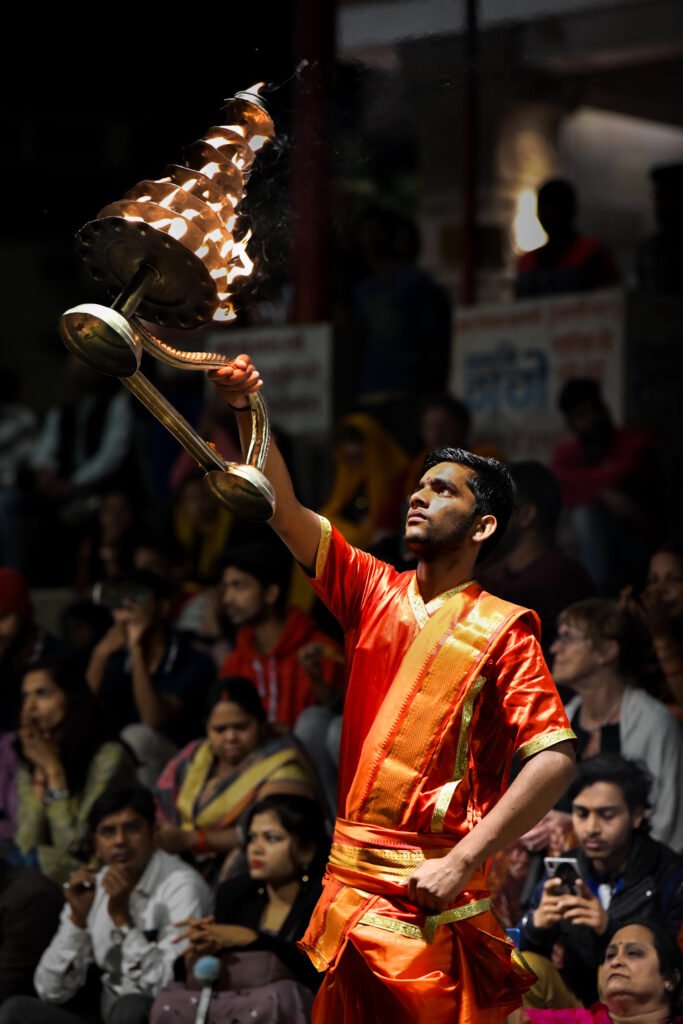
The ceremony is deeply meaningful for Hindus, and many of the people around me were visibly moved, crying or immersed in their prayers.
I like the idea of a river being worshipped as a goddess. The Incas, in Peru, did the same with their mountains, the apus.
When it was over, I couldn’t resist. I was wearing waterproof boots, and all I wanted was to touch the water. So I walked down the steps and did.
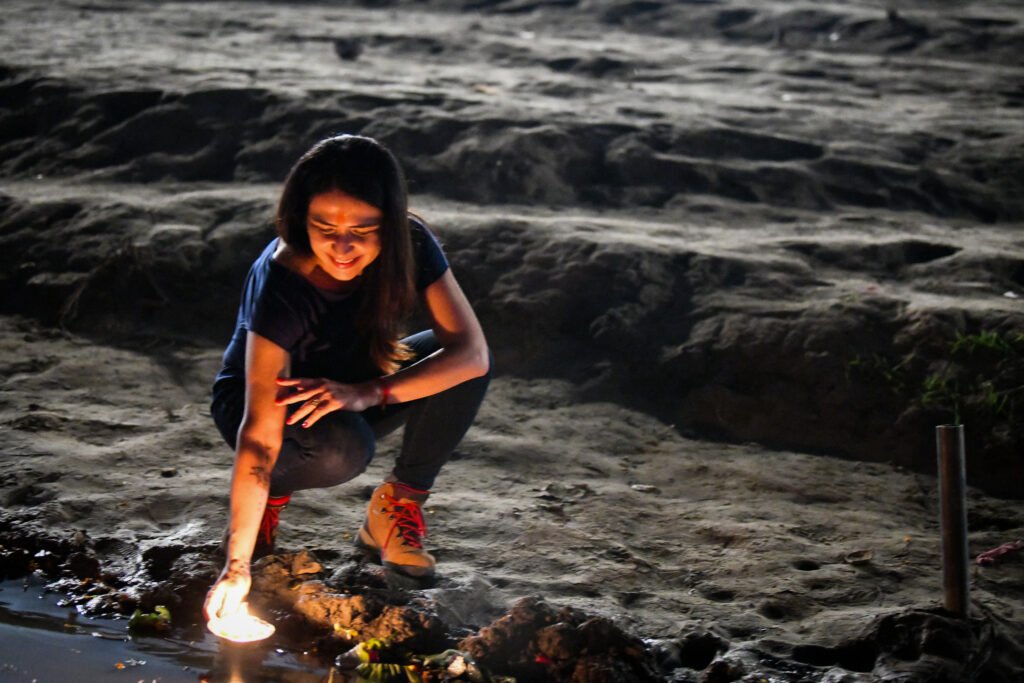
But up close, without the fire, the chants and the crowd, it was a river at night. Something of what the ceremony had given it slipped away as I stood there.
I had to face that strange bedroom again. So I headed back to the “hotel”, this time fully prepared to trespass through other people’s rooms. A few namastes, I thought, and it would be over.
Drifting Through the Sacred River
Before sunrise, Vikkiy and I were back at Assi Ghat, this time for Subah-e-Banaras, the morning ceremony. Like the aarti, it takes place every day.
In the early morning, the atmosphere was quieter, more contemplative, yet still filled with chants, Indian classical music, yoga, offerings, and the sun salutation.
As soon as the sun rose, the ceremony ended and we boarded a small boat. The boatman rowed slowly along the Ganges while I absorbed the landscape unfolding before me. I had never seen anything like it.
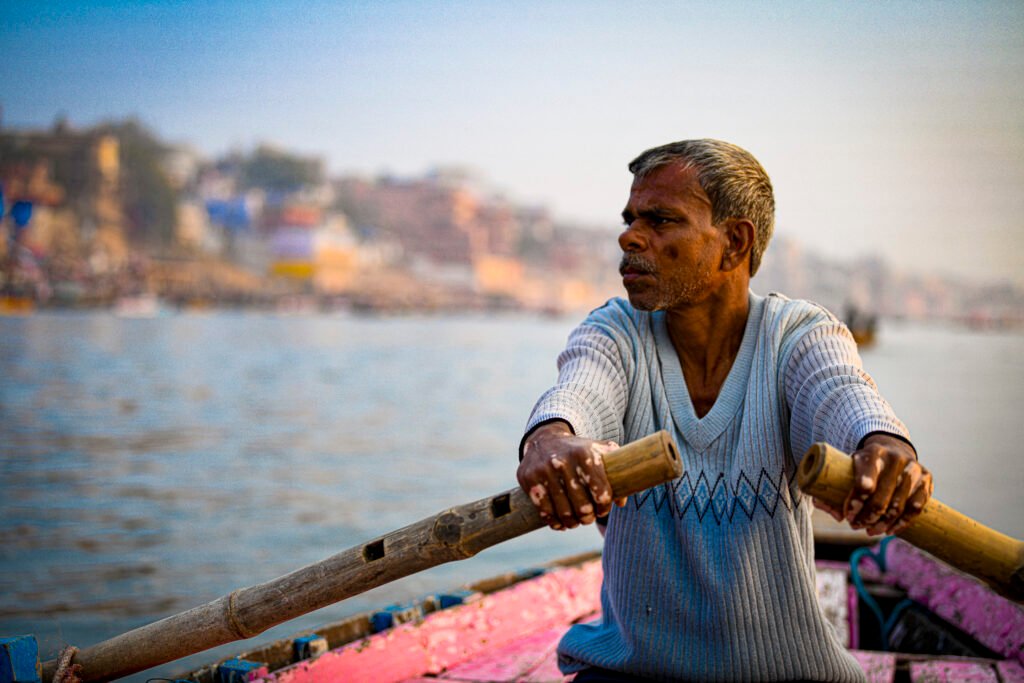
Stretching as far as I could see was a continuous line of earth-colored buildings, their details gradually revealed as our boat moved along the river: from simple stacked houses to imposing palaces.
✦ Footnotes from Elsewhere
A ghat is a series of stone steps leading down to a river, very common in India. In Varanasi, there are 84 of them along the Ganges, by the traditional count. Some are used for daily life, like bathing or washing clothes, while others are sacred spaces for rituals, ceremonies, and even cremations.
Even though it was early morning, the ghats were already full of people.
The river was busy too: boats full of tourists, locals going about their day, vendors selling offerings from boat to boat.
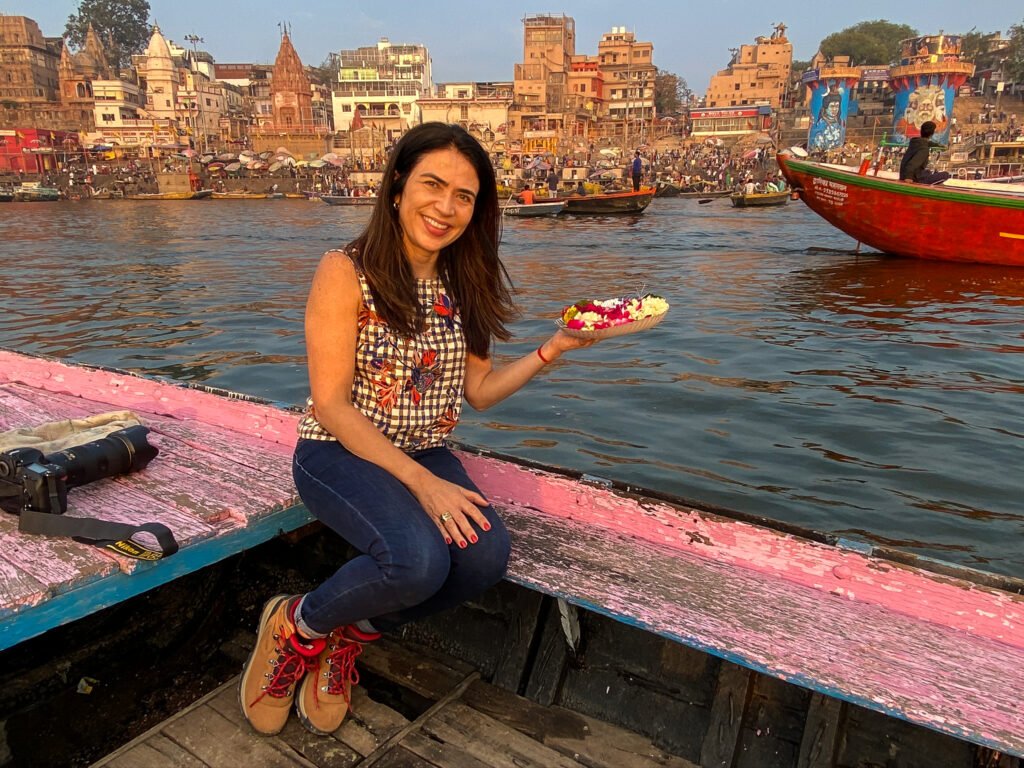
As we drifted along, I watched the steps fill with everything a day can hold, from the sacred to the mundane. People praying, eyes closed. A little farther, a group bathing. Then others washing clothes. And finally, a woman brushing her teeth in the river.
Where Life Meets Death on the Ganges
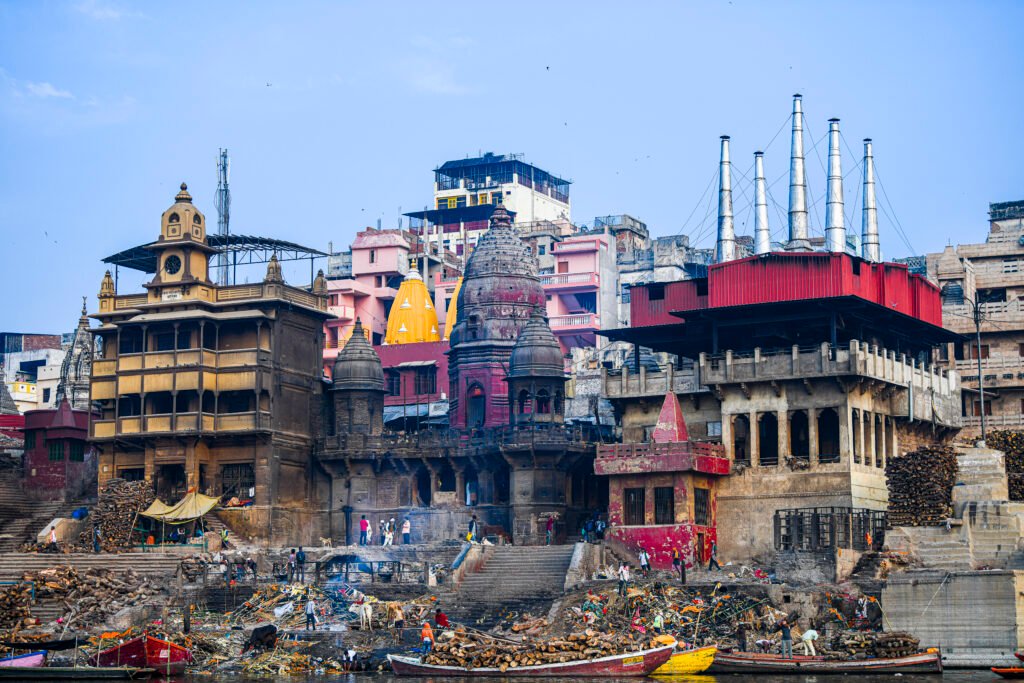
A little farther on, our boat turned toward the shore. I fixed my gaze on the ghat ahead and immediately noticed it didn’t have the same earthy tones as the others. This one carried shades of gray as well.
The water here was darker, with debris floating near the steps. Thick smoke was drifting in the air.
It was Manikarnika, the main cremation ghat.
✦ Footnotes from Elsewhere
For Hindus, being cremated at Manikarnika is believed to grant moksha, liberation from the endless cycle of rebirth. The body arrives wrapped in cloth on a bamboo stretcher and is dipped in the Ganges before the pyre is lit. The fires are tended by the Doms, a community that has long held the right to run the cremation grounds. Every log is weighed on large scales to set the price, and sandalwood is the most expensive.
The boat left us at a narrow pier, and we started walking toward the shore. Even before we reached the steps, the smell met us. Instinctively, I looked for something to cover my face.
A small group arrived carrying a body and laid it on the pyre. It was quiet, something I hadn’t heard since I arrived in Varanasi. Until then, whenever people weren’t talking, there were bells or other instruments. Then someone lit the fire.
I remembered the woman brushing her teeth a few meters back.
My thoughts were scattered, like a word cloud: cultural difference, rawness, body, death, smoke, fire.
While one pyre burned, another body arrived.
After a while, we stepped into a street behind the ghat and started to walk aimlessly.
The sunlight seemed unable to find its way into that maze of narrow alleys. Everything looked dark, heavy, almost drained of color.
There were all kinds of shops and vendors, products spread directly on the street. People moved through their daily routines while small groups carrying bodies rushed past us. And every now and then, a cow wandered slowly through the middle of it all, completely undisturbed.
From Smoke to Colors
Eventually, we ended up at another ghat that had caught my attention earlier from the boat. This one was more colorful than the others, and a substantial crowd had gathered there.
Vikkiy told me its name, but all I caught was the word ghat. It was Dashashwamedh.
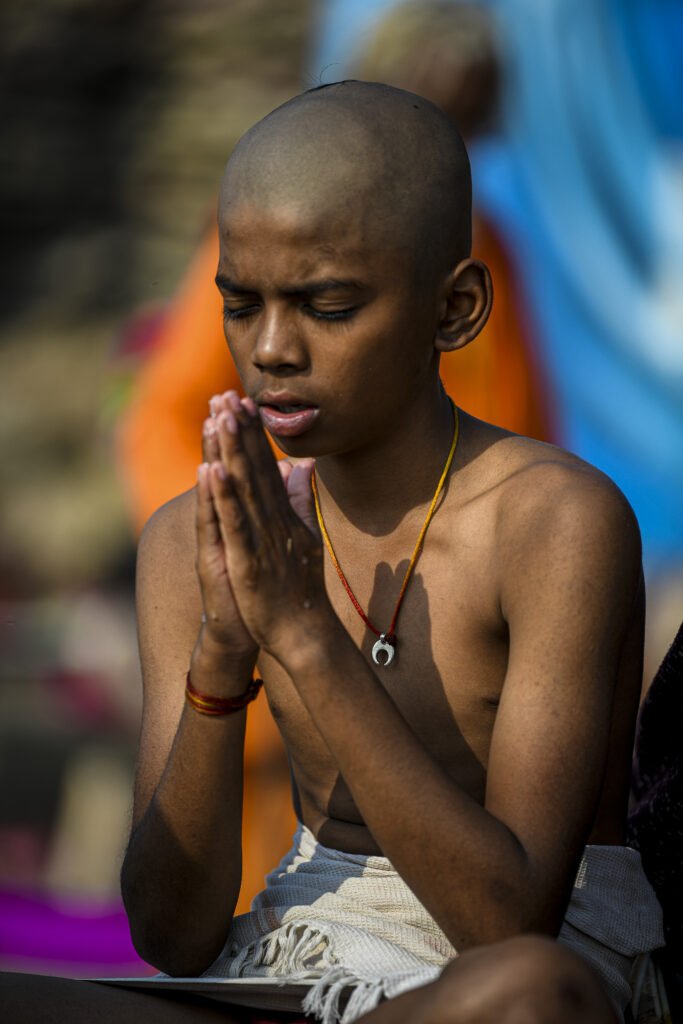
We stayed there for a while, and I could not stop looking at everyone and everything. I saw individuals praying by themselves, and groups praying together. Some were seated on the stairs, while others preferred a closer approach, asking for blessings directly from Goddess Ganga, inside the river. In every case, faces and joined hands were turned toward the river.
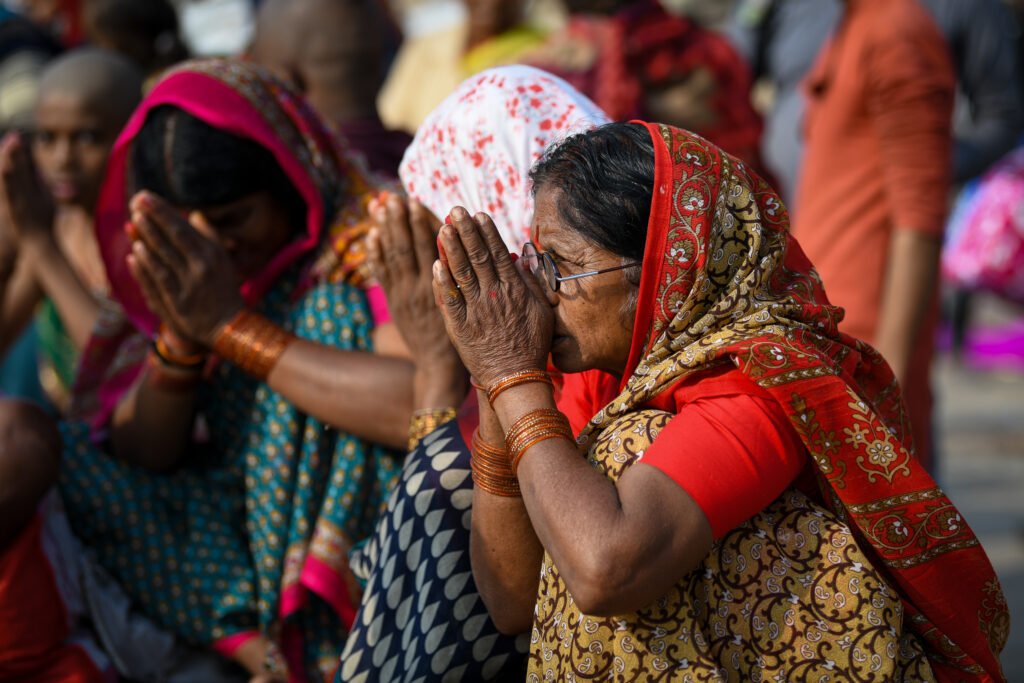
I asked Vikkiy if he ever bathed in the Ganges.
“Every day,” he said. “It’s my daily blessing.”
The Door
And then came the moment when Vikkiy told me my time was coming to an end. I couldn’t believe it. So fast!
I wanted more days. I still do.
We went back to the hotel to pick up my suitcase. One last climb through other people’s rooms.
I didn’t have the nerve to open the door. I live in Rio, so I assumed someone had once left it open and had things stolen.
Still, it felt strange. In a city where I had seen everything happen in the open, from bathing to dying, the only closed door was the one in my room.
The next day, the air turned red: You Have No Idea: Photographing Holi – India, 2020.
Loved this post, it really left me wanting more. Can’t wait for what is coming next!
I love reading your comments! Thank you so much — I’m doing my best to keep up with such a voracious reader!
Pingback: You Have No Idea: Photographing Holi – India, 2020 | Notes from Elsewhere