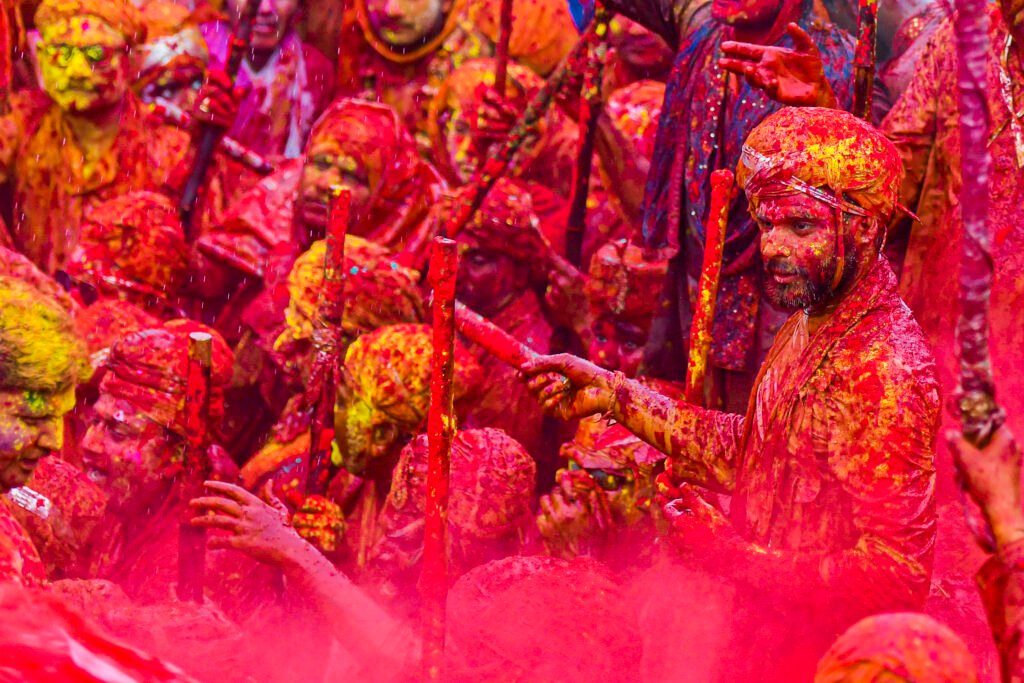
I’m 1.5 meters tall (barely five feet), and that morning in Nandgaon I was carrying a backpack stuffed with my lenses, shoes and water. The courtyard of Shri Nand Baba Temple had disappeared under people, powder and buckets of colored water. I was completely swallowed by the crowd, stuck and unable to move an inch in any direction.
One of my friends from the group surfaced next to me, soaked and grinning.
“War is on!”
I laughed. Somewhere under the drums, I could hear a man who ran photo tours back in Brazil, months earlier:
“You have no idea. You’re not going to make it, and you’ll end up hating it!”
I knew it would be intense. From the inside, it was something else.
Holi Man
The first time I saw Holi, it was in a book, long before I ever went to India.
It was an unusual image: a group of men in turbans carrying another man over their heads. The photo had been taken from even higher up. So far, nothing new — I had already seen similar scenes at countless rock concerts.
But this photo, in particular, was different: all the men were covered in shades of red and orange, except for the one being carried, who was painted green.
My immediate thought was: what on earth is happening here?
The photo was Holi Man, by Steve McCurry, taken during Holi in India.
✦ Footnotes from Elsewhere
Holi has two origin stories. In one, the demon king Hiranyakashipu asked his sister, Holika, to burn his son Prahlad, a devotee of Vishnu. She sat with the boy on a pyre, wrapped in a fireproof cloak, but the cloak protected him instead, and she burned. That triumph of good over evil is why bonfires are lit the night before Holi. In the other, Krishna, embarrassed that his skin was dark blue and Radha’s fair, playfully colored her face, which is said to be the origin of the powders. On Holi itself, caste, gender, age and status are meant to be set aside.
In 2019, I started looking for a photo workshop during Holi. The first one I found was from a Brazilian company. I checked the itinerary and, to my disappointment, saw they would spend only a couple of hours at the festival.
When I asked why, the organizer explained that the previous year they hadn’t had the best experience. He said that some of the women, in particular, had complained about the chaos and ended up asking to leave early.
He asked if I was interested. My answer was short: No! I told him I had already been to Carnival in Bahia five times and that I could handle it.
That’s when he gave me the warning I would hear again in Nandgaon.
I ended up finding Runa, a German photographer, offering a five-day workshop during the festival.
I wrote to her right away, and a few days later, my spot was secured.
No turning back now.
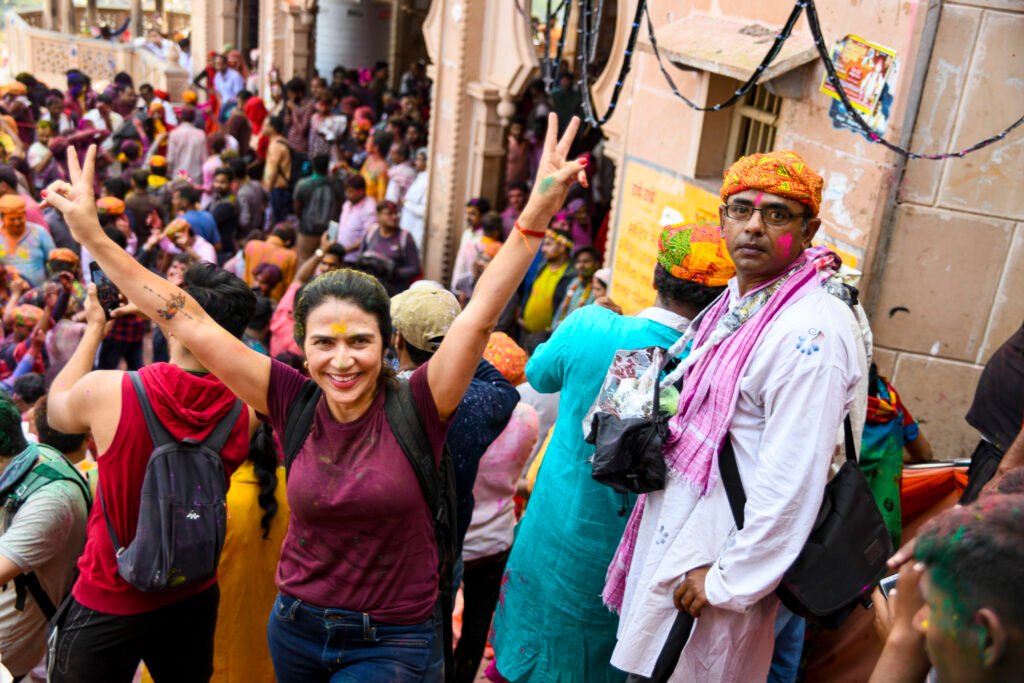
The Day the Air Turned Red — Barsana, Laddu Holi
After my short yet intense visit to Varanasi, I arrived back in Delhi. Runa picked each of us up to begin our three-hour journey by car to Vrindavan.
✦ Footnotes from Elsewhere
Mathura, Vrindavan, Barsana and Nandgaon all belong to Braj, the region between Delhi and Agra where Krishna is believed to have spent his youth as a cowherd boy. Its towns and temples are tied to the legends of Krishna and Radha, and many pilgrims still walk a circuit of more than 300 kilometers through them, a journey that can take up to eight weeks.
Our group was small: besides Runa, there were two other Germans, Urip and Christiane; Javier, from Malaysia; Siddharth, an Indian Runa had hired as her assistant; and me.
The plan for the first day was to photograph Laddu Holi at Shri Ji Temple, and I was feeling pretty anxious.
We left our hotel in Vrindavan and headed to Barsana, where we switched vehicles and jumped into a tuk-tuk. No windows protecting us anymore. Let the game begin.
By then, there were already people covered in color on the streets. Drums were beating somewhere ahead, voices rose over them, and every now and then a burst of laughter cut through it all.
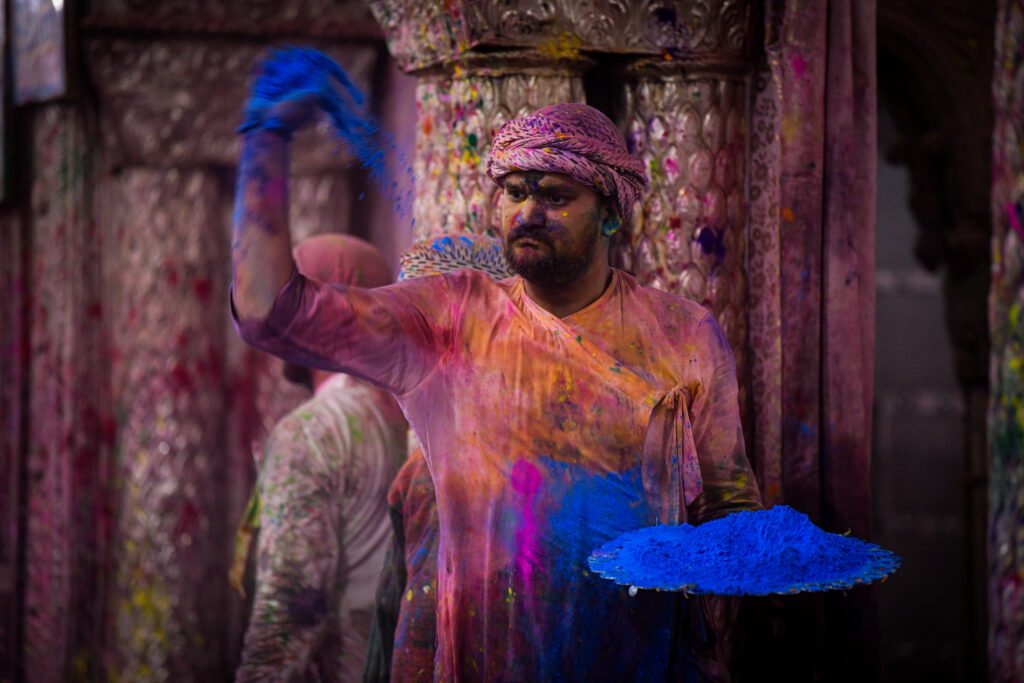
That’s when I discovered that, besides powder (gulal), they also sprayed colored water from what looked like toy machine guns, the pichkaris.
But this first contact still looked very different from the pictures I had seen with massive crowds of people drenched in color. At that moment, I was surrounded mostly by families, children, and women, and the atmosphere felt more like a matinee.
The powders weren’t flying yet. Instead, people would approach us with a smile, gently dabbing color on our faces.
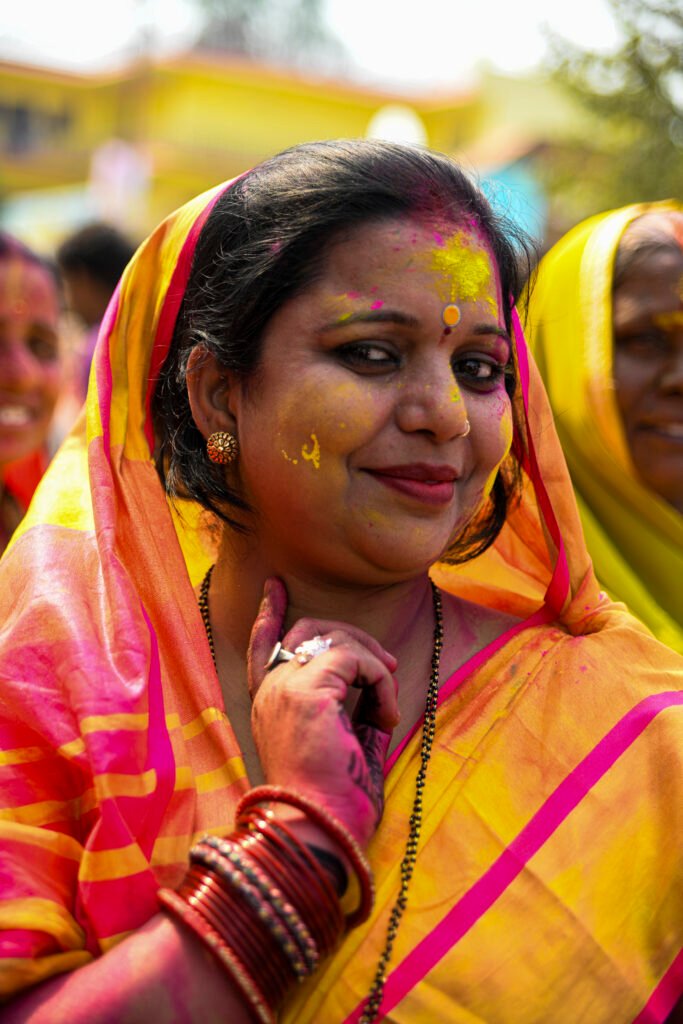
As we left the wider road for narrower ones, the matinee atmosphere faded. The closer we got to the temple, the harder it became to move.
After a while, a little more covered in color, I saw a crowd that seemed to be climbing a hill. Then I spotted the temple on top, and the stairs leading up to the main entrance, already packed with people waiting for it to open.
Runa said we should start moving slowly, getting as close to the entrance as possible to guarantee our place inside.
The crowd was impatient for the doors to open, but mostly it was joyful. As we passed, people smiled at us, and a few pressed their palms together in a namaste. I never felt in danger, and after a while, we were interacting with the people around us.
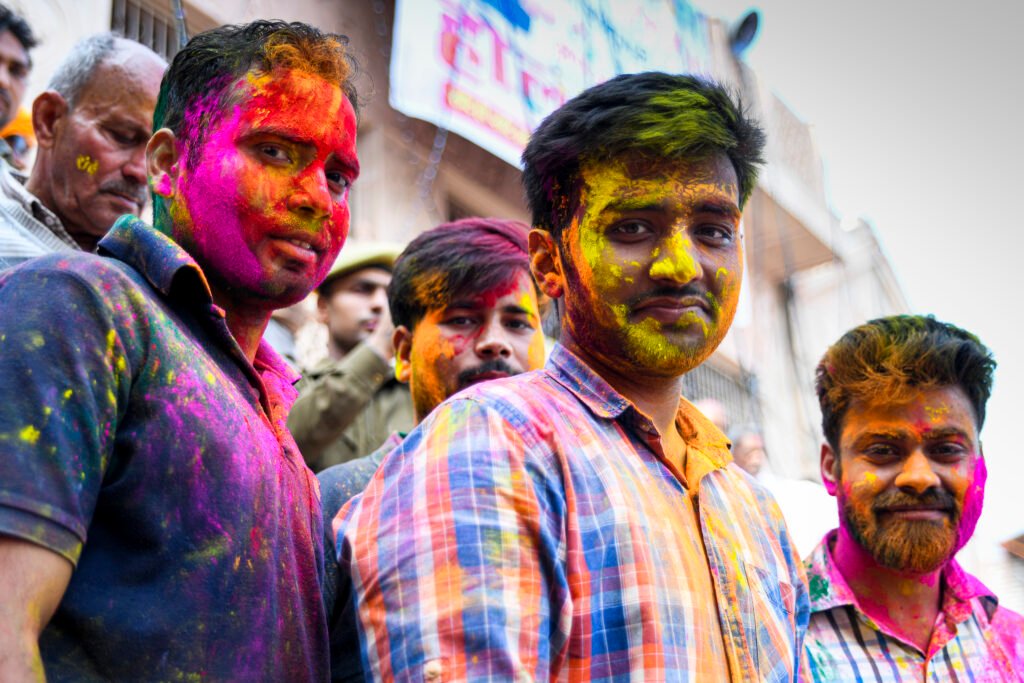
The most awaited moment finally arrived, and someone shouted, “Remove your shoes!” What?! I had bought waterproof shoes just for this!
✦ Footnotes from Elsewhere
Laddu Holi takes place the day before Lathmar Holi. Barsana, Radha’s village, invites the men of Nandgaon, Krishna’s village, to come and play Holi. Legend says that when Krishna’s friends accepted, they celebrated by feeding each other sweets, which is why laddus are still thrown at the crowd. Inside the temple, men from both villages sit together singing traditional Holi songs while red gulal fills the air.
A few minutes later, we were inside, barefoot. I started to wander. At some point, I realized I was alone, lost in my own experience.
But I didn’t even have time to worry about it.
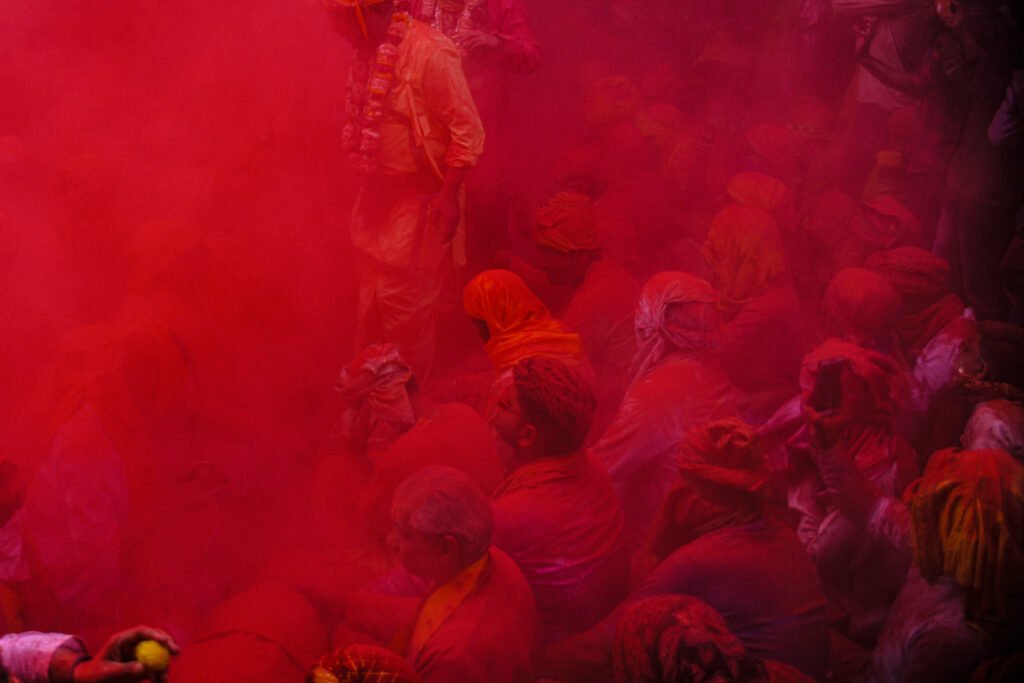
In seconds, the air turned completely red. I saw a group of men sitting on the floor in the middle of the temple while others played traditional instruments and threw even more red powder into the air.
I looked down at my camera and froze. It was completely covered in color. Even with the protection, I had never seen it in that state, and it made me nervous: one more thing on my mind, in the middle of everything else.
Suddenly, trying to photograph one thing at a time felt pointless. I wished I had more cameras, more eyes, more ways to capture it all.
I lost track of time. I looked around and realized I couldn’t see anyone from my group.
Fuck! Whoops — it’s a temple, Catia… sorry!
But where are they?!
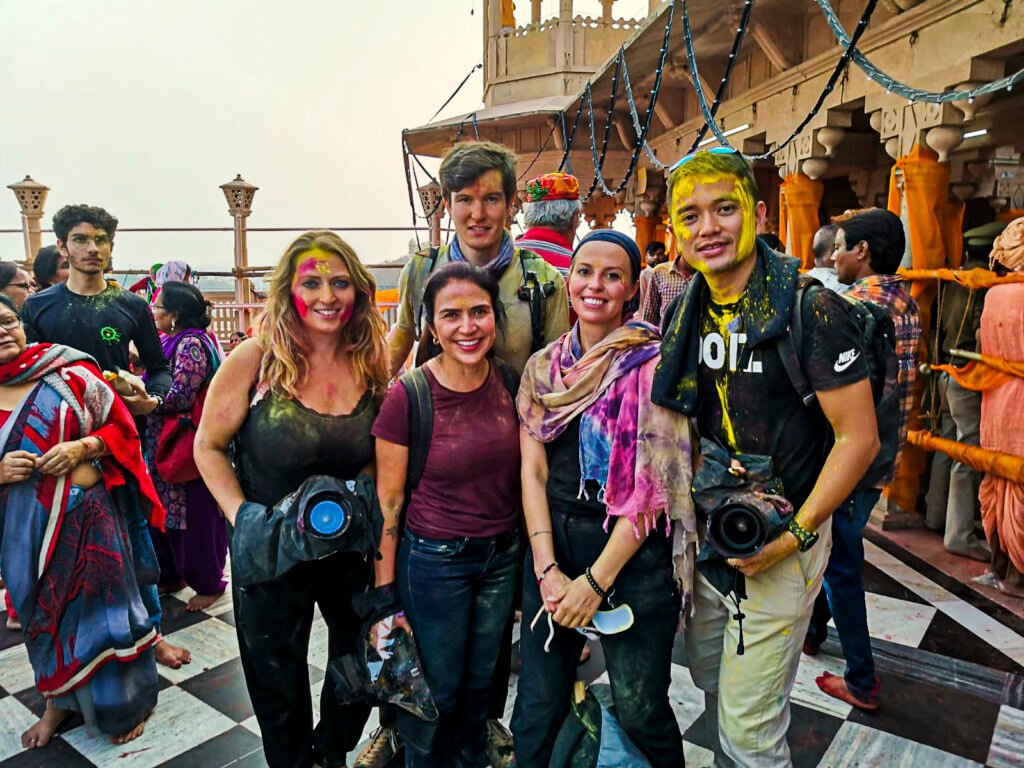
Leaving the ritual behind, I started searching for a familiar face. Then I saw them, all gathered on an open terrace, where the atmosphere had turned festive again.
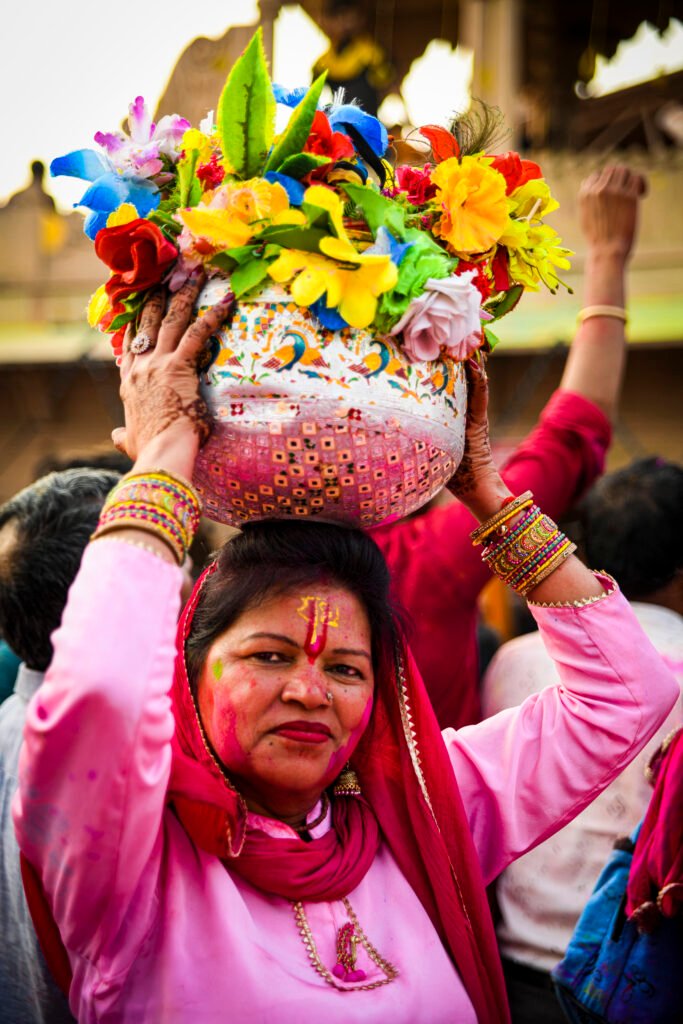
We stayed there until dusk, when physical and mental exhaustion finally got the better of us and we headed back to the hotel.
Chaos, Color, and Sticks — Barsana, Lathmar Holi
When we headed back to Barsana the following morning, this time for Lathmar Holi, I didn’t expect to see anything very different.
This part of the celebration takes place outdoors, so we kept exploring the area, mingling with the people for a while.
The streets were even more crowded, the air was thicker with powder, and colored water was being thrown from every direction.
At one point, it felt like someone was turning a water hose on us. Even with the protection, my camera got wet, and soon I was completely covered in yellow. It was only the first hour.
Then came the powder. They aimed straight for our faces, throwing handfuls with precision. I went blind so many times I lost count.
But the real challenge of the day wasn’t the crowd. It was the camera. Powder settled on it faster than I could wipe it off, and I had to clean the lens before every single shot, with nothing even remotely clean to use.
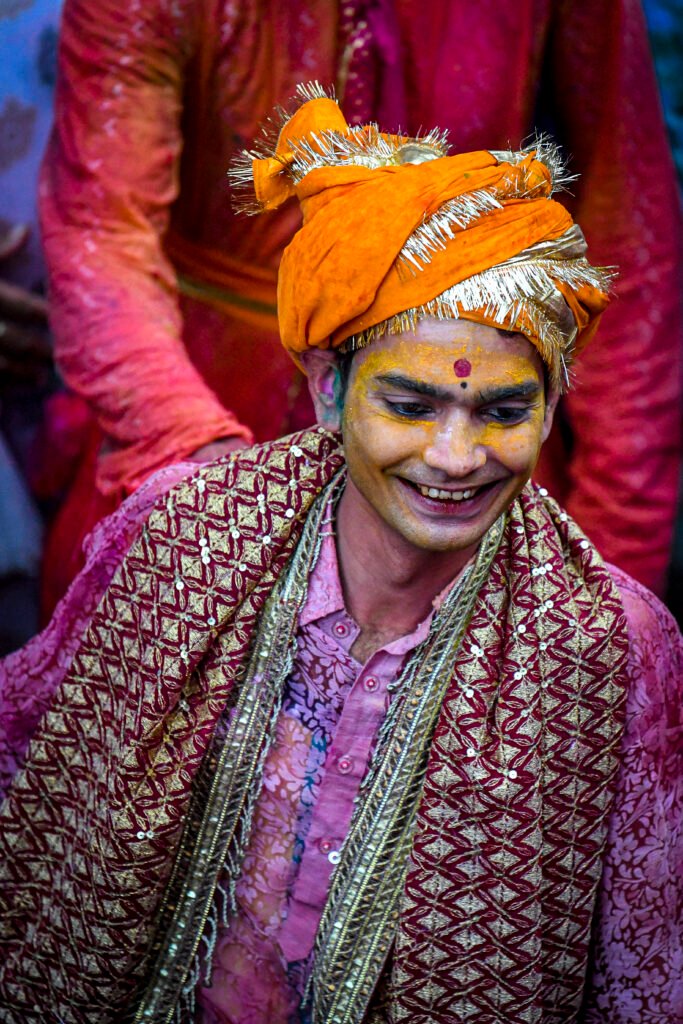
And then we saw it: women in light, flowing saris trimmed with gold and glitter, their arms stacked with bangles, each holding a long wooden stick. In front of them, men in traditional clothes sat on the ground, shields raised over their heads, as the sticks came down. No mercy, no hesitation.
The crowd was having the time of their lives: smiling, shouting, dancing, and right in the middle, a scene that, in any other context, would probably end at the police station.
✦ Footnotes from Elsewhere
Lathmar Holi means, roughly, “Holi of sticks.” Legend says Krishna came from Nandgaon to Barsana to throw colors on Radha and her friends, and they chased him out of town with sticks. Every year the scene is reenacted: men from Nandgaon arrive carrying leather shields and try to drench the women with color, and the women of Barsana answer with long bamboo sticks.
Then Runa came over and said she had managed to get us into a house with a terrace. By then, the air in the street was so dense it was hard to breathe.
The terrace was safer and more comfortable, but what really mattered was the change in perspective: nothing and no one stood between our cameras and the scene. We stayed there, pressing our shutters nonstop.
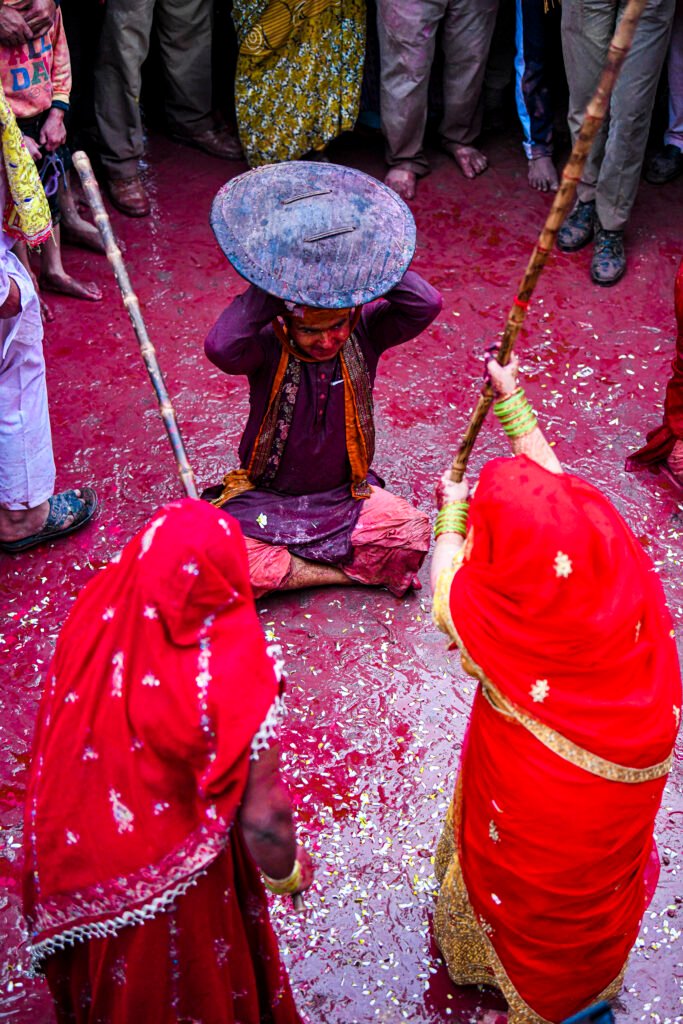
Then it started to rain, turning the streets into a huge, glorious mess. All the shades of color faded away and pink took over everything.
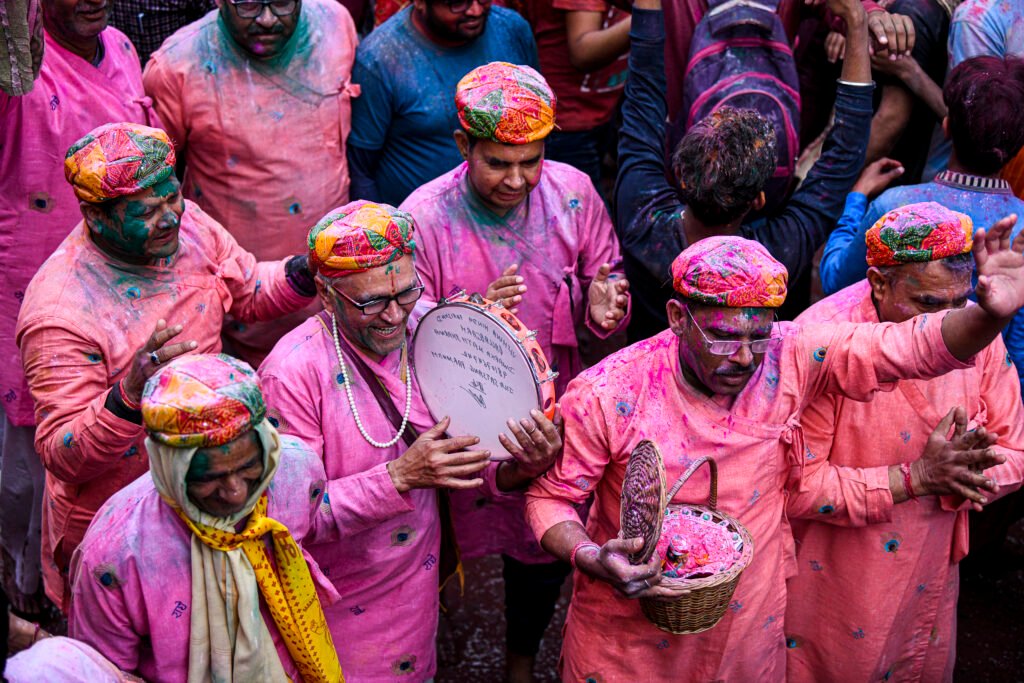
After leaving a still-insane Barsana behind, we looked for a tuk-tuk and found only one. It was time to discover how they managed to fit what sometimes looked like 20 people into one. After all, there were only six of us.
Dreaming about a shower, nobody minded two people squeezing into the space meant for one.
To See and Be Seen — Vrindavan, Darshan at Banke Bihari
The rain was still pouring, but the Banke Bihari Temple was packed. We were standing somewhere near the gate at the back of the temple when the priest spotted Runa. They had become friends years before, when she lived in India, and within minutes someone was leading us through the crowd to a small, cordoned-off area right in front of the altar.
A few priests sat there in traditional dress. Behind them stood a huge silver door, closed.
When the door opened, the whole temple erupted. It felt like being in a stadium the moment the home team scores. It was darshan: the moment the faithful see their god and are seen by him.
I glanced at Siddharth beside me. He had tears in his eyes.
✦ Footnotes from Elsewhere
Darshan means “viewing.” In Hinduism, it is the act of beholding a deity, and the gaze is believed to go both ways: the devotee sees the god, is seen in return, and receives a blessing. At Banke Bihari, where Krishna is worshipped as a child, a curtain in front of the image is drawn open and closed again and again, so no one ever gets more than a glimpse.
After the ceremony, we were invited to have dinner at the priest’s house.
A few minutes later, we were stepping into the front room, a marble-floored space with floral wallpaper and plastic chairs pushed against the wall.
They rolled out a long rug, and we all sat cross-legged.
The priest was still at the temple, so it was his wife who approached us with a smile and, in excellent English, asked if we were enjoying our experience so far. Then she gently warned us that the food we were about to receive had come from the temple and had been blessed, so it shouldn’t be wasted.
I could almost read everyone’s minds: after walking all day through that madness and having only a light sandwich for lunch, wasting food would definitely not be a problem!
Someone began setting leaf plates straight onto the marble in front of each of us: a samosa, two puris, a papad flecked with black pepper and a little spicy achar on the side. Around each plate, small leaf bowls of raita, a vegetable curry, a green curry with paneer and, finally, kheer.
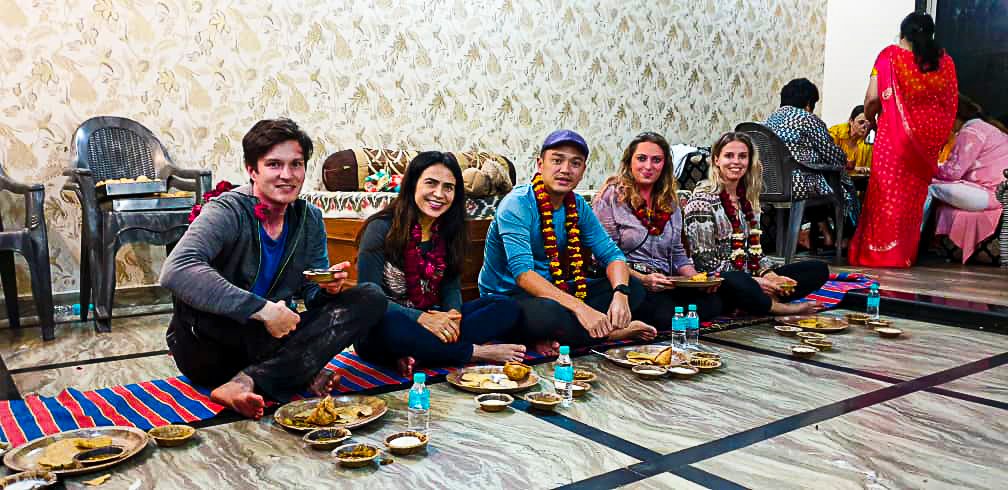
The crunch of the papad played against the heat of the curries and their sweet-and-sour notes, leaving my palate a little lost, never quite sure what to expect next.
I never have a meal without meat. The food was so full of unfamiliar flavors that I didn’t even notice it was missing.
As soon as we finished, Siddharth said it was time to leave. I hesitated. Back home, eating and walking out right away would be rude, as if you had come for the food and not for the company.
“Isn’t it rude to leave right after dinner?” I asked him.
He assured me it was perfectly fine. I wasn’t entirely convinced, but my back was screaming after all that cross-legged sitting, and my tired body was more than happy to finally lie down.
I ended the day exhausted, blessedly fed, and still yellow.
A Living Work of Art — Nandgaon, Lathmar Holi
Our group stood out in the streets, and we knew it. But that day, as we walked through the crowd, some people started shouting at us: “Covid, covid, covid!” We just laughed. At that time, Covid was still something distant, just a headline on the news.
Our destination was Shri Nand Baba Temple in Nandgaon. If you’ve ever looked up photos of Holi, chances are you’ve seen its courtyard.
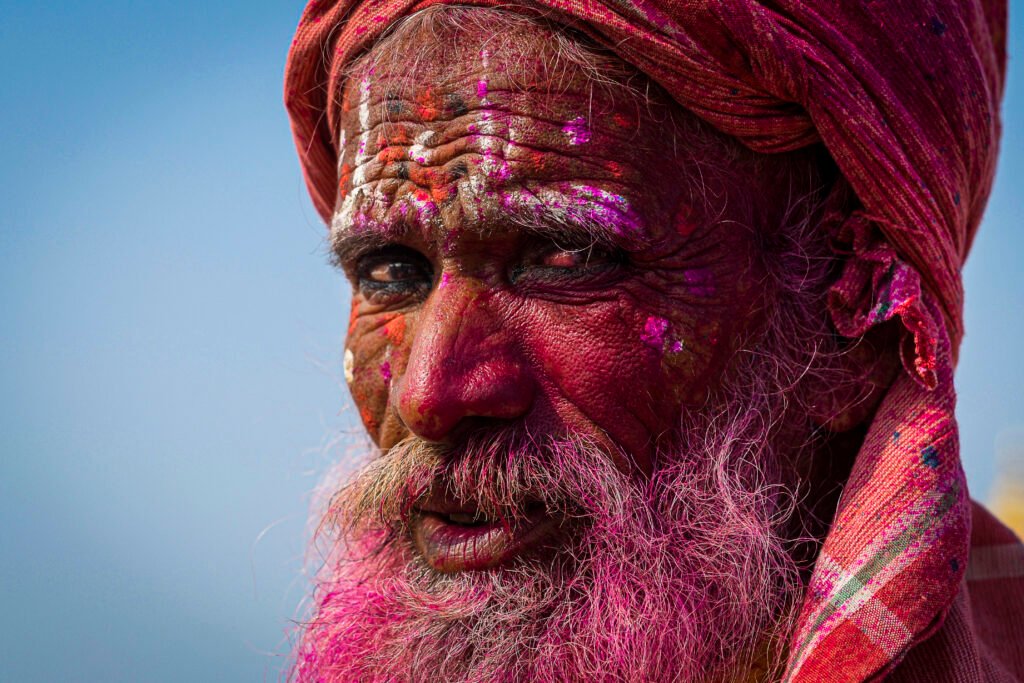
The temple’s ancient architecture offers two ways to join the ceremony: you can stay downstairs, walking through the crowd, or go up to the mezzanine for a panoramic view.
I was trying for a mix of both. Well… up to a point.
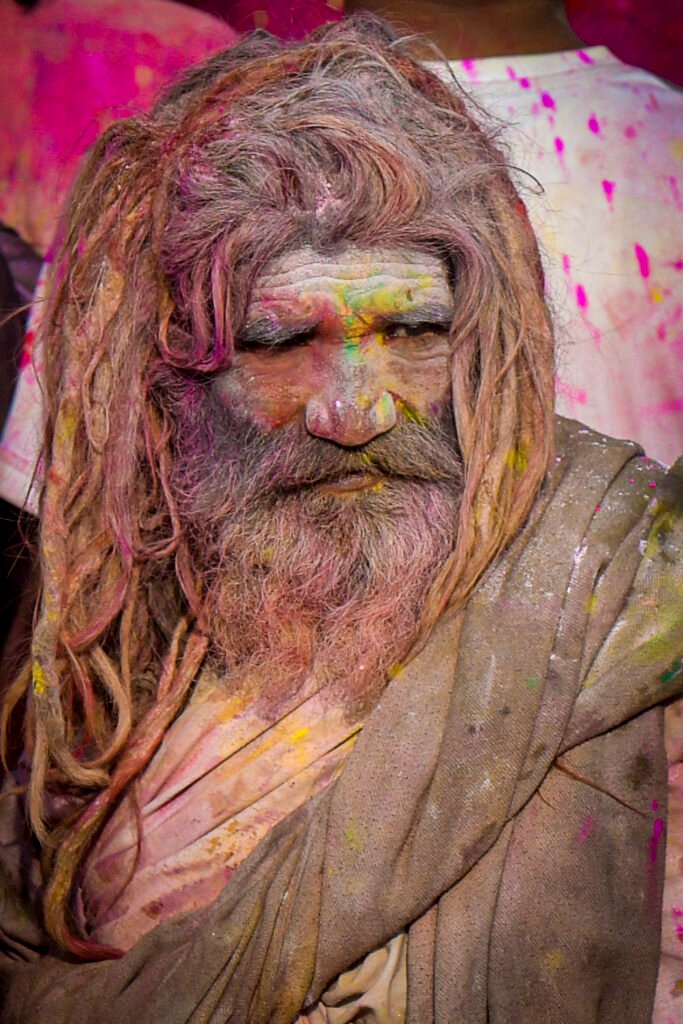
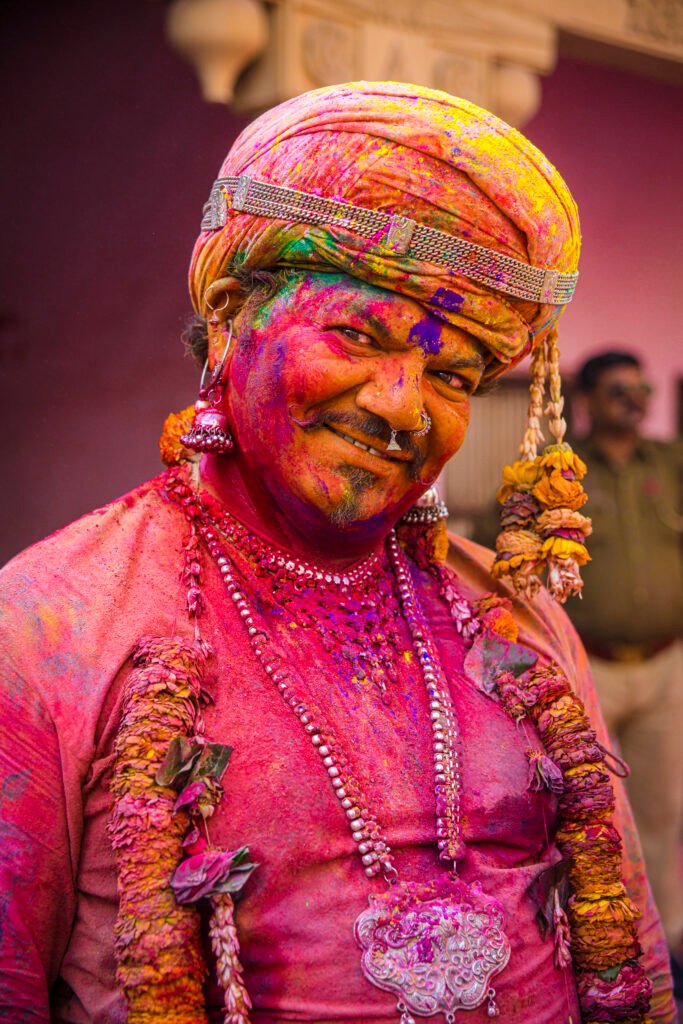
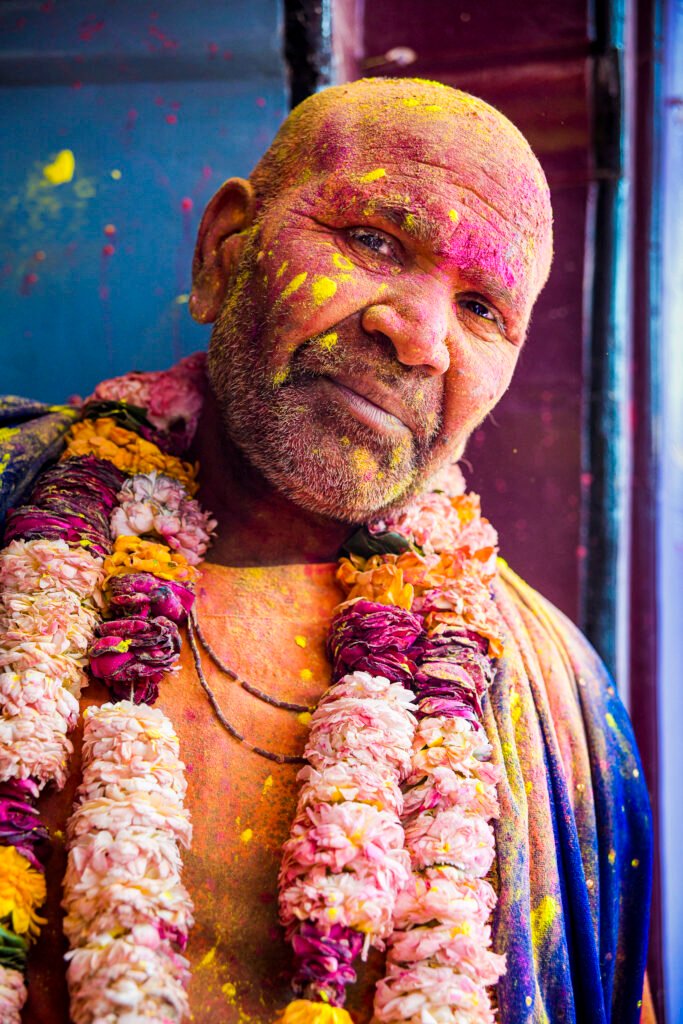
After a while, walking in the lower area became harder, not just because of the powder constantly hitting my face or the inevitable “baths” from buckets full of colored water, but mainly because there simply wasn’t enough space for everyone anymore.
That’s where I was when my friend surfaced next to me, shouting “War is on!”
So I climbed to the upper level and stayed there. I wasn’t sure it was the best spot for photos, or whether I should keep trying to stay downstairs. But what I started to see from up there made me realize I was in the right place.
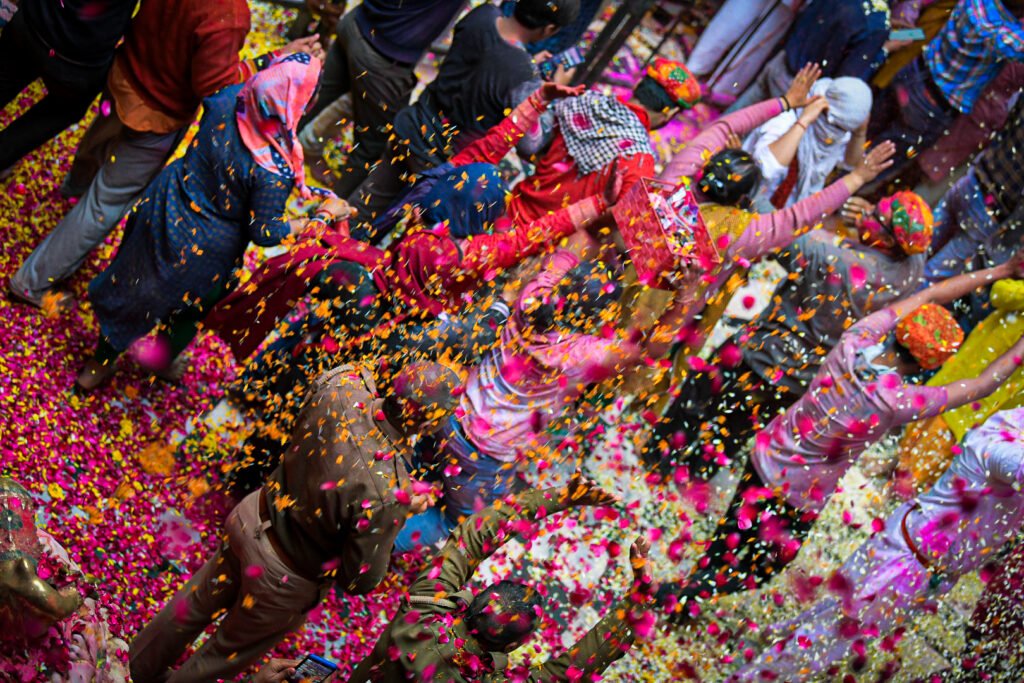
Below me, the crowd threw clouds of pink, then yellow, then blue, and finally red. It was like watching a living work of art.
I was seeing Holi the way I had first seen it, in that book: from above.
On our way back to the car, still taking photos in the streets, we stopped in front of a family house. Everyone was outside enjoying the festivities, and they seemed curious about our group. Siddharth explained what we were doing, and they invited us in.
We took photos together, and as we were leaving, an elderly man spoke to Siddharth, making circular gestures with his hands, and suddenly I heard the word roti.
I asked if they were inviting us to eat chapati (a type of Indian bread I absolutely love), and Siddharth said the man was inviting us to come back another day to eat roti.
Apparently, I can understand an invitation to eat in any language. Even Hindi.
We couldn’t go back another day, but chapati was waiting for us anyway: the priest had invited us to dinner again.
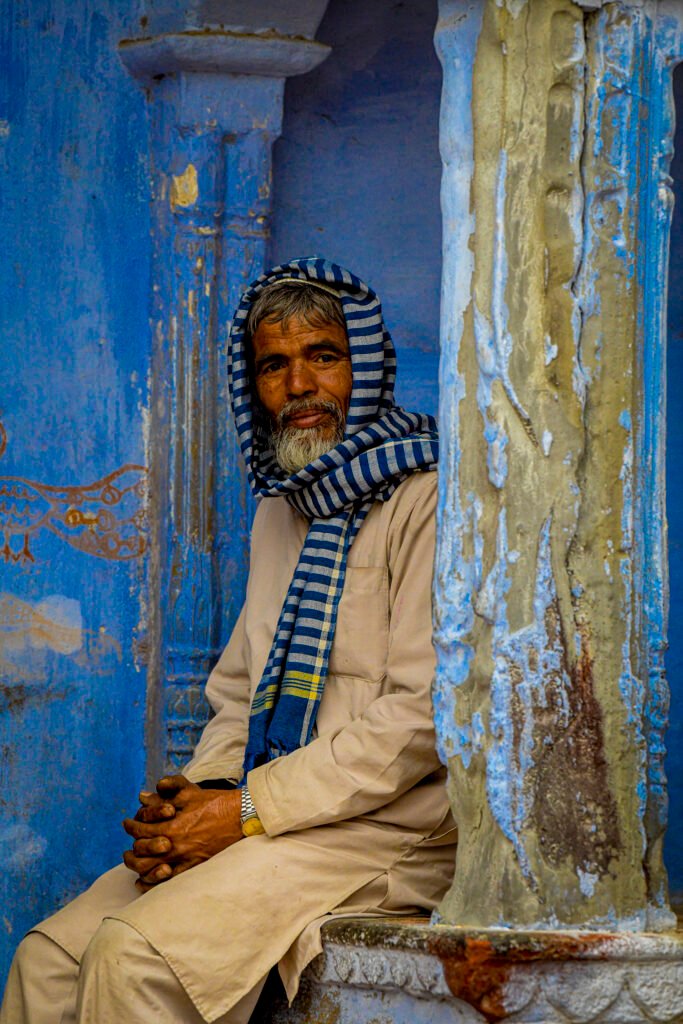
Digital Faith — Vrindavan, Holi at Banke Bihari
The next day, we were back at Banke Bihari, this time for Holi.
We had been offered the balconies, so that’s where we went. From up there, flower petals rained down with the gulal onto the crowd. It was beautiful. Below, women carrying children and elderly people were being crushed against each other, everyone trying to reach the altar.
I was already tired and had stepped a little back when Siddharth approached, complimenting my camera. I handed it to him so he could take a look. He asked if he could shoot a few pictures, and I said, Go ahead! He stayed there for a while taking photos and then handed it back to me.
The next morning, he asked if he could have the pictures, and I said I would send them all later. He insisted on coming by to make a copy, and since I had a free morning, I didn’t refuse. He came with some kind of gadget that he plugged into my camera and after a while left saying he had copied the photos.
It was my last day. The others would stay for four more days of festival, but I didn’t have enough vacation left. Later, before heading back to Delhi, we would visit Keshi Ghat for the Yamuna Aarti, a fire ceremony held in honor of the sacred river.
That evening, sitting in a boat on the Yamuna, I turned on my camera. The only thing on the screen was an exclamation mark followed by: “Folder contains no images.”
What?!
For a moment, I froze. Then I removed the SD card and reinserted it. Same message. After several failed attempts, it hit me. Everything on that card was gone. The entire previous day. The petals falling at Banke Bihari, the street scenes, the portraits I had taken along the riverbank. All gone.
In his hurry to get his pictures, Siddharth had deleted mine.
I turned to Runa, completely freaking out, but there was nothing she could do either.
At that moment, I couldn’t care less about the sacred ceremony. All I could do was yell at him. Big time.
In English, Portuguese, Hindi… suddenly I was fluent in every language, and I was certain he understood every single word.
I made a huge effort to stay calm for the rest of the ceremony, but it was a lost cause.
As soon as we arrived back at the hotel, Runa asked if I could leave the SD card with her.
Later that night, when I arrived at the restaurant for dinner, Runa and Urip were already there.
They gave me the most wonderful news: somehow, Urip had managed to recover my deleted photos. Apparently, he’d used some software and brought them all back from the digital afterlife.
Actually, he was still in the middle of the process, but it was working. It wouldn’t be finished before I left, but Runa promised to send me everything once it was done.
For a few seconds, I just stared at them in disbelief. Then came relief. Pure, overwhelming relief.
When I got back to Brazil, Runa had already sent me a link to a folder with my photos. The files had lost their original numbering, so I’ll never know if every single one came back. But it seemed so.
Saint Urip, I’ll never forget you.
When the Colors Faded
The widows’ Holi in Vrindavan, where women once forbidden to celebrate now play with colors and petals, was cancelled that week. Most of them were elderly, and a new virus was in the news. I didn’t know it then, but that was my first restriction of the pandemic.
I got back just in time. By March 16, I was working from home in Rio. The four extra days of festival I had been so sorry to miss left my friends stuck in India for almost a month.
Within weeks, the world had shut down, and for many people, nothing would ever be the same.
The organizer was right about one thing: I had no idea. But I made it. And I didn’t hate it. Well, except for a few minutes on a boat on the Yamuna.
😮💨 What a scare that must have been — losing all your photos! I can’t imagine the chaos, and what a relief to know they were recovered in the end.
I’m not sure I would have taken this trip myself, but it was wonderful to travel through your eyes — your lens, and your words. Thank you for sharing it so vividly.
Thank you so much! It was such a rollercoaster — I still get nervous just thinking about it! I’m really happy you enjoyed seeing it through my lens. That means a lot! Not sure I’ll ever find another story as fascinating to write about as this one.
Pingback: Bhutan, 2023 -
Pingback: Varanasi Travel Stories | Notes From Elsewhere