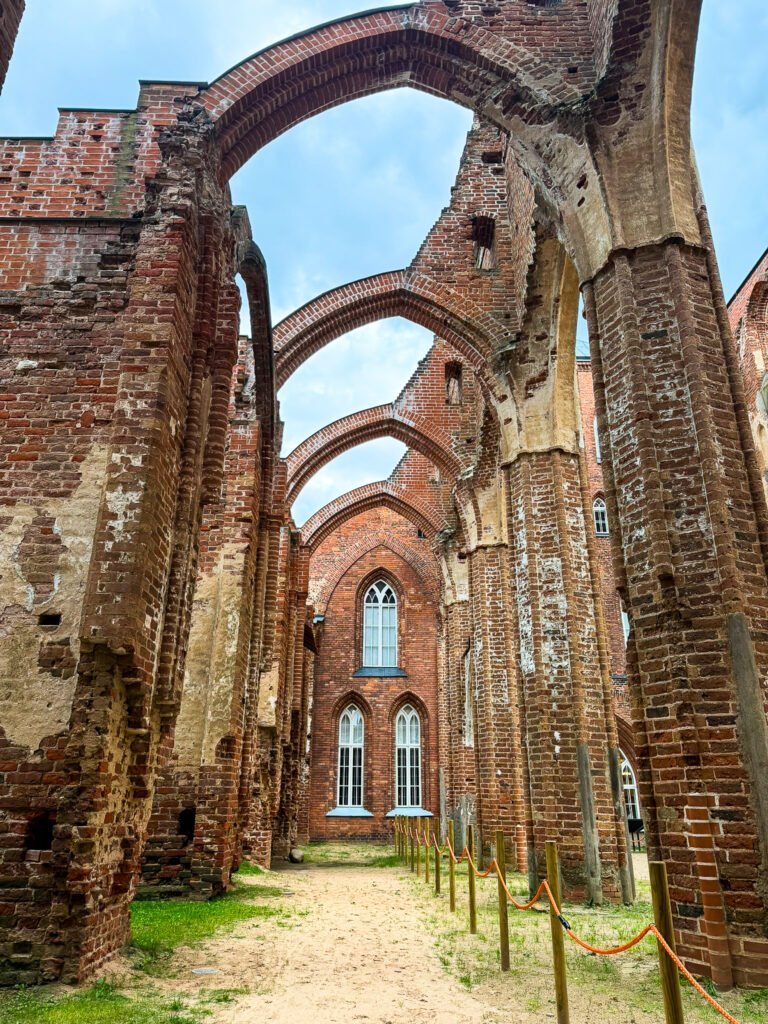
Estonia travel stories often begin in Tallinn’s medieval Old Town, but there is much more to discover beyond its cobblestone streets. From Hanseatic architecture and unexpected encounters to Tartu’s university life and the haunting legacy of Soviet occupation, my journey revealed a country where layers of history and a strong sense of identity are never far apart.
From the Bookshelf to the Baltics
Back when trips were planned almost entirely with books and magazines, I bought a guidebook covering Estonia, Latvia and Lithuania.
In those days, I used to buy guidebooks to places I hoped to visit someday, even when I didn’t have the faintest idea when that someday might come. This one sat on my bookshelf for decades, until 2026, when I finally decided to take it down and use it.
Perhaps because they so often appear between the same covers, it is easy to think of Estonia, Latvia and Lithuania as parts of a single whole. I certainly left home expecting to find plenty of similarities.
Yet the farther I traveled through the three countries, the more that assumption began to fall apart. By the end, what had started as a vague impression had become a certainty: these were not three versions of the same place.
Tallinn, One Tower at a Time
We arrived in Tallinn at eight in the evening, drained after the long flight from Brazil. Marcelo was once again my travel companion.
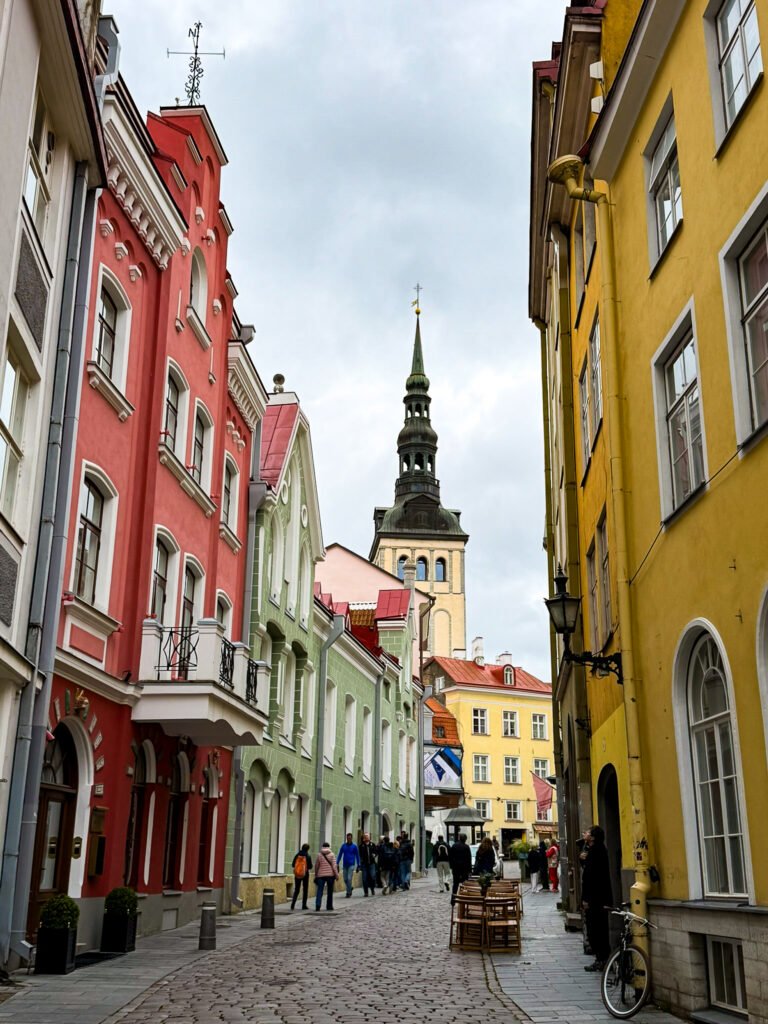
Our hotel was in the Old Town, and I knew we were getting close when the taxi began threading its way through narrow cobblestone streets.
Exhausted, yes, but not enough to skip dinner. Besides, the hotel’s restaurant looked promising, with its cozy underground dining room, vaulted stone ceiling, soft lighting, and fireplace.
By the time the first glasses of wine were poured, we had forgotten how tired we were. The trip had officially begun.
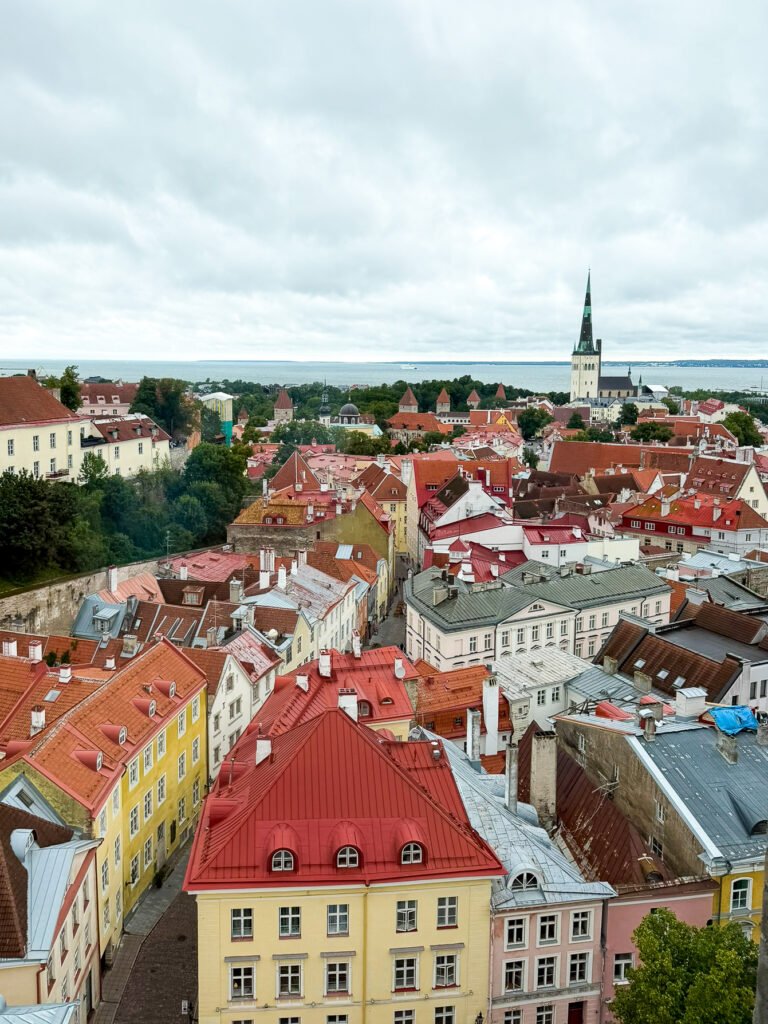
The next morning was cold, with a sky heavy with threatening gray clouds. We left the hotel and soon found ourselves at the old city wall. After climbing to the top, we looked out over a sea of red and gray rooftops. One sight immediately drew my attention, even from that distance: the dark onion domes of Alexander Nevsky Cathedral rising above the rooftops.
A short walk later, the slender tower of Tallinn’s Town Hall came into view. As we approached, the narrow street opened onto Town Hall Square, framed by colorful facades crowned with steep gables. Restaurants and cafés had spread their tables across the square. We were in the heart of Tallinn’s UNESCO-listed Old Town, one of the best-preserved medieval urban centers in Northern Europe.
Although it was Sunday, the square was remarkably calm. Only a few people were crossing it, and even fewer were sitting at the outdoor tables. By then, a fine drizzle had begun to fall.
Looking at the square, I found Tallinn familiar, but not in the generic way medieval towns sometimes do. I had seen this particular kind of scenery before in Bergen and Bruges.
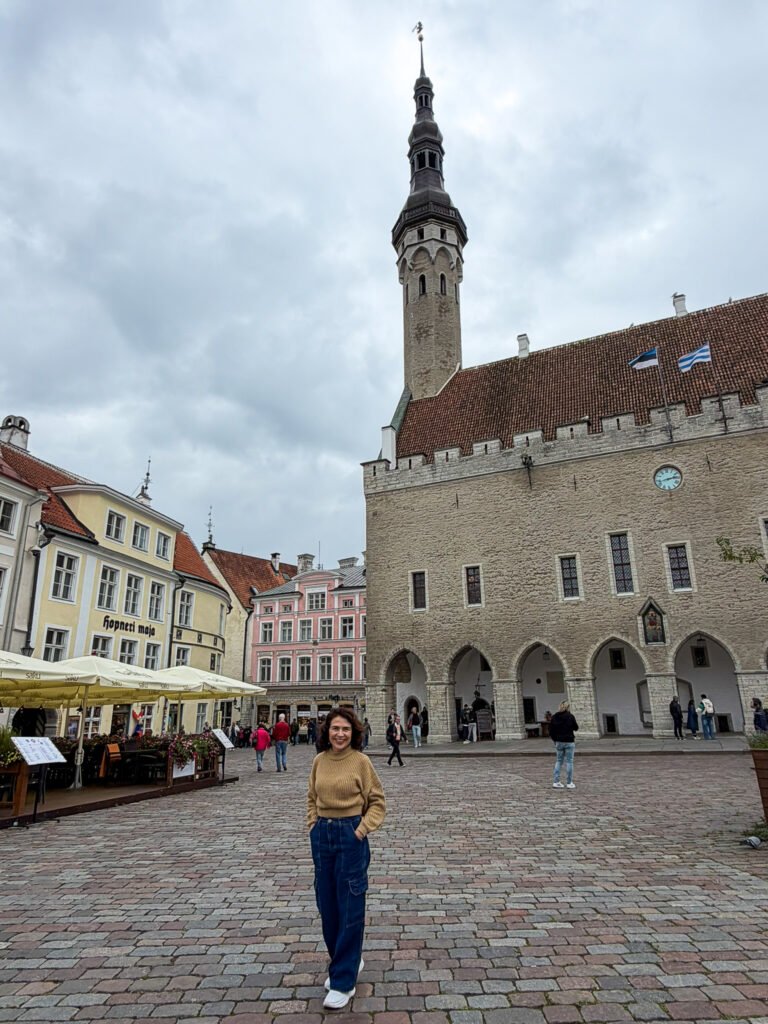
There was indeed a connection between the three cities. But I would only discover what it was later that evening.
Despite the weather, I still wanted to climb the Town Hall tower. From above, the square seemed to shrink into a carefully arranged Christmas village — almost too perfect to be real.
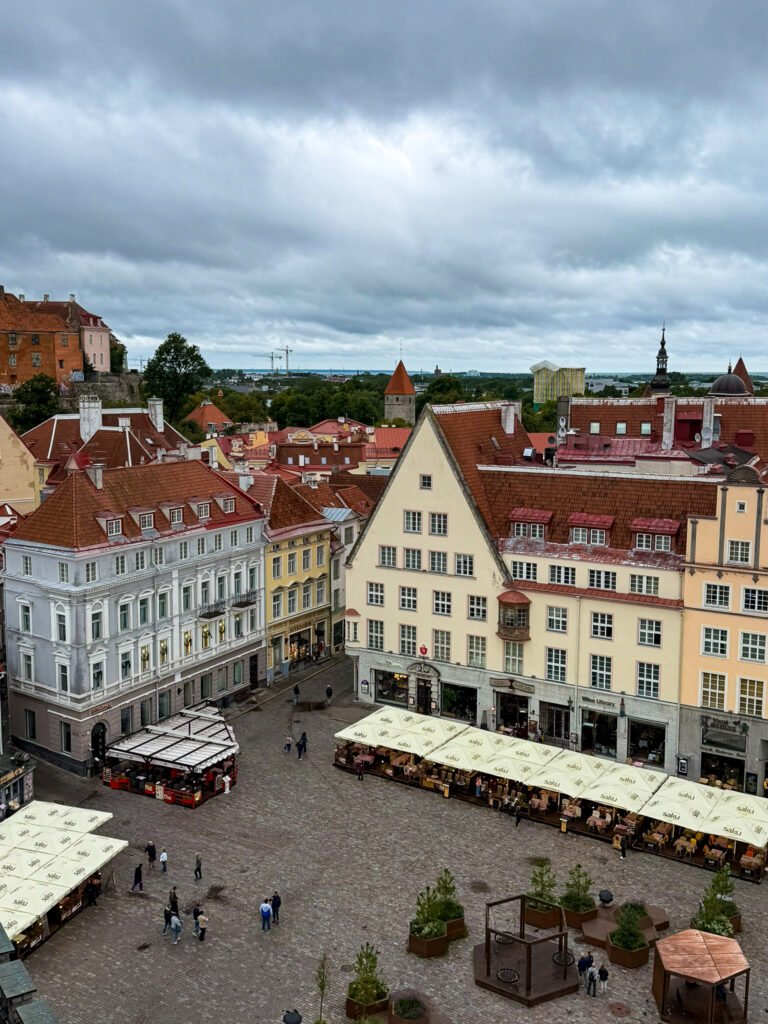
Or perhaps my dear friend’s wonderful Christmas village had been a miniature version of Tallinn all along.
We took the stairs back down. Once inside Niguliste Church, I laughed at Marcelo’s expression when he discovered that the tower had an elevator — pure relief.
The interior did not strike me as particularly splendid, but I was placing all my bets on the Danse Macabre.
✦ Footnotes from Elsewhere
Painted in the late 15th century in the workshop of Lübeck master Bernt Notke, Tallinn’s Danse Macabre shows Death leading people from different levels of society toward the same inevitable end. Only a fragment of the original work survives, yet it remains the world’s only surviving medieval Dance of Death painted on canvas.
The painting stretched much farther than I had expected. As I walked alongside it from left to right, I found it strangely amusing rather than macabre. The message itself was hardly new, but the way it had been staged was wonderful.
The pope, emperor, empress, cardinal and king all looked solemn, resigned or even sad. The skeletal figures of Death between them, however, appeared to be having a wonderful time, dancing in different poses and openly mocking everyone around them.
If I had to choose the best performance, it would be the one surrounding the empress. With her elaborate horned headdress, she stood between two skeletal dancers who seemed particularly delighted with themselves, staring at her while casually kicking their legs into the air.
I loved it.
The view from the Niguliste tower changed the scale once again. The cathedral whose dark domes had caught my attention from a distance now seemed to stand directly in front of us. For the first time, we could see not only its domes, but the entire facade.
We then made our way up to Toompea, the Upper Town. The atmosphere changed almost immediately. Government buildings replaced the merchants’ houses, giving the area a far more formal air.
But Alexander Nevsky Cathedral had no intention of blending into all that restraint.
It was extroverted, theatrical and perfectly happy to occupy the spotlight, a role it had already claimed from almost every angle.
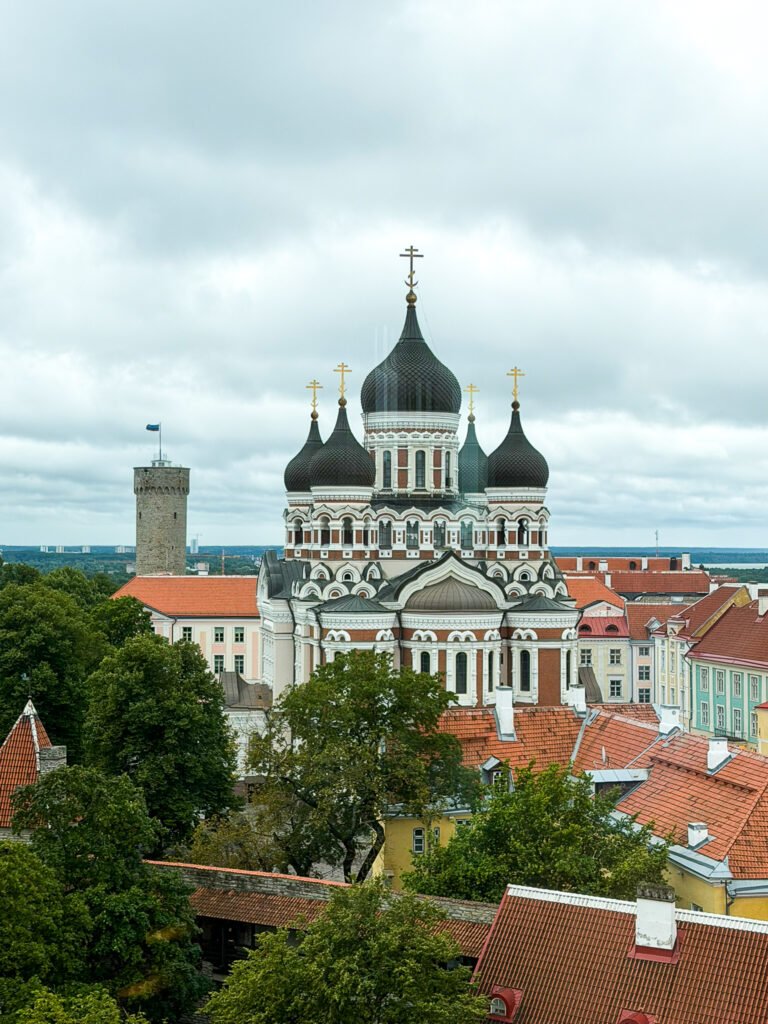
I have to admit that it deserved the attention. Built while Estonia was part of the Russian Empire, during a period of intensified Russification, the cathedral — with its warm-toned facade, dark onion domes and lavish decoration — left little doubt about the power it had been designed to project.
No wonder it had been commanding my attention all morning. Mission accomplished.
And yet, Ukrainian flags were everywhere in Tallinn. We saw them on private buildings and particularly on government buildings. To me, they seemed to carry a message: Russian domination should be a thing of the past.
Time to find out what Tallinn had to offer two starving tourists.
It did not disappoint.
We chose a restaurant in the Lower Town, near the foot of the hill leading up to Toompea. Or perhaps the restaurant chose us: the smell drifting through the doorway made the decision impossible to resist.
We were lucky to get one of the last available tables. Around us, I could hear English, Spanish and several languages I couldn’t begin to identify. As it turns out, Portuguese was just as difficult for others to place. As soon as we started discussing the wine in Portuguese, our waiter asked where we were from, curious about the language.
We both ordered elk. I couldn’t remember ever having tried it before. I clearly remembered eating deer — many times — but elk specifically? I wasn’t sure. That particular dish, however, would be hard to forget: the meat was tender, well-seasoned and perfectly cooked. It arrived in a shallow metal pan, partly submerged in a dark, rich sauce. The portion looked as though it had been intended for someone who had not eaten in days.
Not that either of us left a single bite behind.
Tallinn Through the Wrong Door
Late in the afternoon, we took a taxi and left the Old Town behind. The landscape gradually changed, first into residential streets lined with low-rise buildings and then into something distinctly more industrial.
The taxi turned off the main road and into a narrow side street. A few meters later, the driver pulled over and left us standing among a collection of enormous warehouses.
I had read that Noblessner began life in 1912 as a shipyard building submarines for the Russian Empire. It had since been transformed into a cultural and dining district. I love redevelopment projects like this, places once industrial or forgotten, brought back to life with personality and good design.
Puerto Madero in Buenos Aires immediately came to mind. Noblessner was smaller but followed a similar principle: a former port reinvented as a mixed-use waterfront district.
By then, dusk was beginning to settle in. The rain had returned, now accompanied by a strong, cold wind — not exactly ideal conditions for wandering around. And judging by the lack of people outside, this appeared to be the general consensus.
We tried to explore anyway, but everything looked closed and deserted. Eventually, we reached a waterfront area dotted with curious rounded, wood-clad structures. They were saunas, a passion Estonians seem to share with their Finnish neighbors across the gulf.
As the time of our dinner reservation approached, we headed toward one of the large converted warehouses. I have absolutely no idea how we managed it, but somehow, we entered the restaurant through the kitchen.
The hostess did not look remotely surprised. From what I could tell, we were not the first people to make that mistake. She led us through several rooms before we finally emerged into an enormous dining space filled with tables.
And people.
So this was where everyone had been hiding.
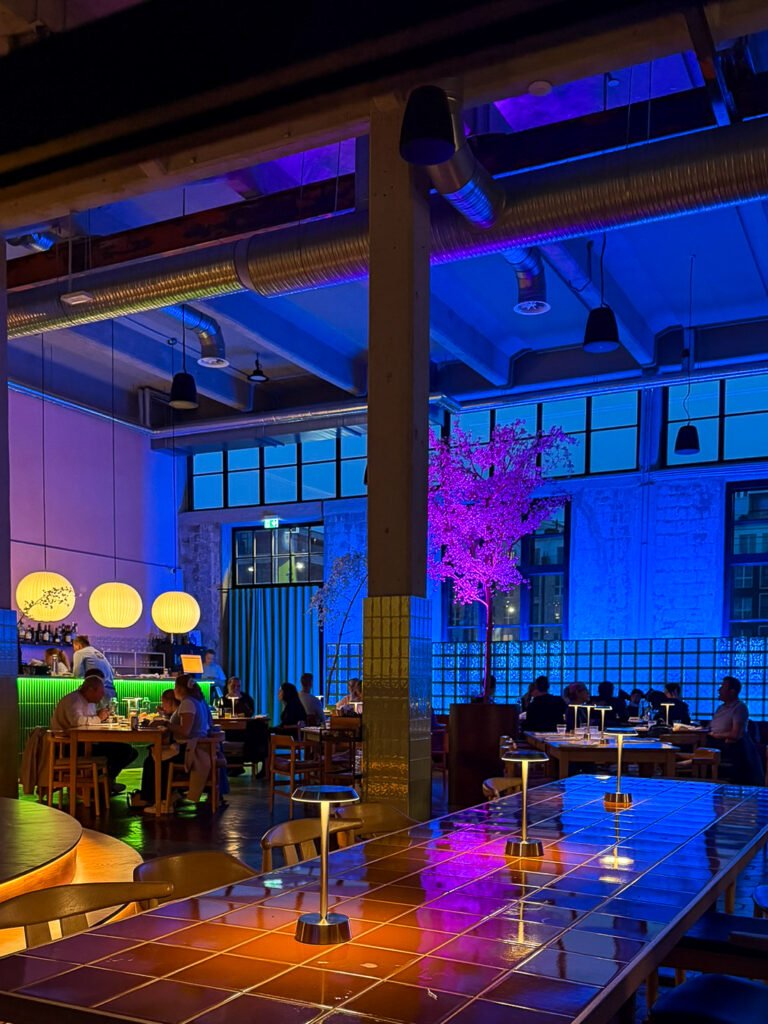
With the elk from lunch still very much on our minds, and possibly still in our stomachs, we asked our server to let us take our time. She happily did.
Between the weather and a full day of exploring, we were both tired. As I slowly sipped a glass of white wine, I did some quick research into the architecture of Tallinn’s Old Town.
That was when the connection I had sensed in Town Hall Square finally revealed itself.
✦ Footnotes from Elsewhere
From the 13th century onwards, Tallinn — then known as Reval — prospered as a member of the Hanseatic League, the powerful network that connected trading cities across northern Europe. Its four principal foreign trading posts, known as Kontore, stood in Bergen, Bruges, London and Novgorod.
That was it.
Tallinn, Bergen and Bruges had occupied different positions within the same vast Hanseatic trading world. That shared history may partly explain why Tallinn’s merchants’ houses and steep gables had brought the other two cities to mind.
Eventually, we finished dinner and returned to the hotel.
Through the right door this time.
The Imperial, the Raw and the Polished
Looking at Kadriorg Palace from its garden, I was disappointed that the weather had still not improved. That grumpy dark sky and the palace’s cheerful colors were definitely not a match.
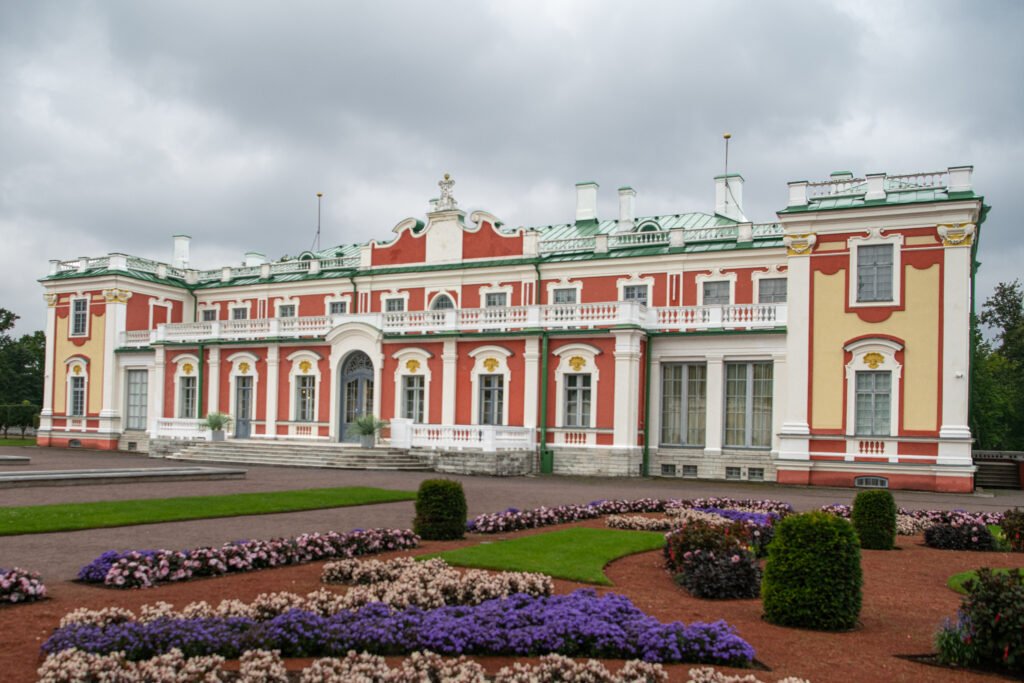
The palace was small, a contradiction in terms, perhaps, but true in this case. Built by Peter the Great for Catherine I, his wife and future empress of Russia, it now houses the Kadriorg Art Museum.
Neither of us was particularly excited by the palace or its collection, so we decided to move on.
While researching the trip, I discovered that Tallinn had its own Fotografiska, the well-known photography museum founded in Stockholm.
The name immediately brought back memories of my visit to the Stockholm museum in 2016. I remembered enjoying the exhibitions, but also the view from its restaurant: a bay bathed in sunset light beneath a sky tinged with lilac.
I immediately wanted to see the Tallinn version.
Even better, Fotografiska was located in Telliskivi Creative City, a former industrial complex transformed into a center for art, design and independent businesses.
Our driver dropped us off beside an open space, where colorful portraits hung from a large installation directly in front of the museum.
Inside, we made our way to the exhibitions on the upper floors. One in particular held our attention: Inta Ruka’s Places Called Home, an exhibition about people and everyday life in Latvia. It brought together two long-term projects, including one in which she repeatedly photographed residents of the same apartment building in Riga over several years.
I loved the intimacy and simplicity of the portraits. Nothing about them felt staged or intrusive. I sensed the trust she had built with the people in front of her camera.
That impression grew stronger when I watched a video showing Inta preparing an exhibition opening and organizing a trip for the residents she had photographed in the Riga apartment building. They were the stars of the exhibition, after all. The whole outing reminded me of a school field trip, with everyone visibly delighted to be part of the occasion.
Beyond the museum, part of the former industrial complex appeared to be occupied by offices, while other buildings housed alternative shops, tattoo studios and galleries.
Telliskivi felt rawer than I had expected, a creative district that knew what it wanted to be but had not quite arrived there yet.
After exploring the area, we returned to the museum for a glass of wine before heading back to the Old Town.
That evening, we had a fancy dinner in the Rotermann Quarter, where contemporary buildings had been inserted among old warehouses and factories.
Compared with Telliskivi’s rough edges, Rotermann was urban regeneration at its most polished — elegant, fully functional and very much alive.
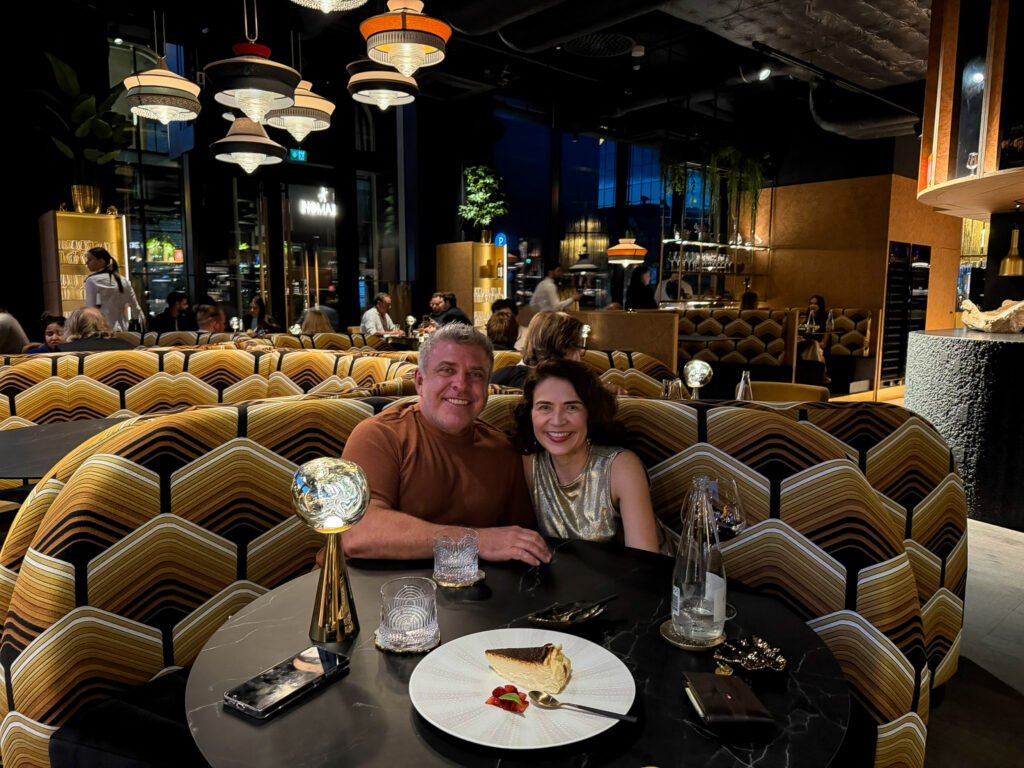
Our restaurant was just as lively. Around us were executives still dressed for the office, two friends who looked as though they had stepped straight off a fashion runway, couples, and groups of friends and families. There was no single dress code, but style was the one thing the room did not lack.
Add a perfectly cooked steak and friendly service, and I could not have asked for a better evening.
We were in such a good mood that we decided to walk back to the hotel. It was only fifteen minutes away and gave us an excuse to explore the quarter a little longer.
Tartu Above and Below
The following morning, we had breakfast and prepared to leave Tallinn behind. Our next stop was Tartu, Estonia’s second-largest city.
This time, not by plane. Or train. Or car.
By bus.
Other travelers praised the comfort, the frequent departures and, above all, the chance to avoid the entire airport routine. That was enough for us to buy into the idea.
And buy the tickets.
I wanted to see what Estonia looked like beyond its capital. Besides, Tartu lay roughly halfway along our route to Riga, our next destination.
When we told our taxi driver that we had come to Tartu as tourists, however, she seemed genuinely surprised. Apparently, it was not an answer she heard very often.
The medieval scenery was gone. Tartu was smaller, quieter and unmistakably shaped by its university.
✦ Footnotes from Elsewhere
Founded in 1632, the University of Tartu played a key role in shaping Estonian national identity. In 1919, it became the national university of independent Estonia, establishing Estonian as a language of higher education and scholarship.
Downtown Tartu felt less like a conventional city center than an extended university campus. Young students carrying backpacks walked purposefully toward their next classes, while older people with messenger bags moved at a slower pace or sat in one of the cafés. Bicycles and bookstores completed the scene.
Everything seemed to orbit around the university’s imposing white main building.
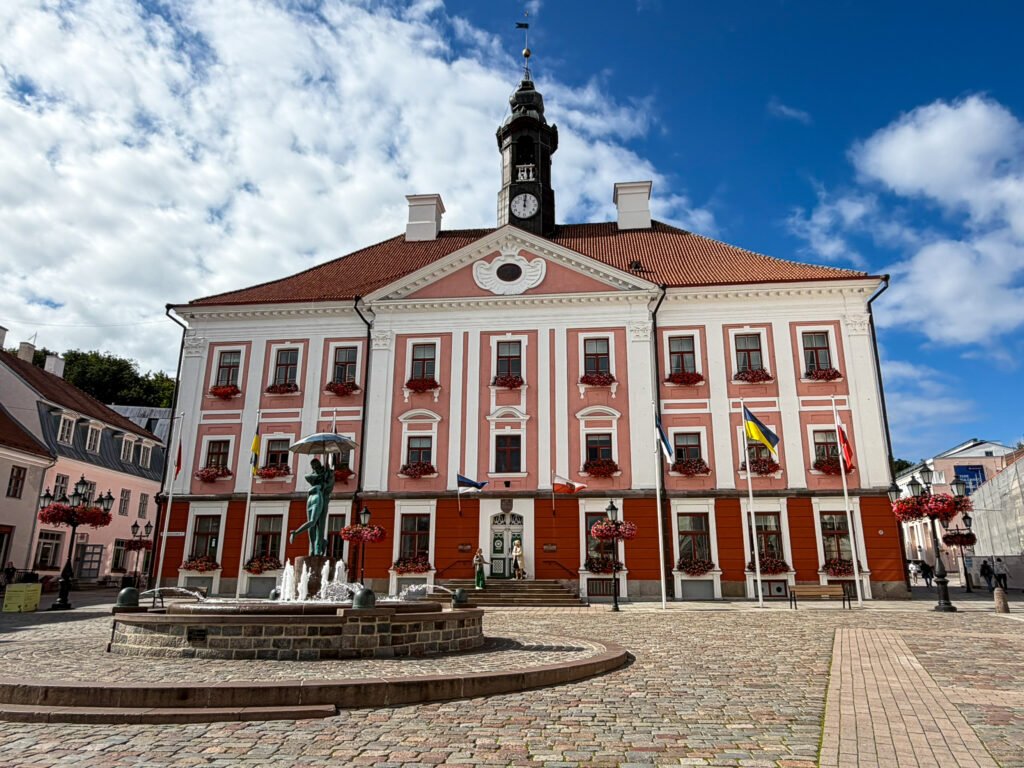
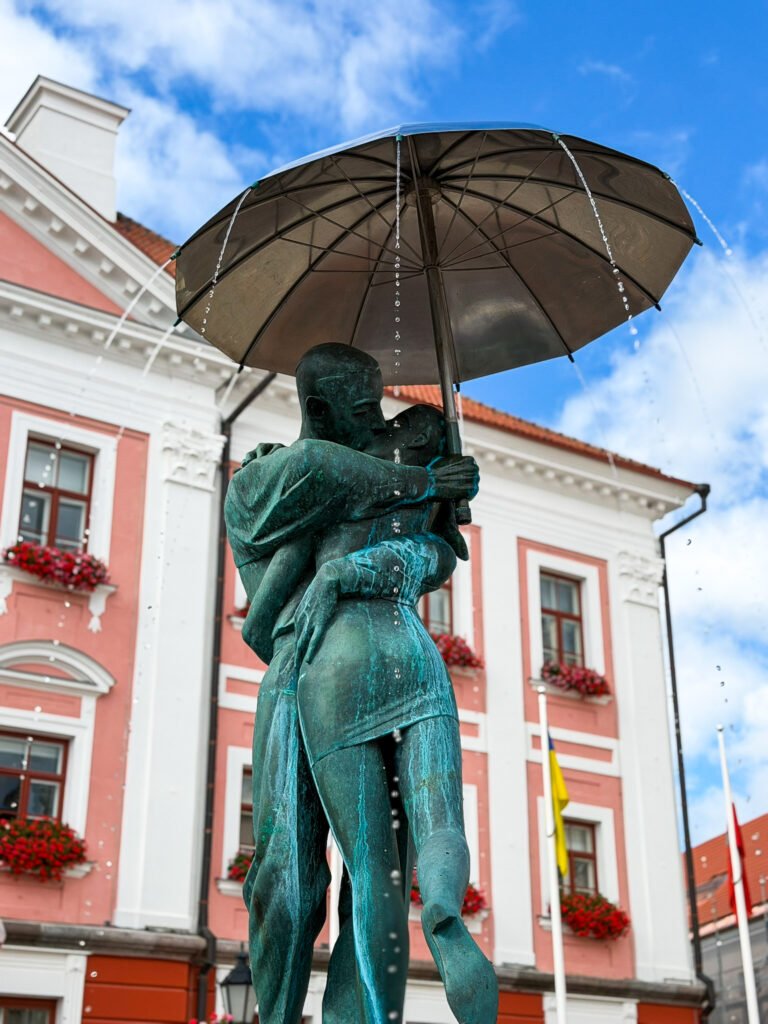
Directly in front of the charming pink Town Hall stood something I found amusing. Instead of a former ruler, military leader or local hero, the square had a fountain crowned by a sculpture of two students kissing beneath an umbrella.
Not only was it lovely, but to me, it said something about the city and the place its students occupied within it.
Even the ruins of Tartu Cathedral had been drawn into the university’s orbit. Part of the medieval church remained open to the sky, while its surviving choir had been converted first into the university library and later into the University of Tartu Museum.
From there, we walked away from the Old Town toward our next stop. A few minutes later, we arrived at the address. But there was no sign of a museum, just a gray five-story building.
Finally, I spotted a small sign pointing to a closed door. Behind it, another one led underground. Apart from that, nothing remotely looked like a museum. People were even entering the building with us, heading to the other businesses inside.
The stairs ended in a dark corridor lined with small rooms. This was the KGB Cells Museum, where political prisoners were held during the Soviet occupation while awaiting interrogation, sentencing, transfer to other prisons or deportation.
The cells were small, and even light and air seemed to have to make an effort to get there. Recordings of interrogations, objects once used inside those rooms and accounts of Estonians deported, killed or missing made the atmosphere increasingly oppressive.
I stepped back onto the street like someone finally reaching the surface after being underwater.
As we passed a hair salon — one of the businesses occupying the building above the museum — I thought again about how little there was outside to indicate what lay beneath it.
I wondered what it had been like back then: ordinary life carrying on just a few meters above those cells, and how much the people upstairs had known about what was happening below.
For that evening, we had booked dinner at a Michelin-recommended restaurant. By then, I had reached one firm conclusion: Leib — the traditional Estonian dark rye bread, slightly sour and usually served with butter — really was a national passion.
It had already appeared on our table a few times. It was not the best traditional bread I had encountered on my travels: too heavy and sour for my taste.
Something else surprised me while I was planning the trip: Michelin-recommended restaurants kept appearing in my searches. For a country as small as Estonia, finding 43 restaurants in the 2026 Michelin Guide was not exactly what I had expected.
From Michelin to places we chose at random, we found consistently wonderful food and service. Looking back on our meals, Marcelo and I agreed that only one or two had been merely good. Not a single one had disappointed us.
Cooking, it seemed, was taken very seriously in Estonia.
The next morning, on our bus to Riga, I found myself thinking about how visibly Estonia’s history of foreign rule remained part of the country. Its traces were everywhere, yet so were the signs of an identity that had endured and a country still reinventing itself.
Perhaps what makes a country unique is not only what happened to it, but how it responded to an imposed past and what it chose to build from it.