Part of my India travel stories, this journey moves through shifting landscapes, intense sensory experiences and moments that rarely allow indifference.
When India Wouldn’t Leave My Mind
The decision to go to India was not something that happened out of the blue.
India was different.
The idea had been quietly built over time.
Part of it came with experience. As my travels expanded, so did my curiosity about the world. After a long circuit through Europe, I had begun exploring Asia — Vietnam, Cambodia and Thailand — and with each trip I returned home wanting to see more.
In 2016, India kept returning to my thoughts.
I still can’t explain exactly why. But I felt a growing excitement about finally seeing for myself the country that seemed to inspire only two reactions: love or hate.
I was about to understand why.
At the time, I was also considering traveling with a friend. We explored many possible destinations together, but none of them seemed as compelling to me as India.
For my friend, however, the feeling was quite the opposite.
India simply wasn’t on her list.
But by then, I had already made up my mind.
Deep down, I knew my next destination.
India.
Looking back now, it was one of the best decisions of my traveler’s life.
A Quiet Beginning in Delhi
I arrived in Delhi in the middle of October. The temperature was pleasant and, most importantly, the monsoon season had already passed.
My hotel was near Connaught Place, an area filled with luxury stores, elegant restaurants and embassies — not exactly the India I had seen in photos and videos.
No problem. Soon enough I would be discovering many different versions of India.
By the time I cleared immigration, it was already afternoon. The travel agent had suggested free time to rest for the remainder of the day.
As I always say — I don’t sleep in reais, much less in dollars, euros or even rupees.
So resting was out of the question.
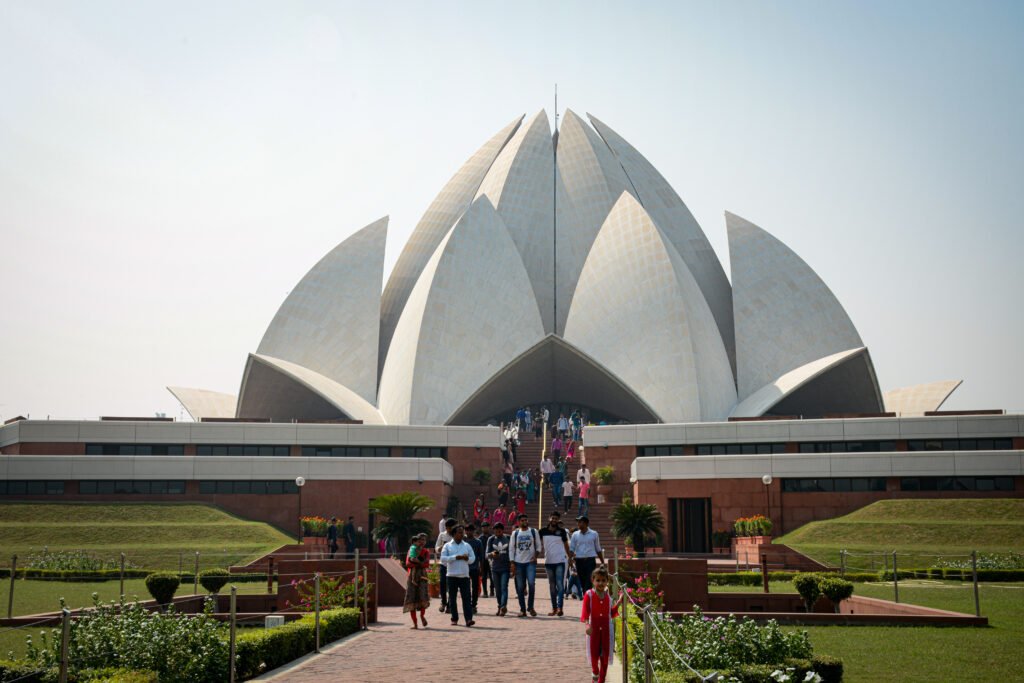
That’s when the idea of visiting the Lotus Temple came up.
All it took was one photo on Google of the extraordinary lotus-shaped building. No explanation about religion, history or architecture was necessary to convince me it was the perfect program for the afternoon.
✦ Footnotes from Elsewhere
The Lotus Temple in Delhi belongs to the Baháʼí Faith, a religion founded in the 19th century by Baháʼu’lláh in Persia (modern-day Iran).One of its central teachings is the unity of all religions and humanity. For that reason, Baháʼí Houses of Worship are open to people of any faith — or none at all. No sermons are delivered inside the temple. Visitors gather in silence or listen to readings from different sacred texts of the world’s religions.The lotus shape reflects purity and universality — fitting for a place meant to welcome everyone
The temple was full of visitors and, judging by the number of people photographing the exterior, its striking contemporary architecture was clearly part of the attraction.
Inside, there were only rows of seats. Some people wandered quietly. Others seemed lost in their own thoughts. There was a certain lightness in the air.
One question crossed my mind: how many of them were actually Baháʼí followers?
At that point, my knowledge of religions was still quite limited. The Baháʼí Faith was something I had never even heard of before that day.
To be honest, I admired its principles. There was something quietly inspiring about them.
I left the temple happy with this unexpected discovery — and eager for the next day in Old Delhi.
India in its rawest form was getting closer.
Layers of History
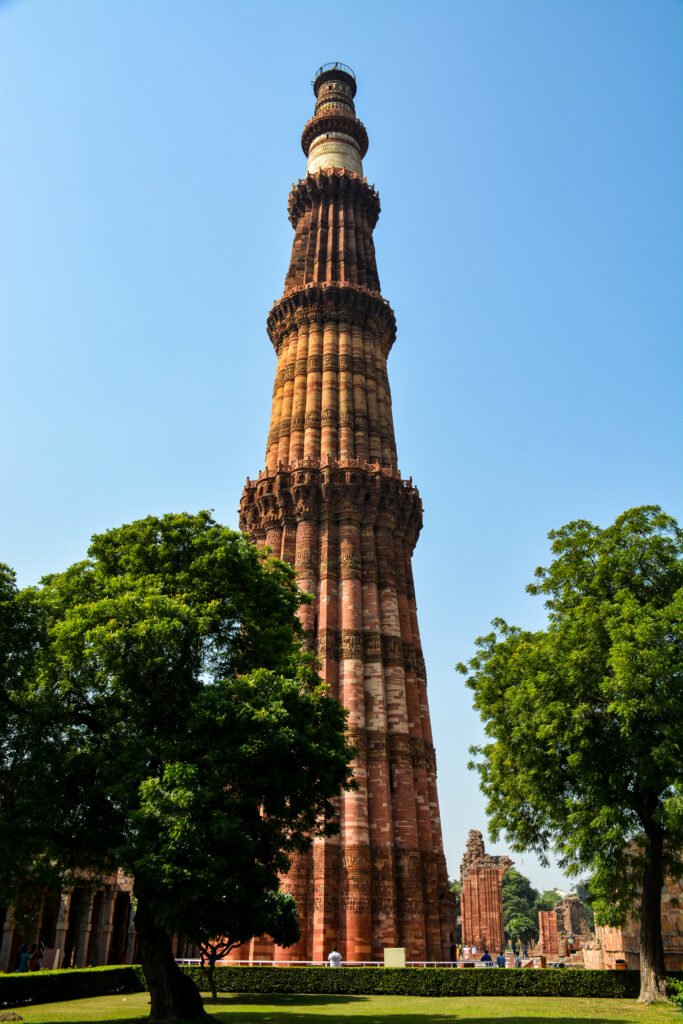
The Qutab Minar as a strong start to the day.
It stands within a complex of remarkable monuments, listed as a UNESCO World Heritage Site.
At 73 meters, the minaret is beautifully sculpted in red sandstone. Beyond its striking color, the angular flutings add movement to the facade, drawing the eye upward to the top of its five storeys — the only section where marble was used.
The conical form further reinforces the sense of height.
It felt more like a piece of art than a religious structure.
Yet within the same complex, an intriguing contrast appeared — a mixture of Hindu and Islamic elements.
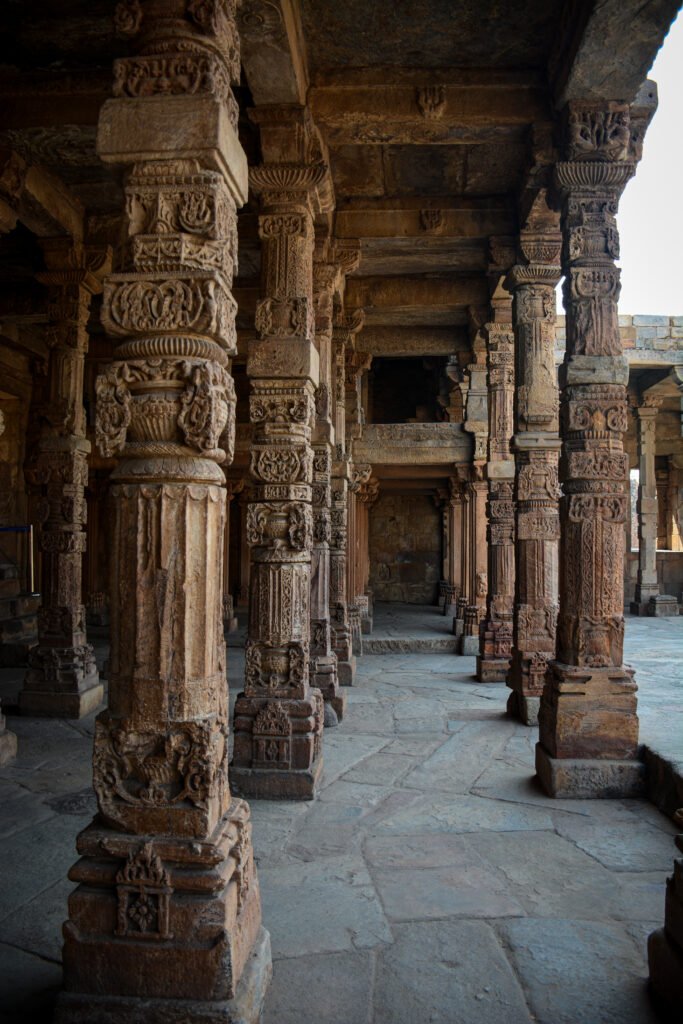
What was going on here?
✦ Footnotes from Elsewhere
The Quwwat-ul-Islam Mosque is considered the first mosque established in Delhi after the beginning of Muslim rule. One of its most striking features lies in its construction: parts of the mosque were built using materials from earlier Hindu and Jain temples, likely dismantled in the aftermath of the conquest. Many of these reused pillars still display intricate carvings of deities, floral motifs and traditional patterns.The result is a unique architectural layering — Hindu and Jain craftsmanship supporting early Islamic structures.
The place was packed with people, though foreign tourists were not everywhere.
Very soon, I would realize that Indians themselves form one of the largest groups of tourists within their own country.
That was only the beginning.
India is widely known for its sheer population density. But the moment this idea moved from something I had read into something I could actually feel came during my visit to Humayun’s Tomb.
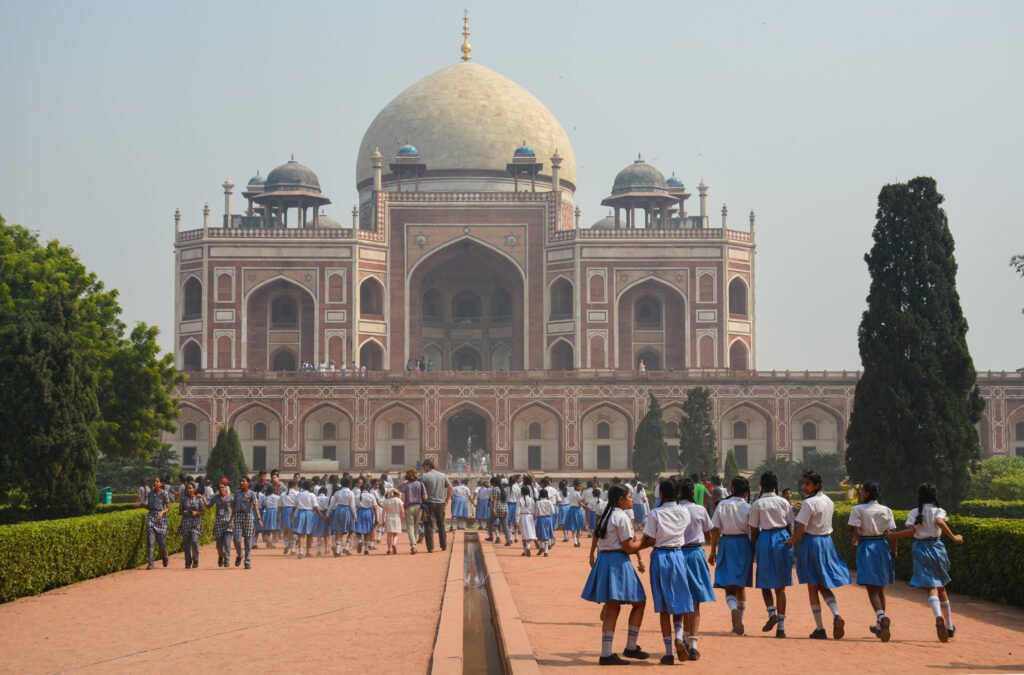
Something was becoming clear — for those suffering from agoraphobia, Delhi might not be the ideal destination.
I would soon be sure of it.
There was something else I hadn’t expected.
As curious as I was about them — a natural instinct for most travelers, myself included — they were just as curious about me.
That was new.
And possibly not something everyone would enjoy.
Those conflicting feelings about the country were already beginning to show.
While observing and being observed, I made my way through the mausoleum — my first Mughal monument.
✦ Footnotes from Elsewhere
Mughal architecture emerged in the 16th century with the rise of the Mughal Empire, founded by Babur, a ruler of Central Asian origin.Its style reflects a fusion of influences — Persian, Timurid (from present-day Uzbekistan) and Indian traditions — brought together as the empire expanded across the subcontinent.Key elements include symmetry, large domes, intricate geometric decoration and the use of gardens as part of the architectural design, symbolizing a vision of paradise.Over time, this blend evolved into some of India’s most iconic monuments, where foreign and local traditions merged into a distinct imperial style.
As someone who calls Rio de Janeiro home, I’m used to being constantly alert. It echoes one of the most common phrases about the city:
Rio is not for amateurs.
At India Gate, I realized just how much that mindset had shaped me.
I was walking near the monument when a group of teenagers approached and — without saying a word — surrounded me.
I instinctively stepped aside, clutching my camera.
Probably looking far more frightened than I should have.
They seemed startled too.
The guide, who had witnessed the whole scene, quickly explained: they simply wanted a selfie.
To them, I looked… different.
What followed was a mix of embarrassment and disbelief at my own reaction.
But I quickly recovered, apologized — and took the photo.
The first of many.
Until that moment, India’s architecture had been red. And the next stop would not change that.
Jama Masjid is one of the largest mosques in India and another important Mughal monument.
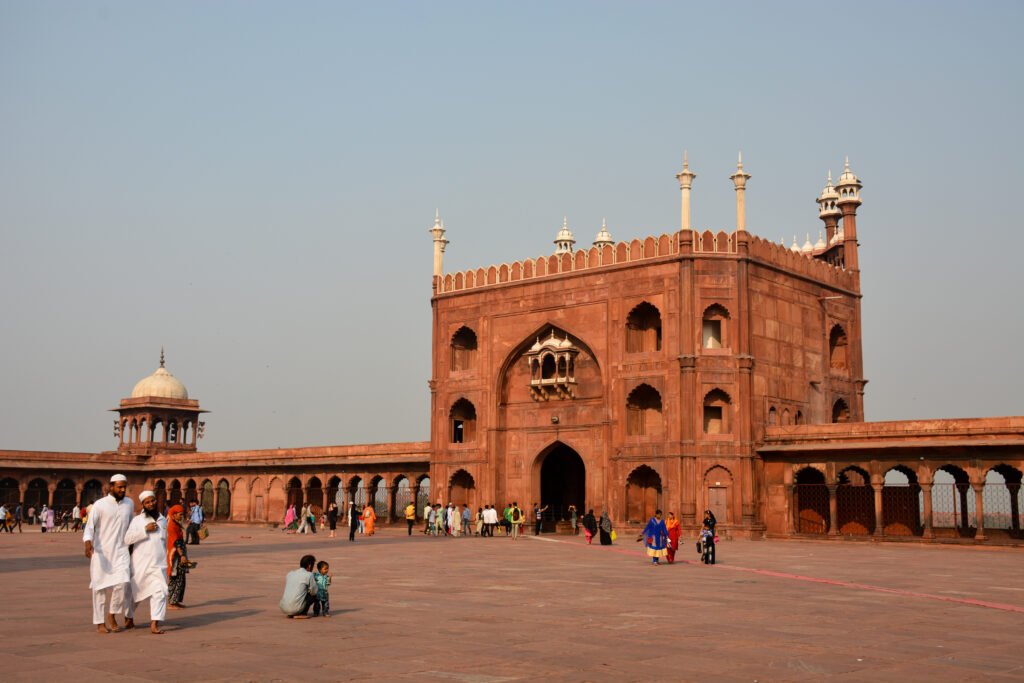
To reach the entrance, you have to make your way up a wide staircase.
After the usual adjustment required to enter a mosque — in this case, not just a scarf covering my head and shoulders, but a loose, full-length robe with wide sleeves and a hood — I stepped into an immense open courtyard.
As expected, the silence stood in sharp contrast to the noise outside. There were fewer people than in the other places I had visited so far, but it wasn’t Friday — when the courtyard can hold up to 25,000 worshippers during prayer.
The interior was a surprise.
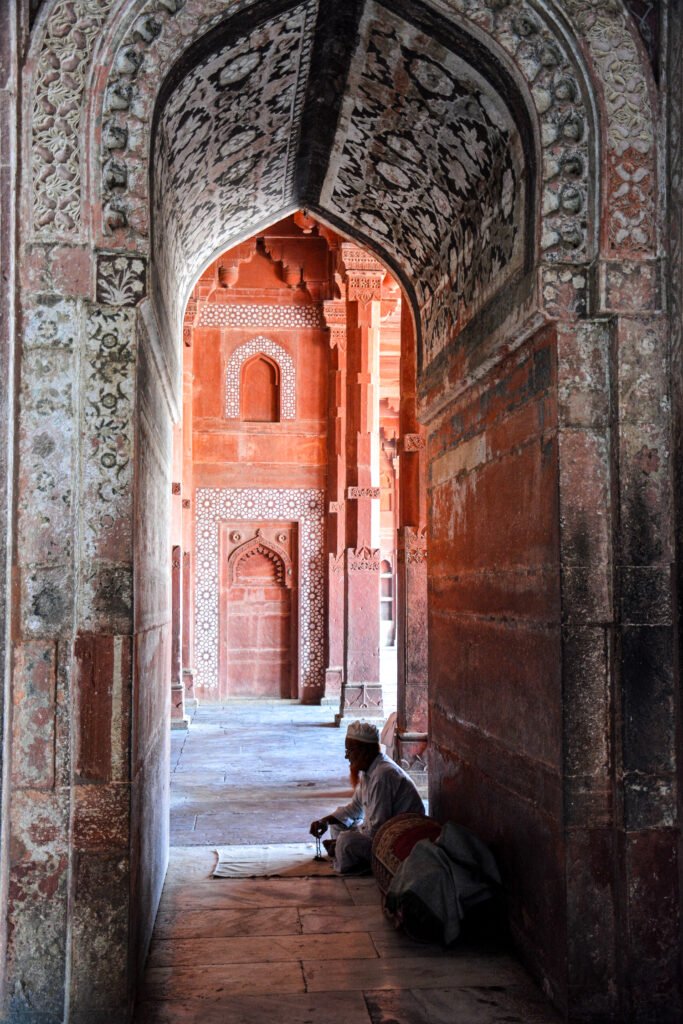
The layered arches, with their intricate carvings of floral motifs and delicate patterns, made the space far more beautiful than I had expected from what, at first glance, seemed a limited palette: geometry, red sandstone and white marble.
Into Old Delhi
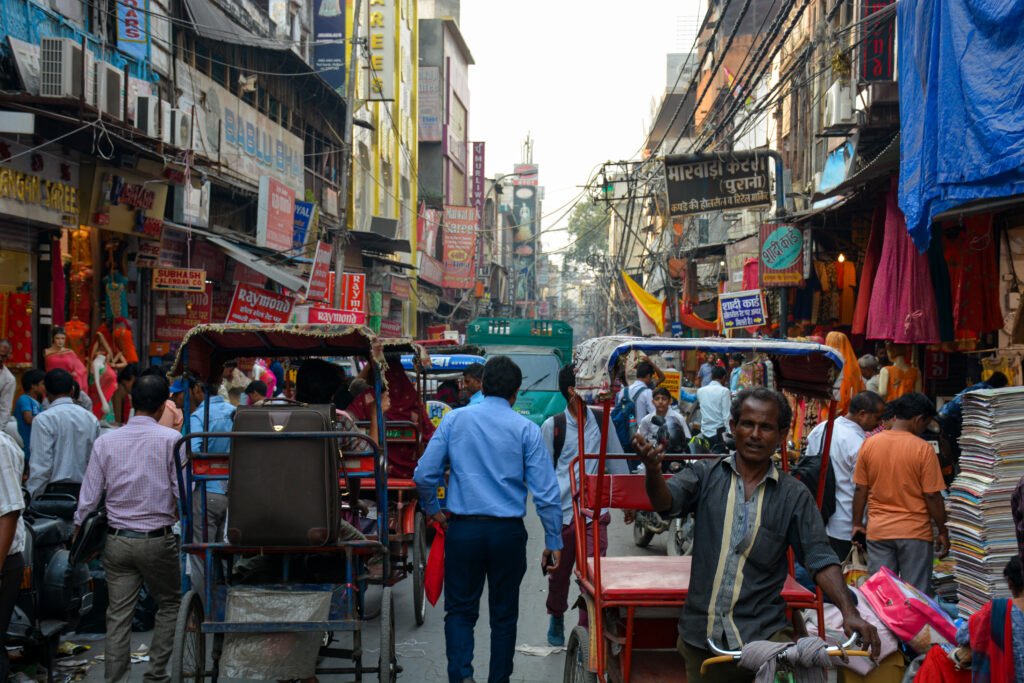
From here, the journey shifts into a new phase.
Once outside the mosque, I climbed into a tuk-tuk — the only way to navigate the narrow streets and alleys of Old Delhi.
Whenever I think of tuk-tuks, one scene comes to mind — from the marvelous The Best Exotic Marigold Hotel.
They arrive in Delhi and can’t find a taxi. Someone suggests a tuk-tuk.
“What is a tuk-tuk?”
Cut to the next scene: they are hanging on for dear life as the driver speeds through Delhi’s chaotic traffic like a maniac.
Any resemblance to reality is not a coincidence.
As the driver pushed through streets — or rather, alleys — packed with people, bicycles, motorbikes and street vendors displaying an endless variety of goods, I was being tossed around inside the tuk-tuk while the guide kept shouting instructions:
“Hold on tight.”
“Keep your hands inside.”
From time to time, the tuk-tuk bumped into something.
No one seemed to care — not the driver, not the person on the receiving end.
It felt like one of those amusement park rides that only the bravest dare to try.
Until it didn’t.
At some point, speed was no longer possible.
Old Delhi came into focus.
The density reached an entirely different level.
And the noise?
A constant mix of car and motorbike horns, loud music from shops, rickshaws, and people raising their voices just to be heard over it all.
The Pulse of Old Delhi
We left the tuk-tuk and continued on foot through Chandni Chowk — one of the oldest markets in India.
India in its rawest form had arrived.
A mixture of chaos, noise, history and intensity.
A full sensory experience.
Nothing quite compares.
We walked through narrow, crowded streets, each one seemingly dedicated to a specific type of product.
Eventually, we reached one filled with traditional women’s clothing.
Of course, I couldn’t resist trying one.

From time to time, the smell of spices drifted through the air — things I couldn’t even begin to identify.
We even hopped on a rickshaw to cover a larger area.
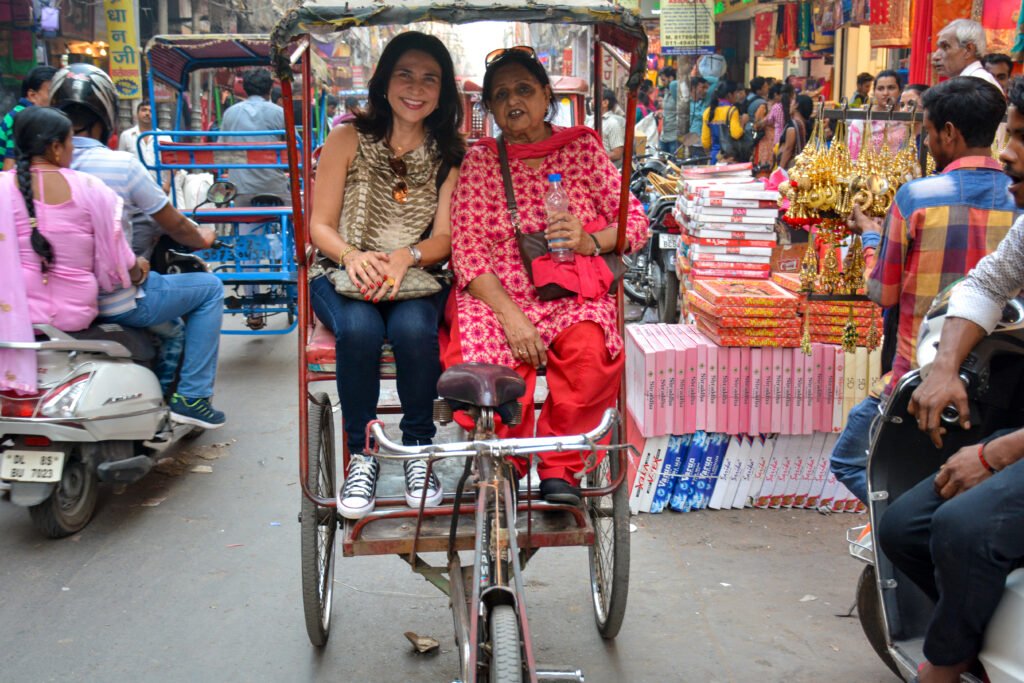
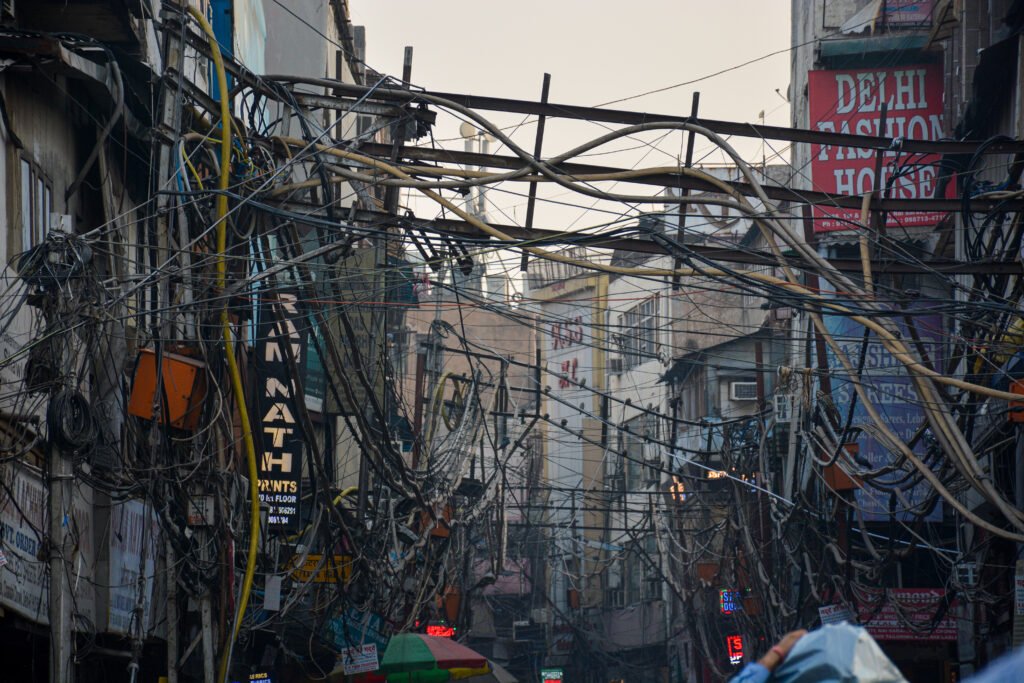
And then, something else caught my eye.
If Delhi’s residents have reliable internet — or any communication system that actually works — it must be nothing short of a miracle.
Even though I don’t believe in them, here it felt like the only possible explanation.
Above us, an impossibly dense web of tangled wires stretched across the sky.
It was intense — the kind of experience that could easily overwhelm.
The kind that makes you understand why India isn’t for everyone.
A Necessary Pause
To soothe the senses and ensure a good night’s sleep, after the Old Delhi tour, someone had the perfect idea: to leave the peaceful Raj Ghat for the end of the day.
On the way, the Red Fort brought back the now familiar architectural style, once again confirming how central Delhi had been to the Mughal Empire.
I arrived at Raj Ghat just as the sun was setting behind the monument. The temperature was pleasant, and the sky was painted in shades of blue and orange.
Raj Ghat is a serene memorial dedicated to Mahatma Gandhi.
The entrance sits slightly elevated, offering a view of the deliberately simple structure — a black marble platform with an eternal flame — set at the center of a vast, carefully maintained garden.
The complete opposite of Old Delhi — or of Delhi itself.
A place that invites reflection on peace and simplicity.
And somehow, they managed to create a space that gently leads your thoughts in that direction.
And just like that, the same city that overwhelms you finds a way to slow everything down.
A Taste of Paradise
Long story short, we loved it. My friend became obsessed with Indian food, and we even went back a second time before returning to Brazil.
One detail stayed with me: beneath the restaurant’s name, it read —
Delhi — London.
And that’s how I ended up there, in Delhi.
If it was good in London, in Delhi it felt close to paradise.
From the moment I arrived, the aroma did the honors, quietly inviting me inside.
Generous, golden pieces of meat, accompanied by an endless variety of sauces and sides made with spices that don’t even seem to exist in America.
The level of spice in those dishes isn’t for everyone — but I love it, and for me, it has never been a problem.
All of it served in a beautiful, cozy Indian setting.
Once again, I ate as if there were no tomorrow.
Akshardham Temple — Where Modern Feels Ancient
In Delhi, even modernity can feel like antiquity.
That was the impression I had while visiting Akshardham Temple.
✦ Footnotes from Elsewhere
Akshardham Temple, inaugurated in 2005, is one of the largest Hindu temple complexes in the world.Built using traditional techniques — without steel — it features thousands of hand-carved sculptures depicting deities, dancers, animals and scenes from Hindu mythology.
The security protocol was stricter than anywhere I had been before.
I had to leave my phone, camera and bag locked away before passing through an X-ray screening.
It wasn’t easy to fully take in the scale of it all — countless sculptures, columns, fountains, monumental domes and gardens arranged with striking precision.
The sheer size somehow makes all that abundance feel lighter — almost perfectly balanced.
At times, it even reminded me of visiting the Vatican.
The level of control, the organization, the almost immaculate cleanliness — all of it made the temple feel mesmerizing, but less spontaneous.
The Road to the Taj
Time to hit the road — destination: one of the New Seven Wonders of the World, the Taj Mahal.
To get there, a three-and-a-half-hour drive was required.
Not a problem for me. On the contrary.
Traveling by car in India feels like a premium version of a road trip.
The sheer number of cars, buses, motorcycles, tuk-tuks — and whatever hybrid versions they seem to invent — is surreal, to say the least.
Women of all ages, dressed in colorful traditional outfits, appeared here and there, often carrying large bundles balanced effortlessly on their heads.
Students in uniform walked to school, sometimes right in the middle of the road — on their own, without a single adult in sight.
Life in small villages passed quickly through the window.
People shopping.
Drinking tea.
Chatting.
Watching the road.
And then, suddenly — a motorcycle passed by carrying something the size of a house… along with a family of four.
Was this even real?
The laws of physics simply didn’t seem to apply there.
The Story Behind the Walls
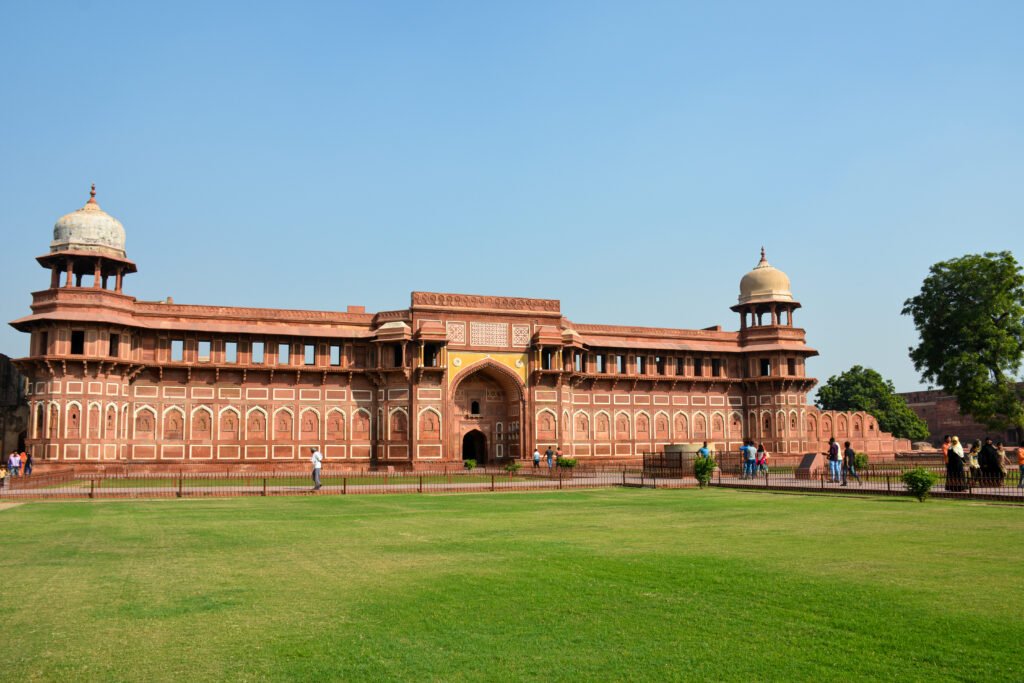
Once in Agra, our first stop was the Agra Fort.
To be honest, inevitably overshadowed by the Taj, I didn’t have high expectations for the visit.
I wasn’t dismissing its historical importance — I value places for that — but I wasn’t expecting something that would also be visually striking.
✦ Footnotes from Elsewhere
The Agra Fort, a UNESCO World Heritage Site, was the main residence of the Mughal emperors until the capital moved to Delhi.Built in the 16th century by Emperor Akbar and later expanded by his successors, the fort combines military strength with refined palace architecture in red sandstone and marble.It is also closely linked to the story of the Taj Mahal: Emperor Shah Jahan was imprisoned here by his son Aurangzeb and is said to have spent his final years looking at the monument from a distance.
Behind the towering walls, a different world unfolds — a collection of structures that vary in style and purpose.
The materials, however, remain surprisingly consistent: red sandstone or white marble, depending on when they were built.
Palaces and courtyards filled with decorated arches. Some spaces feature intricately carved marble that almost resembles lace. There is even a mirrored palace.
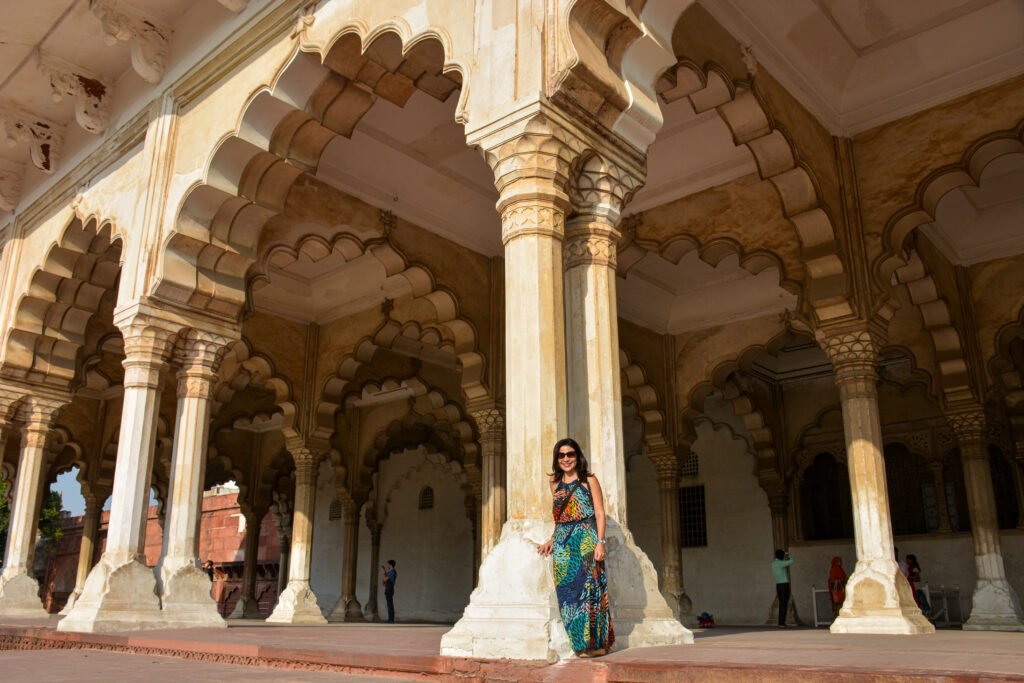
But what truly stands out is not the architecture — it’s the story behind one of those palaces.
After a violent struggle for succession, Emperor Shah Jahan was imprisoned there by his own son.
From that palace, he could see the Taj Mahal — the monument he had built for his wife.
It is said that, in the final years of his life, he spent hours looking out toward it from a tower, his gaze fixed on the place where she rested.
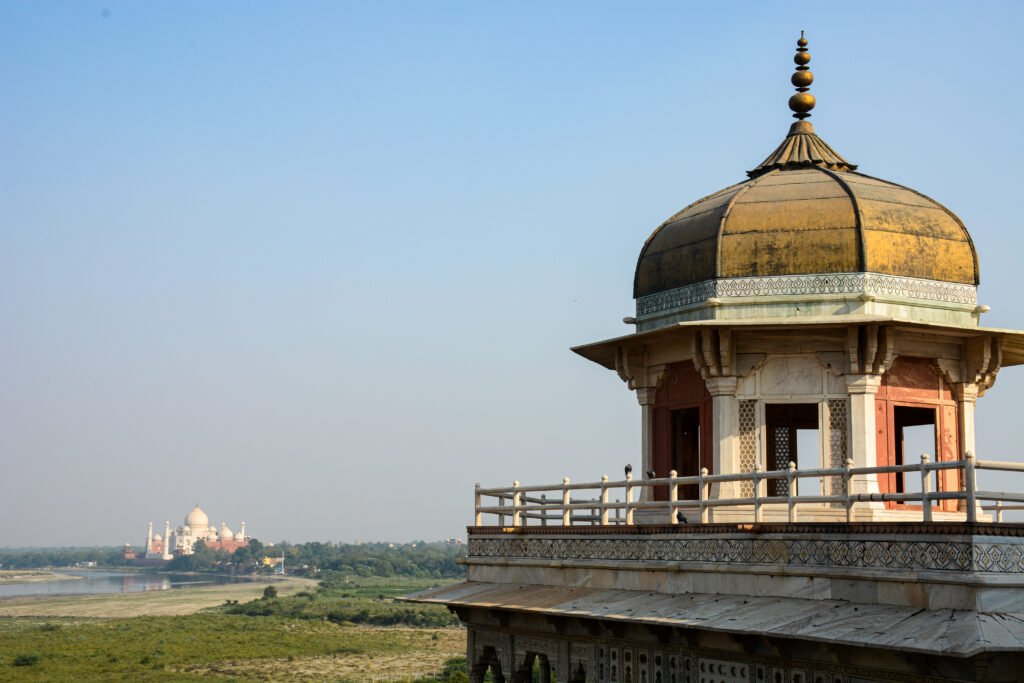
Eventually, he was buried beside her.
Some stories are impossible to compete with.
India kept shifting — never staying in just one place.
Taj Mahal — The Balance of It All
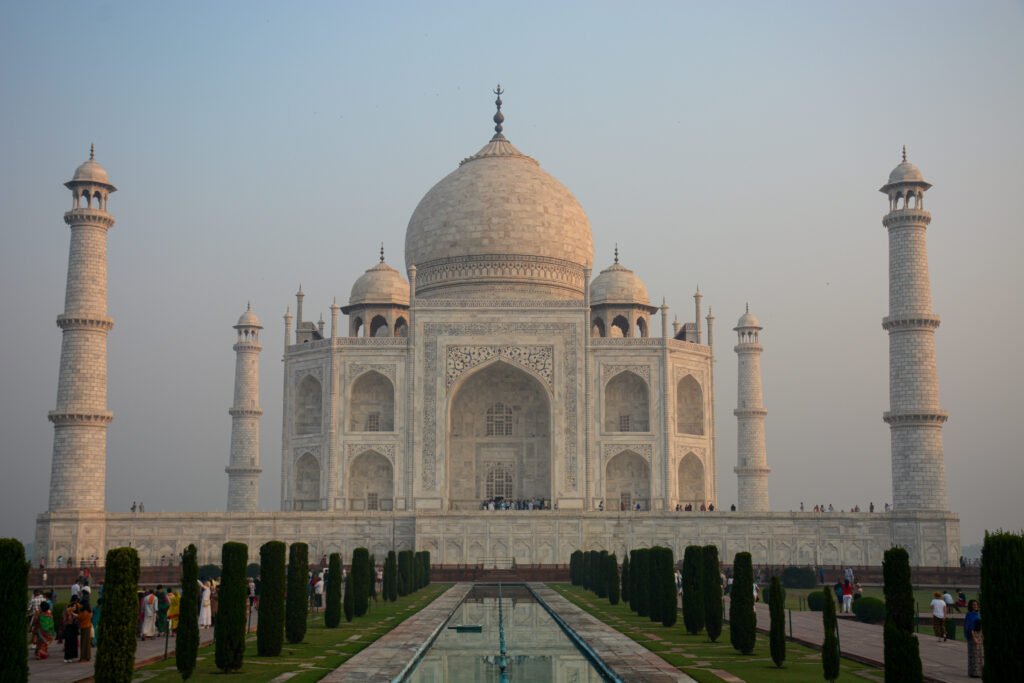
It was time to finally see the Taj.
It had been in my imagination for years — and, whether I liked it or not, I could feel a quiet sense of anticipation building.
A monumental gate, surrounded by a well-maintained garden, marks the entrance to the Taj.
Once inside, the Taj appears straight ahead, framed by the entrance gate.
Stepping forward, there it was — almost regal, in all its whiteness and grandeur.
By then, all the familiar narratives inevitably come to mind.
A monument built for love. A masterpiece of Mughal architecture.
But standing there, those labels feel almost secondary.
By then, I had stopped trying to define it.
India wasn’t something to simplify.
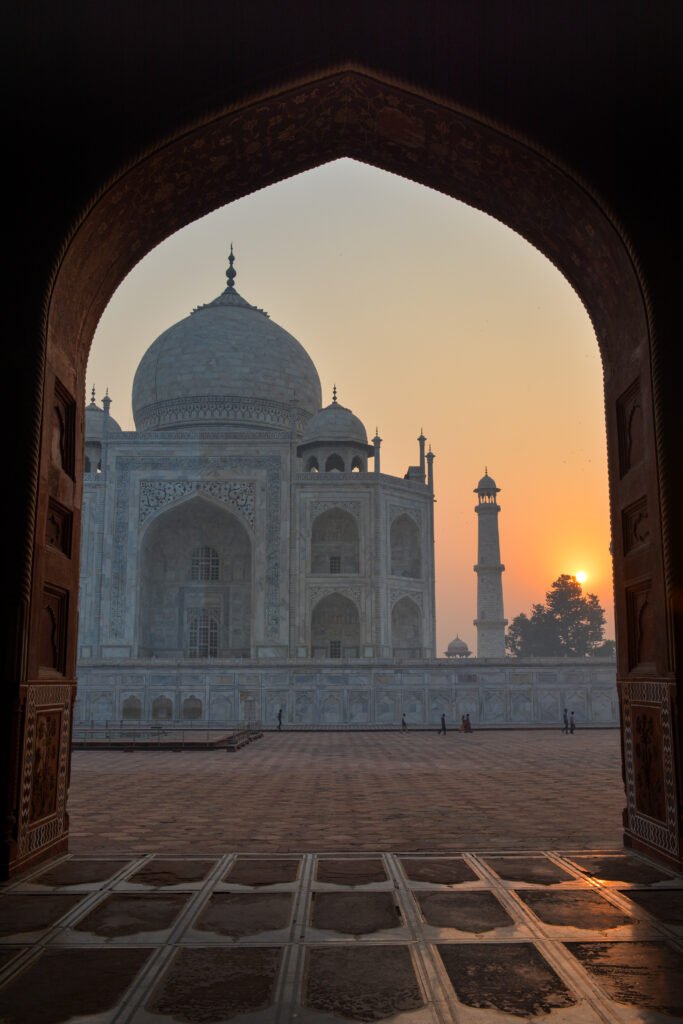
The light shifted, painting the scene in shades of orange and lilac — not by chance.
What truly stands out is something else:
an obsessive pursuit of balance.
Everything seems designed to align, to reflect, to mirror.
The gardens, the pools, the minarets, the gates — each element reinforcing the next.
Even the details follow that same logic.
Delicate floral patterns formed by semi-precious stones, cut into extremely thin slices before being inlaid into the marble, repeating with remarkable precision.
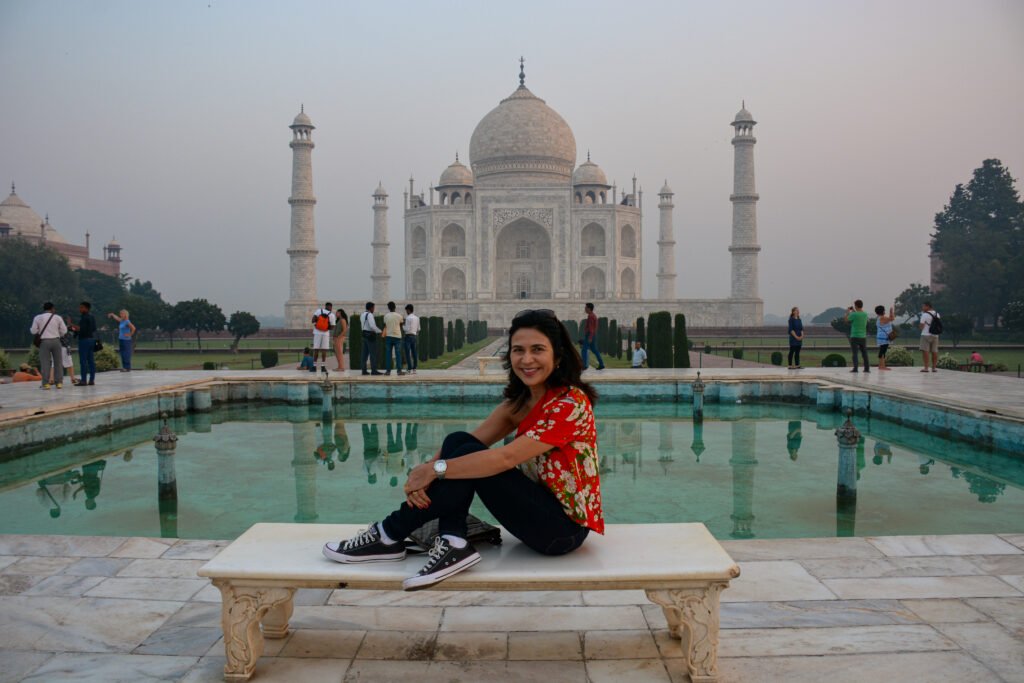
I walked around slowly, sitting from time to time on the benches scattered across the garden, letting the view change with the light.
It was crowded — but not uncomfortable.
And for the first time, I noticed something different:
I wasn’t surrounded only by Indians anymore.
The next morning, before sunrise, I was already back.
I had seen it in the golden light of the evening.
Now I wanted to see what the morning would bring.
It turned out to be a foggy morning. Visibility was limited, but the fog eventually lifted, revealing the Taj once again.
On one side, a mosque.
On the other, a nearly identical structure — built not for worship, but for balance.
A perfect mirror.
Well — mission accomplished.
It is perfectly symmetrical.
But more than that,
it is unforgettable.
Fatehpur Sikri – A City Left Behind
Fatehpur Sikri — the former Mughal imperial capital — lies on the way between Agra and Jaipur, my next destination.
It is known for having been built from scratch as a fully planned city — which makes it all the more paradoxical: meticulously designed, yet abandoned only fourteen years after its foundation for something as basic as water.
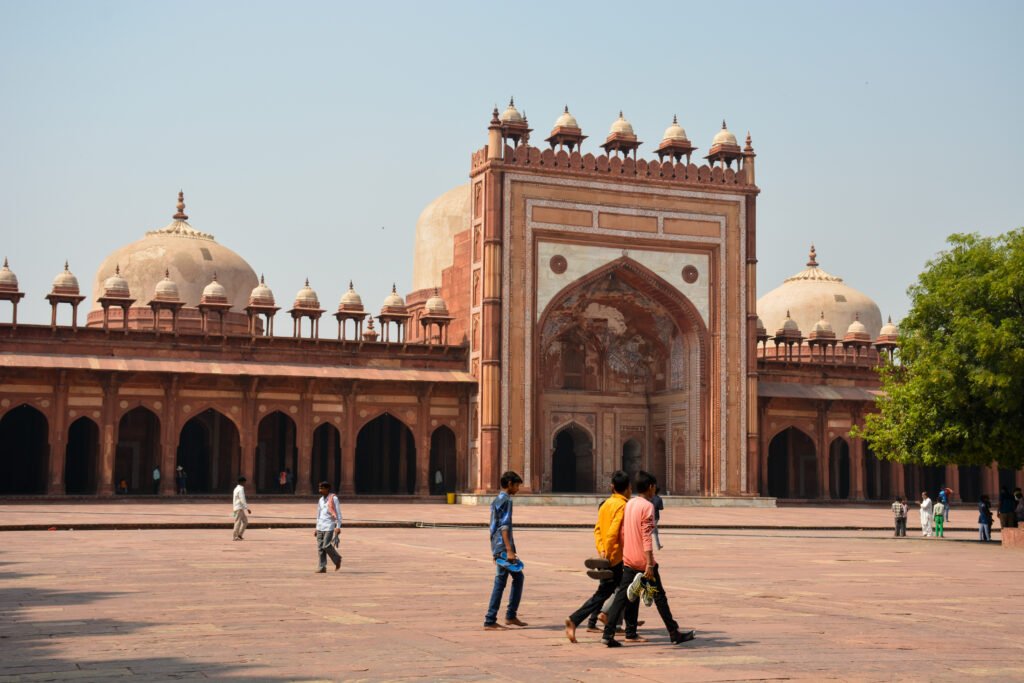
The entire complex was built mainly in red sandstone. Less focused on intricate marble carvings, it feels more solid than delicate.
That solidity feels almost out of place against the void.
The emptiness is almost tangible.
More than a city, it feels like a set left behind after filming ended.
It is as fascinating as it is unsettling.
Jaipur — Between Celebration and Chaos
Walking away from Fatehpur, we spent a while on the road before arriving in Jaipur in the late afternoon — stepping into Rajasthan, the land of the Rajputs.
✦ Footnotes from Elsewhere
The Rajputs are a group of warrior clans from northern and western India, particularly associated with Rajasthan.From around the 8th century onward, they ruled a number of kingdoms known for their fortified cities, palaces and a strong code of honor centered on loyalty, bravery and lineage.Even after the rise of the Mughal Empire, many Rajput rulers maintained a degree of autonomy through alliances, leaving a lasting cultural and architectural legacy across the region.
As we made our way to the hotel, I noticed that the usual noise and crowded streets felt even more chaotic than before.
That’s when I was reminded that the following day was Diwali — already turning the traffic into something that demanded monk-like patience.
It felt like Christmas Eve in Brazil.
People bumping into each other, voices and laughter cutting through the air, shops buzzing, selling tiny oil lamps, fireworks, string lights, garlands and flowers — competing with vendors who simply spread their products across the streets.
One thing, however, stood out: rows and rows of vibrant colored sweets — mithai — carefully arranged and meant to be shared as gifts.
Passing through that madness brought me a familiar feeling: as if everything had been left to the very last moment.
✦ Footnotes from Elsewhere
Diwali, also known as the Festival of Lights, is one of the most important celebrations in Hinduism, symbolizing the victory of light over darkness and good over evil.
It is most commonly associated with the return of Lord Rama to his kingdom after exile, when lamps were lit to guide his way home.
Today, millions of oil lamps and candles illuminate homes, streets and temples across India — turning the festival into a powerful visual expression of renewal and hope.
The next morning, Diwali — and the Pink City itself — seemed to compete for my attention.
The city’s pink color dates back to a visit by the Prince of Wales, when Jaipur was painted to welcome the future British king.
The color, associated with hospitality, became such a defining feature that it is still preserved in the Old City today by law.
From its strategic position, the Amber Fort protected the city — and, for a moment, offered some distance from the Diwali hustle and bustle.
At least from afar.
Getting closer revealed something different: elephants “sharing” the narrow road leading up to the gate with pedestrians.
Agra and Amber Fort share several elements — the halls of public and private audience, the Palace of Mirrors, and their dual role as both palaces and forts.
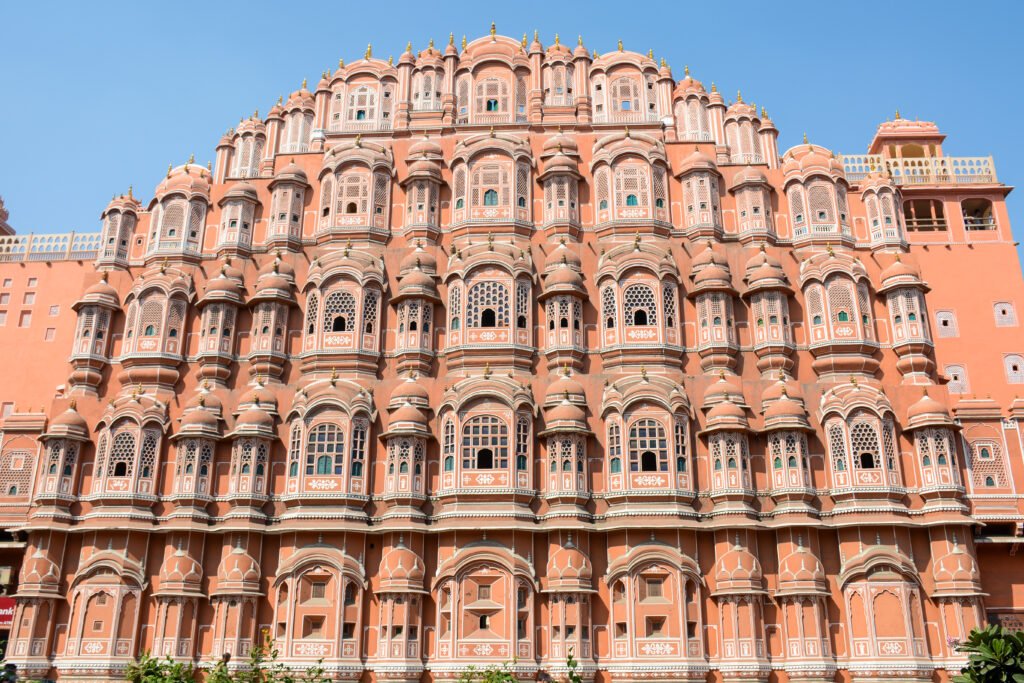
On the other hand, the Hawa Mahal — with its iconic facade — could not be compared to anything I had seen before.
Almost lace-like in its level of detail.
This elaborate structure was designed to allow the women of the court to look outside — through its nearly 900 small windows — without being seen.
Its shape — higher at the center and lower at the edges — is said to be inspired by Krishna’s crown.
As the day went on, the streets sank deeper into the Diwali atmosphere, and moving from one place to another became increasingly difficult.
By the time I arrived at the City Palace, I wasn’t sure it would still be possible to continue the itinerary.
But I wasn’t going to give up that easily.
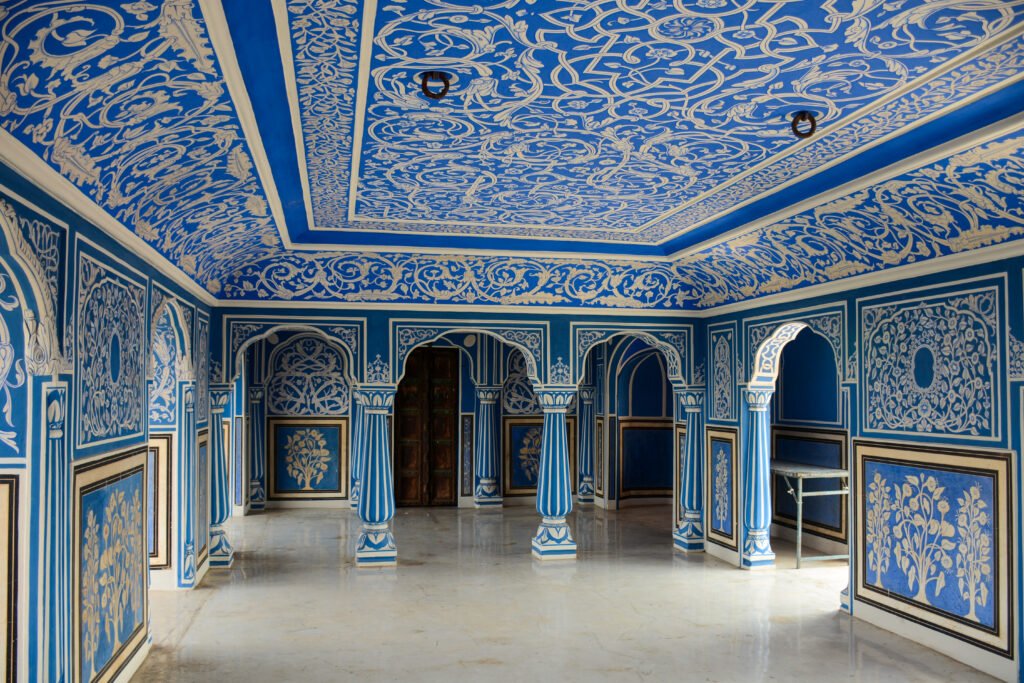
The palace has a singular private space – Chhavi Niwas Hall – I had seen on social media, beautifully painted in intense blue from top to bottom.
And I was really looking forward to seeing it.
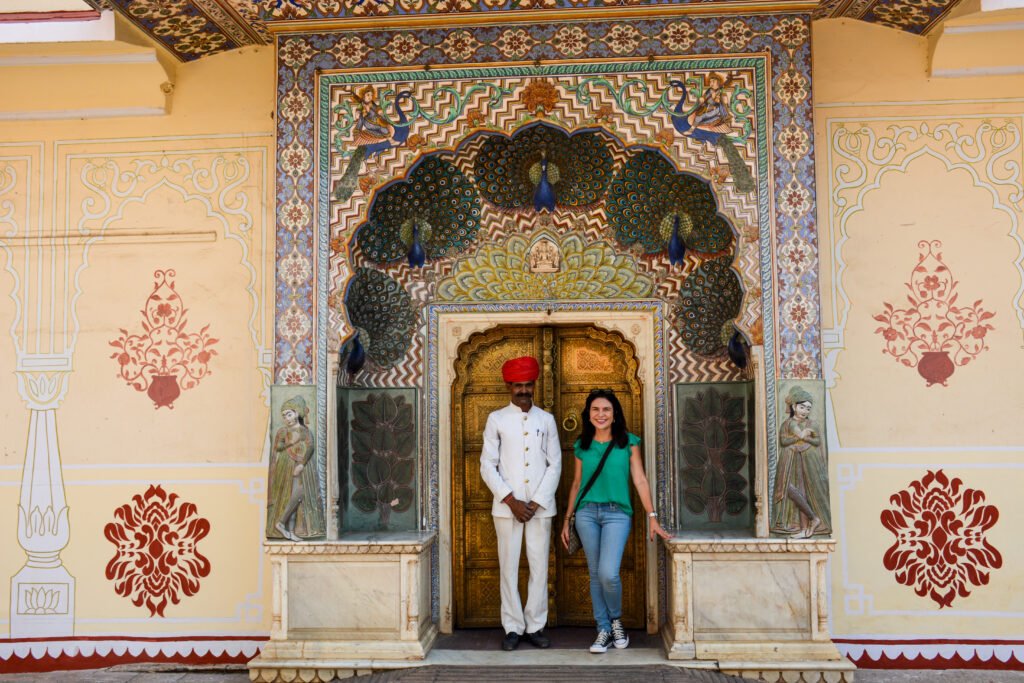
Yet, the four gates separating the public area from the private quarters almost made me forget about it.
The paintings followed the same style, but each gate had a distinct theme, connecting the palace to elements of nature.
After taking a few photos, I found it strange that my guide was heading in the opposite direction, away from the gates. I assumed the entrance to the interior must be somewhere else.
Then he mentioned we were moving on to the next stop.
What?
And what about the interior? What about that room that looked like heaven?
He looked confused and asked, “I’m sorry… do you want to go inside?”
“Of course. Why? Is it closed?”
“No… it’s just very expensive.”
Well — it wasn’t. After all, expensive would have been missing the chance to see it after coming all this way.
To this day, I’m not sure if it was that — or the rush of Diwali — that almost made me miss it.
And I can’t even imagine how I would have felt if I had.
The room was fascinating. The motifs were delicately painted in white — and even the color itself felt refreshing, after so much red and pink.
The last stop of the day was Gaitore Ki Chhatriyan — the royal cenotaphs of Jaipur’s maharajas.
A marble-domed pavilion was built for each of them.
Nothing about the place feels funerary.
On the contrary, the quiet atmosphere and the delicacy of the structures create the feeling of walking through a garden.
Here, size and refinement become a language of power — the more important the ruler, the more elaborate the cenotaph.
Ajanta & Ellora Caves
One of the most unexpected moments of the trip came later — in a place I had never even heard of before.
Ajanta & Ellora Caves — India’s Hidden Masterpieces
Mumbai — A Different Kind of Chaos
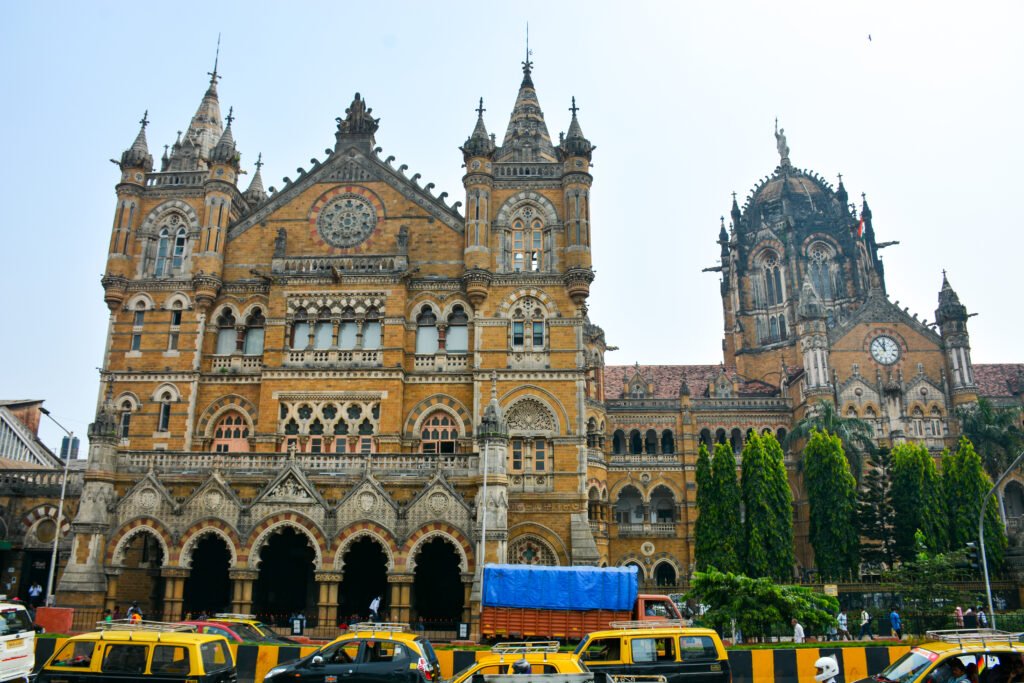
Mumbai is known as the financial and cultural heart of India — and also as a place where extremes meet: poverty and wealth, tradition and modernity, luxury and simplicity.
The pace is insane.
Yet, it feels different from Old Delhi.
There, the rhythm is rooted in tradition — narrow streets, tuk-tuks, motorbikes and endless crowds.
In Mumbai, it feels closer to cities like New York or London — fast, intense — but carrying a different kind of weight.
I arrived at my hotel at the beginning of the night. The lobby was full and buzzing.
After a while, I finally made my way to the elevator, where two other guys were already inside.
Out of nowhere, a group of girls started taking photos of them.
Who the hell are these guys?
Later, I noticed people asking for autographs and selfies. I had to ask.
It turned out that the most important national cricket championship was taking place in Mumbai — and the local team was staying at the same hotel.
Then the waiter said something that made it all click:
“They’re doing really well — they just had a big win.”
Cricket is a national passion in India — much like football in Brazil.
And I had absolutely no idea.
That quiet fan frenzy became part of the hotel’s routine.
Inside the elevator, they smiled at me — probably amused that I wasn’t asking for autographs or selfies.
From the top of the hotel, the glow of the streetlights along the arch-shaped Marine Drive made it clear why it is known as the Queen’s Necklace.
Mumbai feels like a mosaic — different pieces constantly shifting, yet somehow forming a whole.
As I was leaving the following day, it felt appropriate to pass under the Gateway of India, facing the Arabian Sea.
The Gateway once served as a symbolic ceremonial entrance to India, reserved for high-ranking officials.
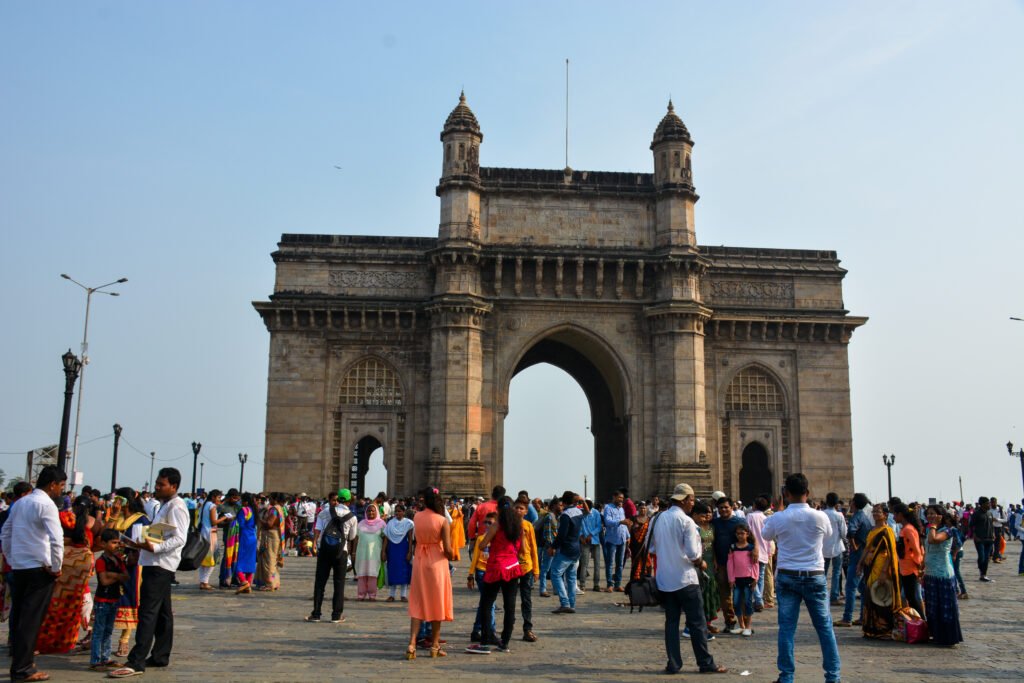
Right in front of it stands the Taj Mahal Palace — not in the same colonial style.
Yet the hotel is not known for its architecture alone.
In 2008, it became the center of a terrorist attack that held guests and staff hostage for days — making headlines around the world.
Not far from there, the Haji Ali Dargah — a Muslim shrine set on a small island, reached by a narrow causeway — feels worlds apart.
Around it, the skyline continues to rise, increasingly filled with skyscrapers.
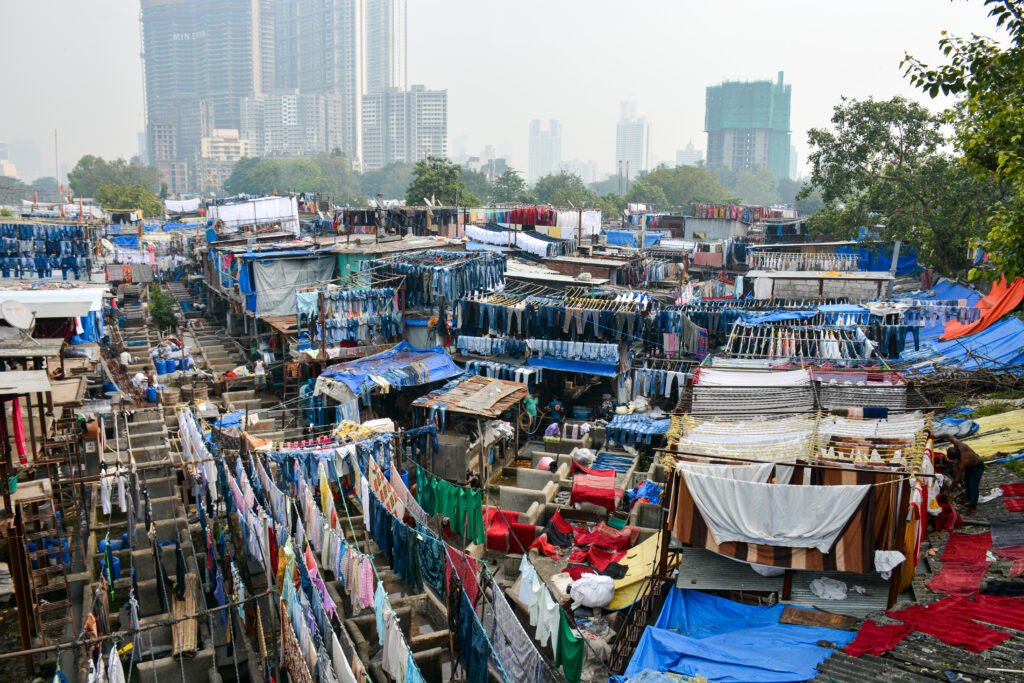
And, at the other end of that contrast, there is Dhobi Ghat — an open-air laundry on a colossal scale.
Each family owns a station where they manually wash for residents, hospitals, restaurants and hotels.
Rows of clothes hanging to dry stretch as far as the eye can see, raising an inevitable question: how do they ever keep track of it all?
If there is one thing Indians care about, it is chili.
And how much it matters became clear in Lalbaug.
Unlike the other markets, this one felt unexpectedly calm.
But looking closer, there were lines of women patiently waiting as vendors manually ground spices.
Not only for freshness — but because each had her own precise blend, turning it into something unmistakably personal.
India is, indeed, intense.
It felt as if all my senses were being tested day after day.
Just as my mind began to adjust to a place or a moment, everything would shift again — in an instant.
It’s not a place for those seeking calm or quiet landscapes.
And that’s exactly why I loved it.
Looking back, that feeling I couldn’t quite explain made perfect sense.
India confirmed what I had already started to discover — that the places that move me most are often the ones that feel far less familiar.