Part of my Slovenia travel stories, this journey moves from the lively streets of Ljubljana to the alpine landscapes of Lake Bled and Bohinj, through vineyard-covered hills and all the way to the Adriatic coast. Along the way, it became a story about wine, shifting borders and the people behind some of Slovenia’s most remarkable experiences.
The Beginning of a Very Long Wine List
A few years ago, my travel agent suggested Slovenia after one of her friends came back completely in love with the country. She immediately thought of me.
The idea stayed somewhere in the back of my mind until I started planning my 2026 trips.
At first, Slovenia seemed to be all about Lake Bled — and, honestly, that alone already looked worth the visit.
But the deeper I looked, the more the country revealed itself: a captivating capital, wine regions, castles, dramatic caves and even a small coastal area.
At some point, visiting Slovenia stopped feeling like an idea and became an obvious decision.
On May 1st, we finally arrived.
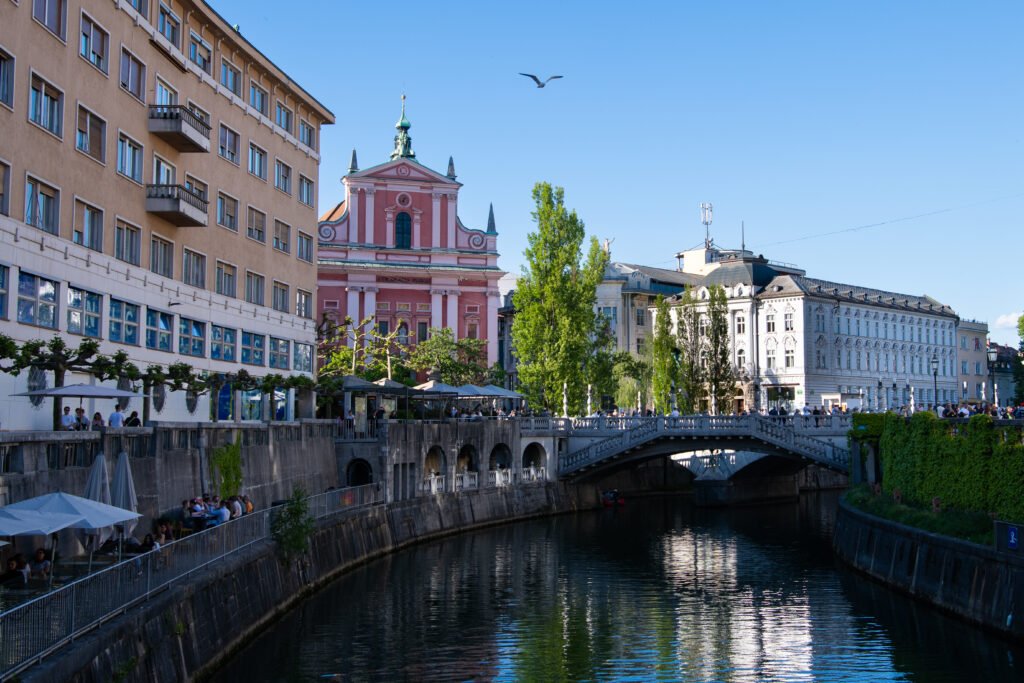
Ljubljana was buzzing with people crossing the many bridges over the Ljubljanica River.
The river is the heart of the capital and, along its banks, people were relaxing with a drink, chatting or simply watching life go by from one of the many bars lining the water.
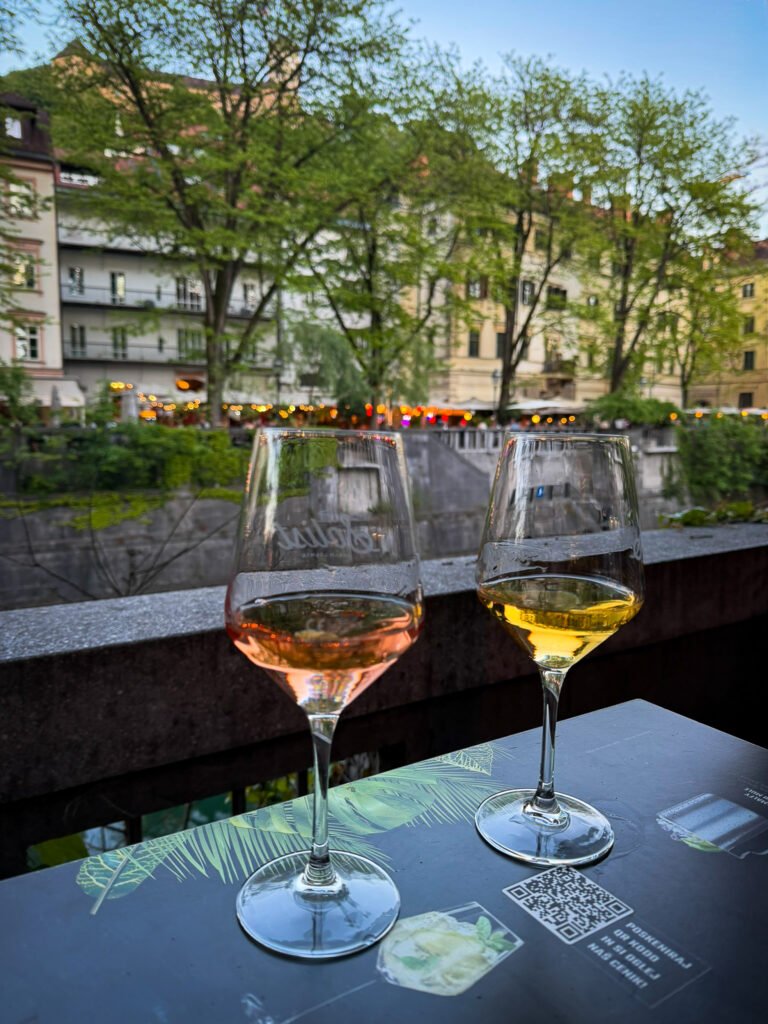
As we walked past crowded terraces and overflowing wine glasses, one thing became impossible to ignore: Slovenians love wine and, judging by the number of white glasses on the tables, they clearly have a favorite.
Mirela and I were starving and thirsty — not for water — so we chose a restaurant facing the river for a long lunch. At that moment, we simply wanted to be part of that scenery, soaking in the atmosphere and the incredible view.
That was exactly when something that would become a trademark of this trip started. Mirela told me that during a trip to Bordeaux she had kept a list of every wine she tasted and the scores she gave them and suggested we should do the same in Slovenia.
At that point, we had absolutely no idea where that list would lead.
Once hunger was taken care of, curiosity took over and we went for a walk.
Away from the river, we wandered through narrow cobblestone streets, baroque churches and lively squares while the medieval castle overlooked the city from its strategic position above the hill.
We would have time to properly explore everything the next day.
That afternoon was only for first impressions — and we were already loving everything we had seen so far.
To end the day, we sat at a wine bar by the river and, at some point, decided to pair the wine with a traditional Slovenian sausage from a huge street stall we had spotted earlier.
It felt like the perfect pairing for our first day in Slovenia.
Dragons, Castles and Wine Bars
Ljubljana is a city to explore on foot. Its historical center is compact and almost every attraction is within walking distance of one another.
A blue sky and pleasant temperatures gave the city an almost summery atmosphere and we were excited to start exploring.
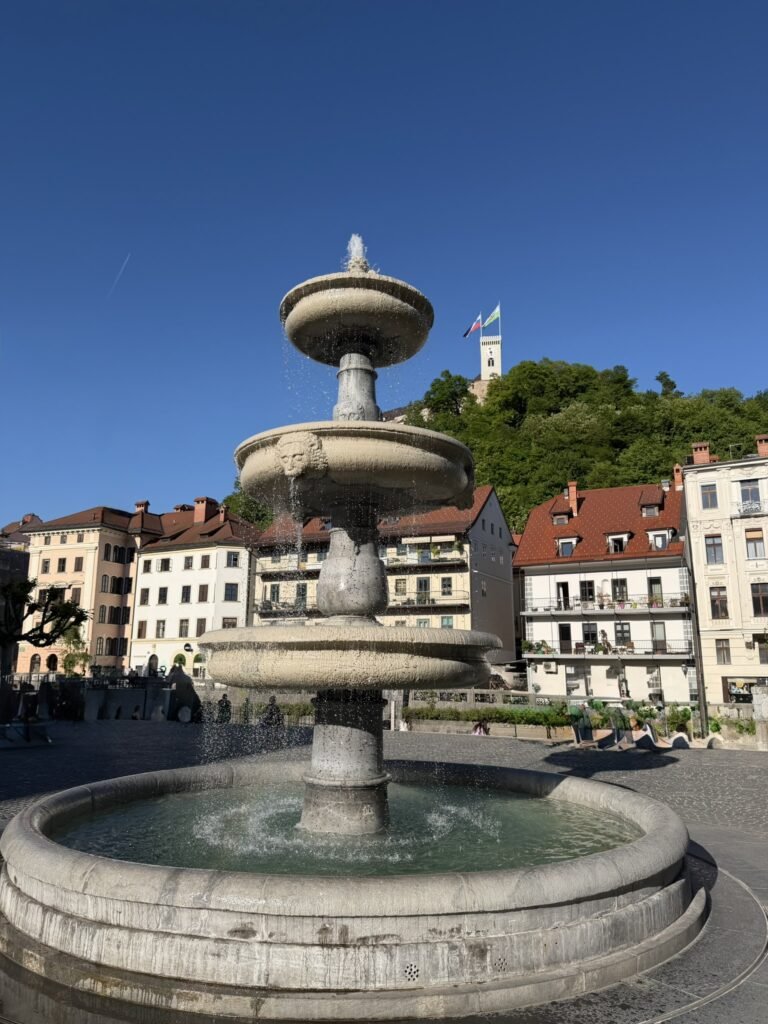
A few minutes after leaving our hotel, we found ourselves right in the middle of Prešeren Square, surrounded by the statue of the poet the square is named after, the Franciscan Church of the Annunciation and its striking pink facade, the famous Triple Bridge and even the stall selling the delicious sausage we had tried the day before.
I briefly considered another one, but we had just had breakfast.
While browsing through traditional souvenir stores, we started noticing something curious — dragons everywhere.
Then we ended up in front of an entire store dedicated only to dragons. Every size. Every color.
✦ Footnotes from Elsewhere
The dragon is the symbol of Ljubljana and appears all over the city — from its famous bridge to its flag and souvenir shops. According to Greek mythology, Jason and the Argonauts passed through the area while returning from the Black Sea and supposedly fought a dragon in the marshes near present-day Ljubljana. Over time, the creature became linked to the city itself.Another interpretation connects the dragon to Saint George, the patron saint traditionally associated with defeating dragons and representing the triumph of good over evil
Eventually, we decided to make the climb up to the castle. After trying Slovenian wine, we skipped the funicular, as it had become crystal clear that we would need every calorie burned possible to keep our weight under control.
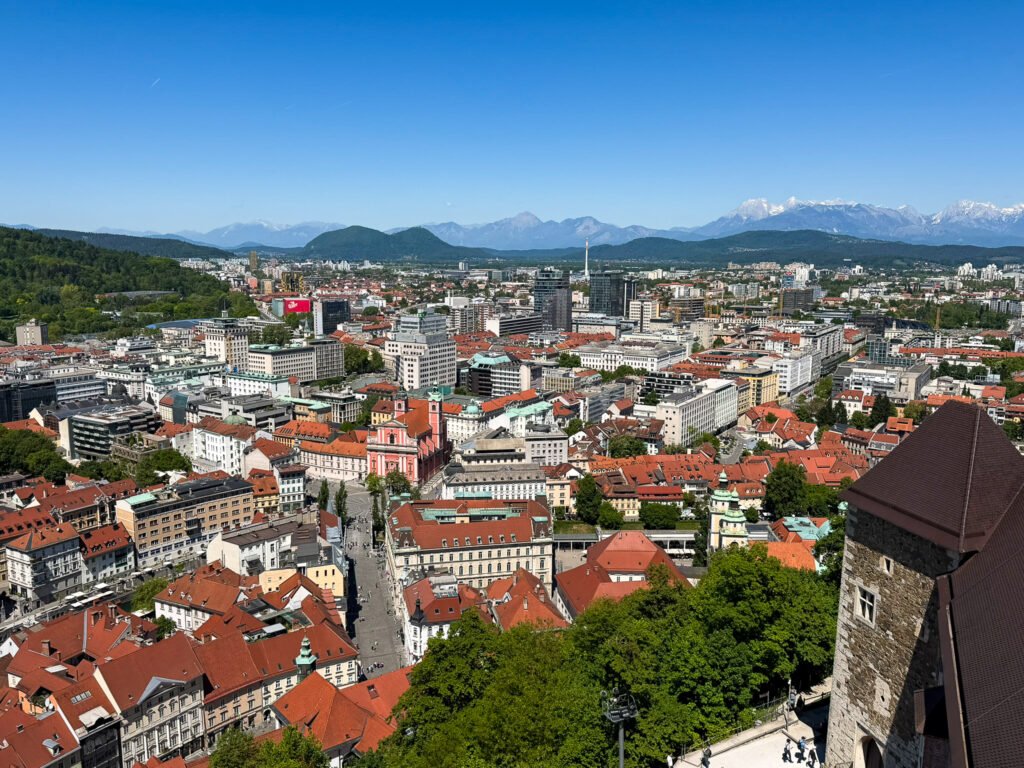
There is not much of the original medieval castle left nowadays besides the walls and towers. Much of the space has been transformed into exhibition halls, restaurants and cultural venues.
In fact, we would have our last dinner in Slovenia there a few days later, inside one of the towers.
We walked along the walls to enjoy the lovely view and, while moving from one exhibition to another, I suddenly heard Mirela:
“Catia, I saw a cork.”
I immediately turned around to check it out.
It was indeed a cork.
A very big one.
As it turned out, the benches outside a wine bar were shaped like giant corks.
Pause for a few glasses. Of course.
When we first passed in front of the St. Nicholas Cathedral, it was closed for Mass, so we decided to try again later.
The masterpiece serving as its bronze doors should have prepared me for what was waiting inside.
The moment I stepped into the cathedral, the ceiling immediately stole my attention.
It was entirely covered by a mesmerizing fresco.
My mind immediately went to the Church of Saint Ignatius of Loyola in Rome and its spectacular ceiling fresco, famous for the illusionist technique that makes people swear it is three-dimensional.
Right in front of the St. Nicholas Cathedral sits Klobasarna and its famous Carniolan sausage.
On a Saturday, the giant sausage hanging above the entrance was much harder to spot than I had expected, hidden behind rows of packed tables spilling out from restaurants and bars into the street.
It really is delicious. No doubt about it.
The surprise, however, was the horseradish served alongside it. I had never realized how perfectly it pairs with mustard.
Mirela decided to rest while I spent the rest of the afternoon with the difficult task of deciding whether to walk along the riverbank or through the streets surrounding it.
Not an easy decision, I have to say. I simply couldn’t decide which part of the city was the most enchanting.
Between espressos and window shopping, I eventually crossed the Dragon Bridge and wandered through the Central Market, with its elegant colonnade stretching alongside the river and creating a seamless connection between the water and the surrounding architecture.
When Mirela came back, I was relaxing at a wine bar, already completely in love with the city.
As the sun started setting, we wandered a little farther from the old town and, somewhere along the way, chose a restaurant that looked traditional and packed with locals for a Slovenian dinner paired with wine.
I wasn’t feeling tired.
Just anxious.
The next day, we would finally see Slovenia’s most iconic landscape — Lake Bled.
It Just Wasn’t Fair
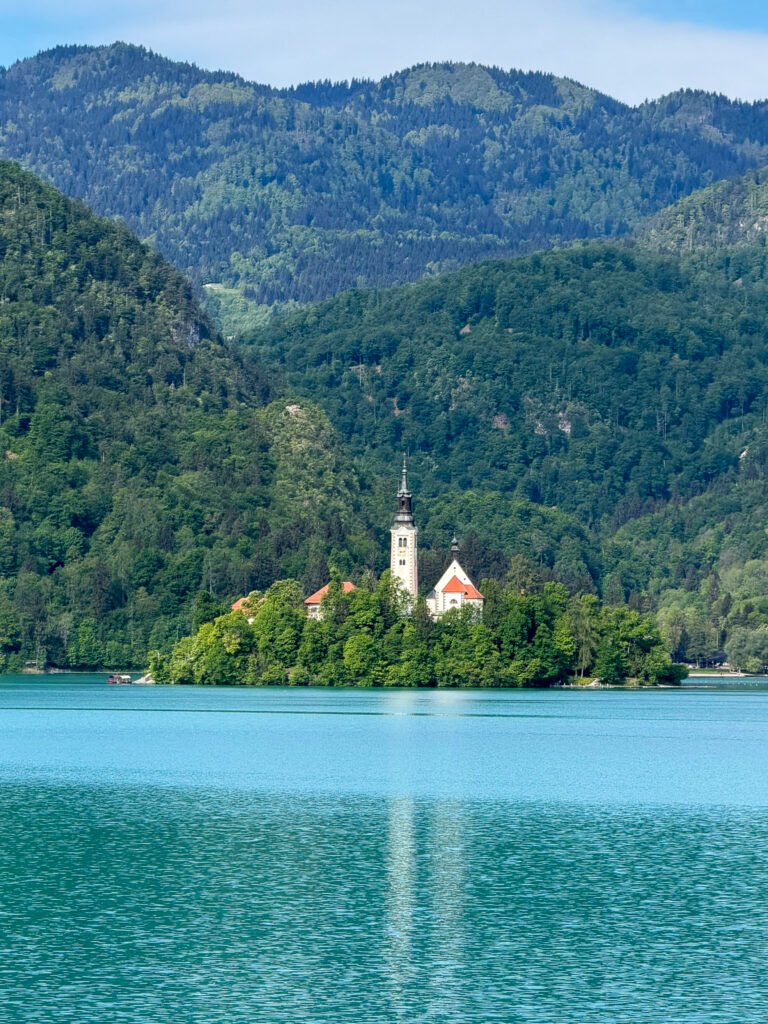
And then, it was time for Slovenia’s most famous landscape: Lake Bled.
After picking up the car, we hit the road and, within minutes, the scenery shifted from a European capital to quiet neighborhoods and finally to a classic Alpine landscape.
Small villages lined the road, almost always marked by the tower of a church, while mountains with snow still covering their peaks framed the horizon.
The architecture changed as well. Houses became larger, with long triangular rooftops designed to prevent snow buildup during winter.
It felt like another country altogether, yet the beauty somehow kept intensifying.
Eventually, the road became narrower and more winding. Then, for a split second, I caught my first glimpse of the lake.
And just like that, it disappeared again, only to reemerge a few minutes later in full frame, surrounded by what felt like an endless stretch of green.
At that point, we no longer knew whether to focus on the GPS, the traffic or the outside landscape, which looked more like a painting than real life.
By the time we arrived at the hotel, it was difficult to pay attention to anything the reception staff was saying.
All my senses were focused on the lake. There was no space for anything else.
✦ Footnotes from Elsewhere
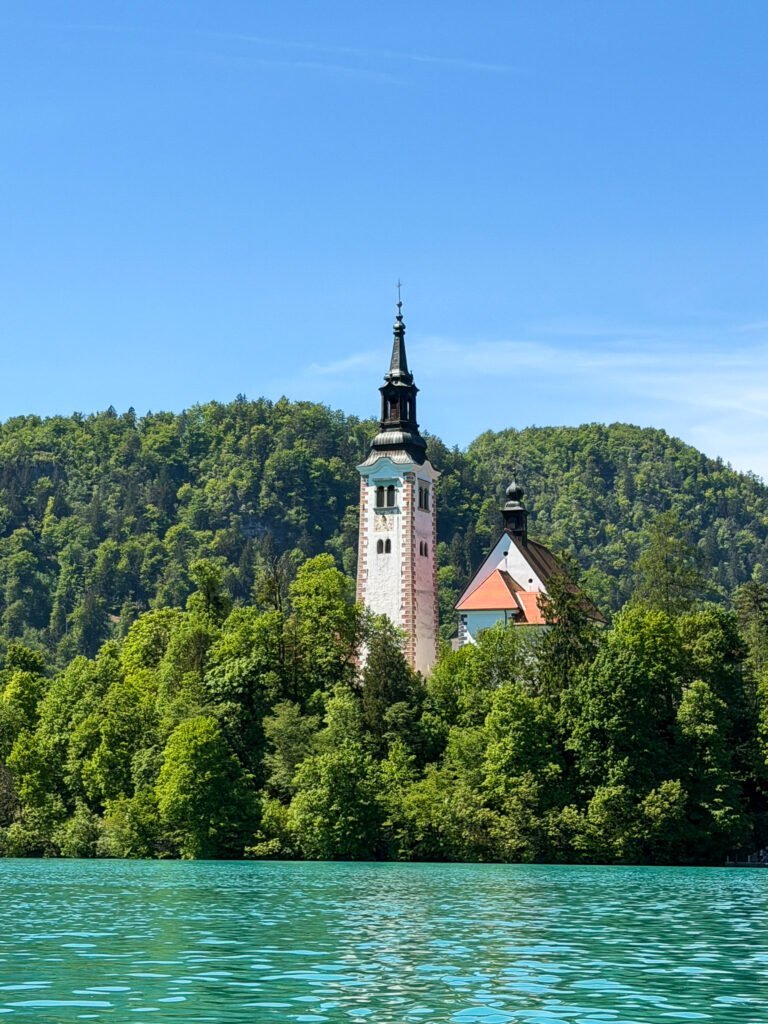
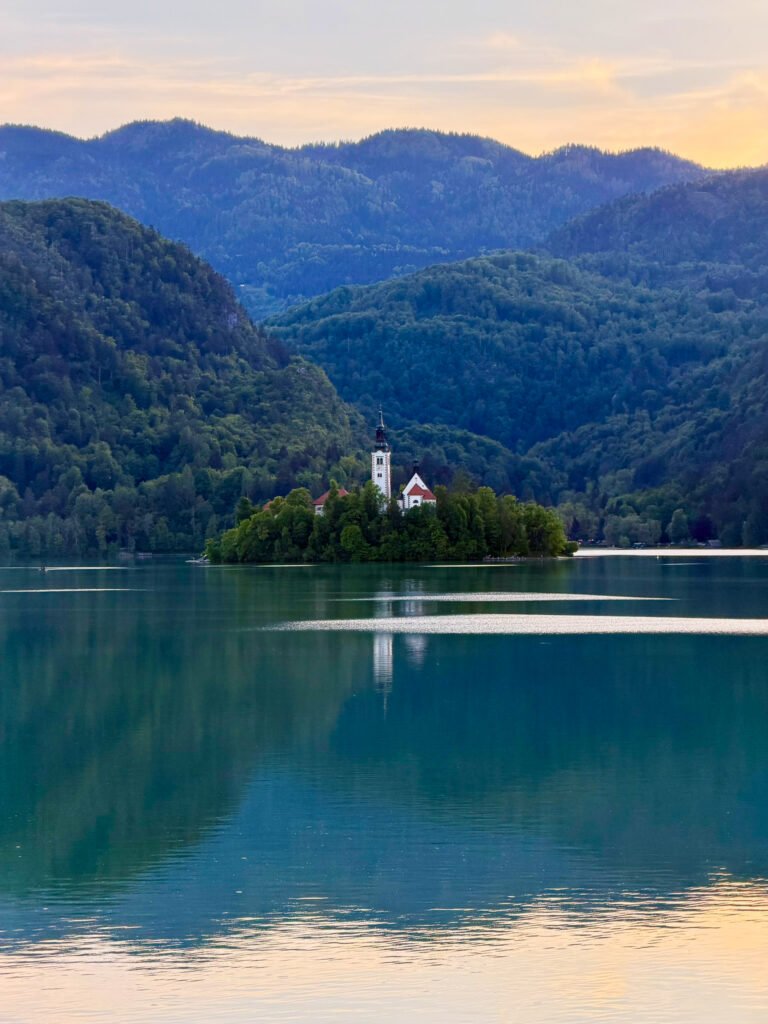
The church on Lake Bled’s tiny island is probably Slovenia’s most iconic image. The Church of the Assumption sits on the only natural island in Slovenia and has been a pilgrimage site for centuries.
Long before Christianity arrived, the island was already considered sacred and dedicated to a Slavic goddess of love and fertility.
Today, visitors reach the island by traditional wooden boats called pletna and climb the famous 99 stone steps leading to the church.Inside the church, visitors can ring the “wishing bell” — a tradition believed to make wishes come true.
We took the traditional pletna across the lake to reach the Church of the Assumption. The alternative was paddling ourselves.
No, thanks.
It was the first — and last — time I noticed signs of mass tourism in Slovenia. The boats only operate as round trips and wait for just 20 minutes on the island.
I had imagined sitting there for a while, admiring the view with a nice glass of wine. There was no time for that.
By then, I regretted not knowing how to paddle.
Still, it was enough time to ring the bell and notice something else: the color of the water was changing dramatically.
When we arrived in Bled, the lake was dark green. Now, it had turned into a vivid emerald shade that somehow made the landscape look even more surreal.
The higher the sun climbed, the greener the water became.
I was secretly glad the church was tiny so I could quickly go back to admiring the scenery outside.
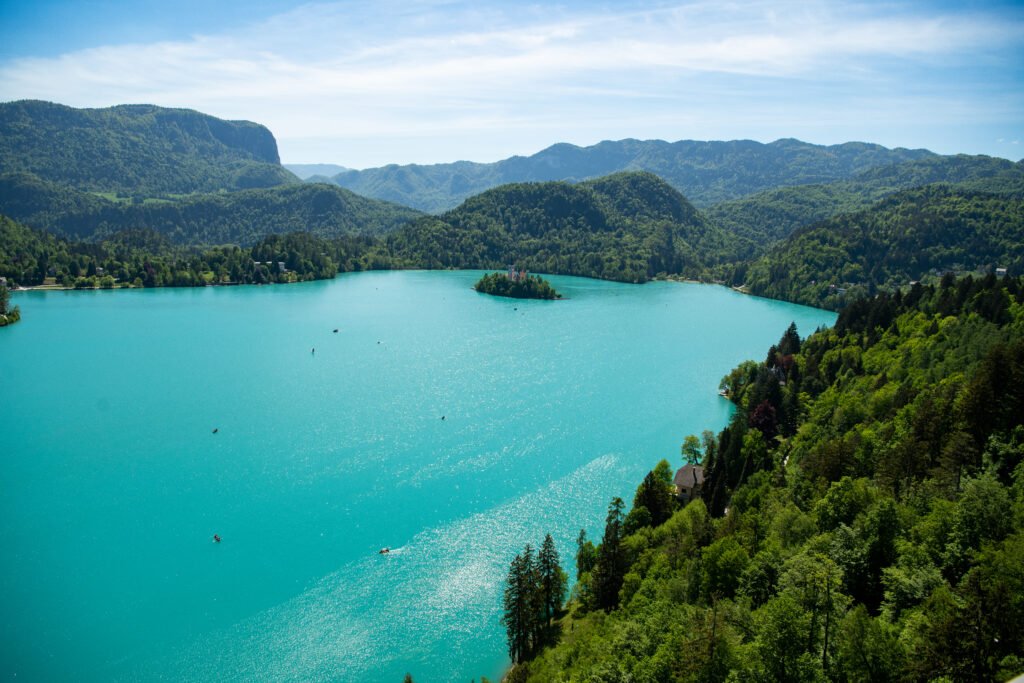
The region also has its own signature dessert — the famous Bled cream cake — and we found the perfect table facing the lake at the café where the dessert’s most famous version was first created. Of course, that view also called for a few glasses of wine.
The dessert itself — crispy puff pastry, vanilla custard cream, whipped cream, another layer of puff pastry and powdered sugar — was lighter and more delicate than I expected from its ingredients.
Still, I wouldn’t call it life-changing.
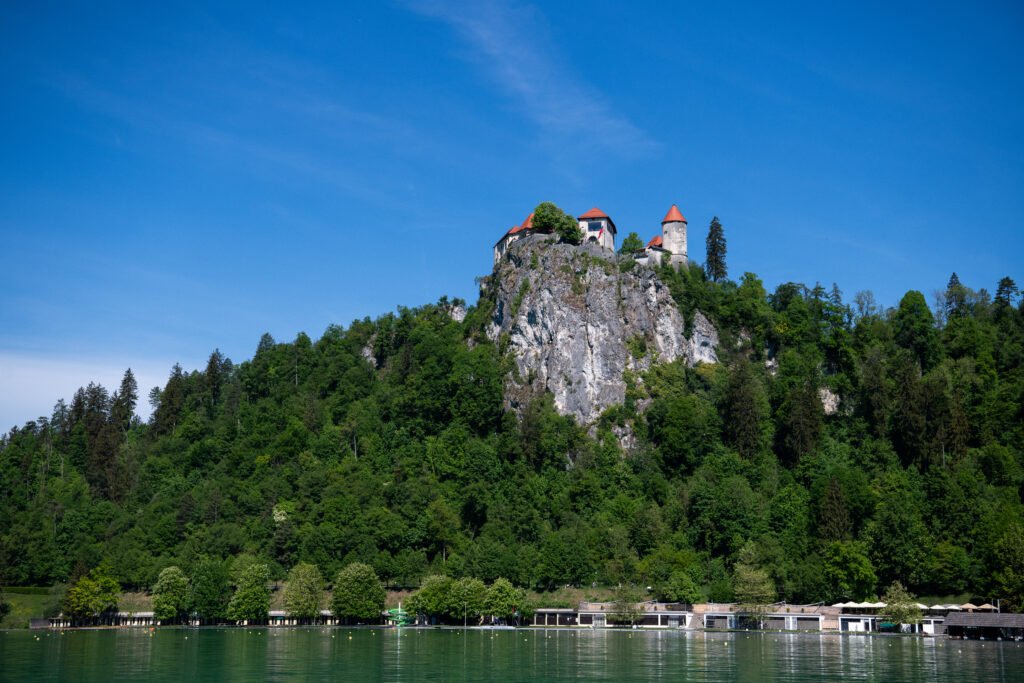
At some point, I noticed Mirela staring at the castle.
I said:
“Yep, it’s time to deal with that climb — no funicular this time.”
We slowly made our way around the lake and eventually reached the base of the path leading up to the castle.
The surrounding vegetation sheltered the steepest part of the climb and, before long, we were inside the castle like two children arriving at Disneyland for the first time.
Bled Castle is considered the oldest castle in Slovenia and stands perched on top of a steep cliff. After centuries of renovations and transformations, it no longer looks like the stereotypical medieval castle many people might imagine.
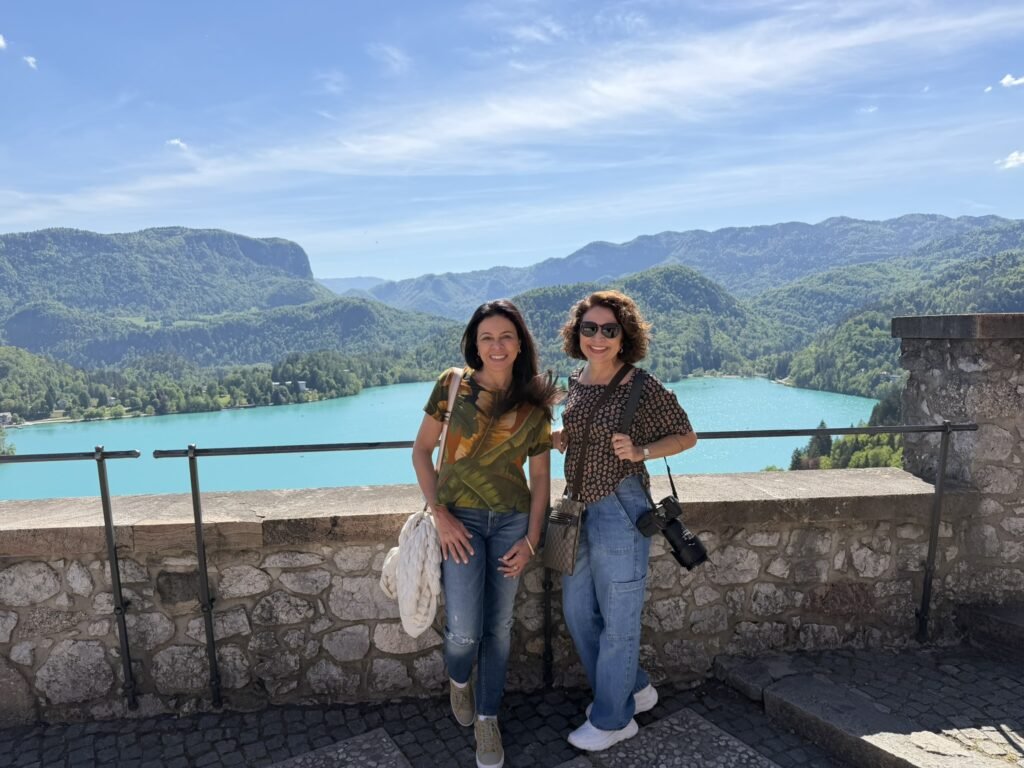
But who cares?
Even if it were the most impressive castle in the world, it would still have to compete with the immense emerald-green lake, the tiny island and its church, the dark forest surrounding the water and the Julian Alps framing everything in the background.
It just wasn’t fair.
Our hotel was located on the shore of Lake Bled, directly facing Bled Castle.
From that privileged spot, we watched the lake slowly turn dark green again as the sun disappeared behind the castle.
At some point, I asked if we were going out to look for a place for dinner.
“Not a chance. Just order some food. No other place is going to have this view.”
Bohinj – Where Slovenia Turned Wild
It was really hard to leave Lake Bled behind. But we were only just beginning our journey through Slovenia and I forced myself to move on from the lake.
Funny enough, another lake was waiting for us that same day. But first, we stopped at another spot just 20 minutes away — Vintgar Gorge.
When we arrived, we read that there were two trail options: a 1.6-kilometer path alongside the emerald-green river or a longer 4-kilometer route.
The walk through the gorge itself was pleasant and fairly easy. Somehow, however, we ended up on the 4-kilometer route, climbing through a forest before opening and closing gates through farmhouses along a trail running beside a hill.
That little misunderstanding made our stay at Lake Bohinj shorter than we wanted.
Bohinj has a much wilder atmosphere than Bled. Less polished, calmer and more connected to nature.
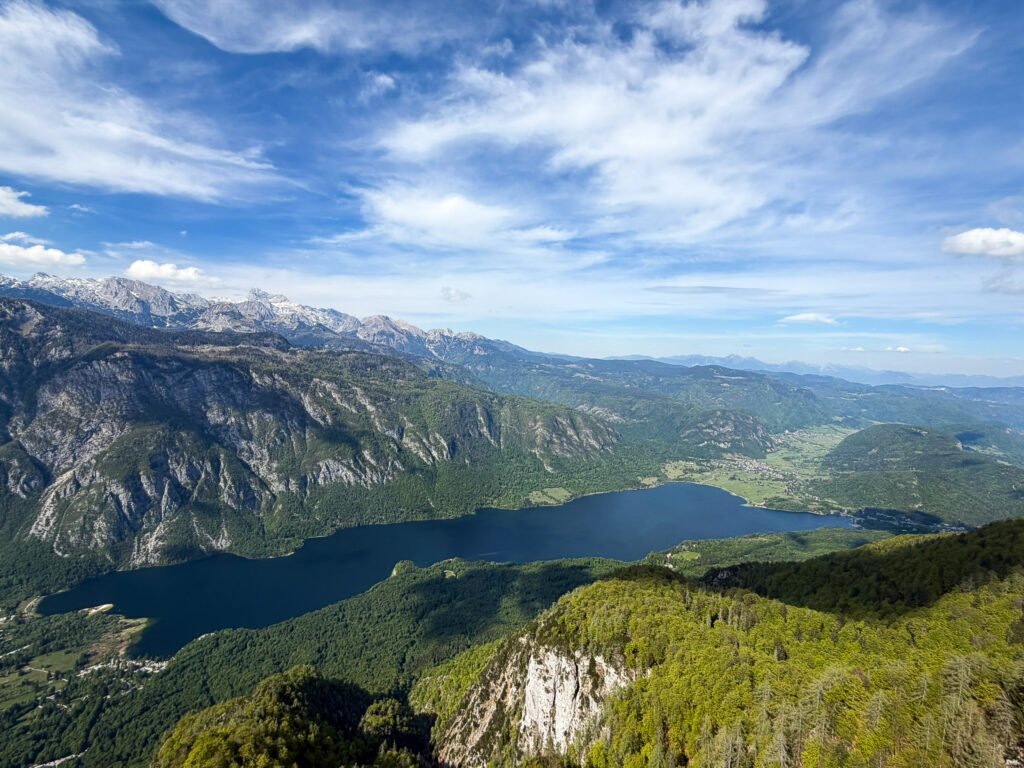
We managed to take the cable car up to Mount Vogel for panoramic views of the Julian Alps and Triglav National Park.
The enormous lake below added an extra layer of beauty to the landscape and, for the first time during the trip, I felt truly inside the Alps that until then had only appeared far away in the distance.
Ironically, the cable car station itself was surrounded by snow.
A curious detail: we had both packed completely wrong for the trip and I fully blame the weather apps. We had brought far too many cold-weather clothes while Slovenia, until that moment, had felt almost like summer.
In a moment of desperation, we bought T-shirts from a surf shop — definitely not our style — and ended up wearing them that day.
As luck would have it, standing next to the snow in our random surf-shop T-shirts, it turned out to be the one moment we actually needed the coats we had packed — and we didn’t have any of them with us.
Not only because we were freezing, but also because we were starving, we finally made our way back to the car.
Since we no longer had enough time to properly explore Lake Bohinj, I asked ChatGPT to suggest a nice place by the lake for a late lunch.
And it found the perfect spot — almost floating on the water and serving great pizza.
Europeans were comfortably sitting outside. But it was slightly chilly for the Brazilian surfers, so we found a table inside next to a window overlooking the lake and, later, the sunset.
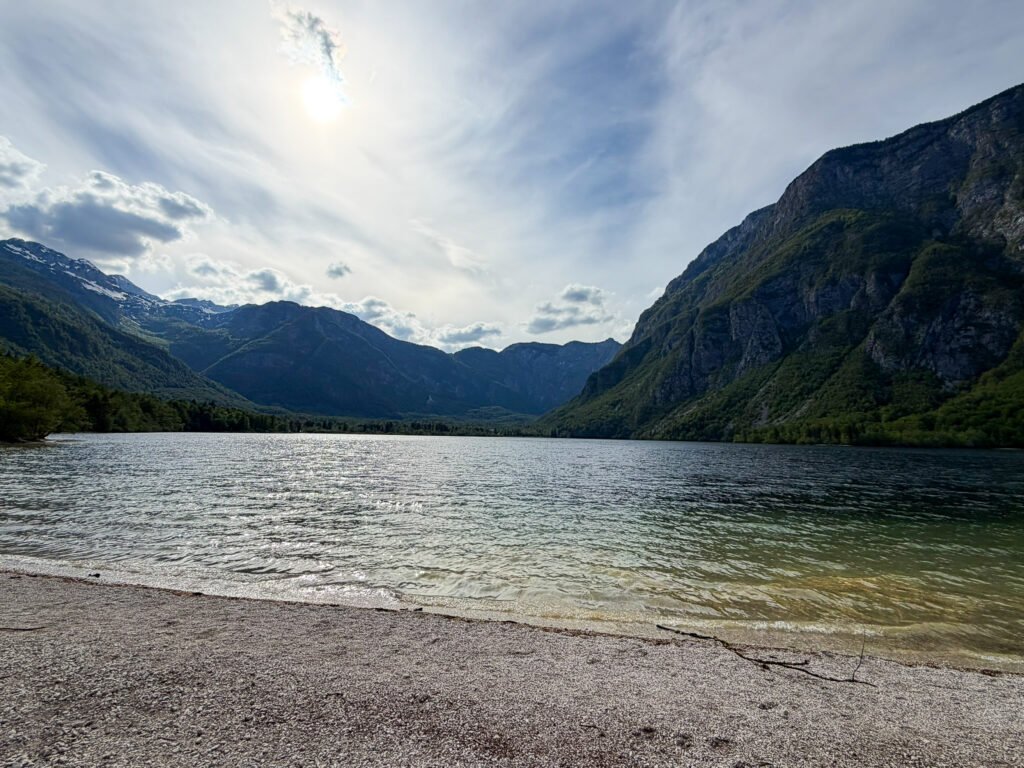
The perfect spot to slow down and take in Bohinj’s atmosphere.
Before darkness fully settled in, we got back on the road.
And it turned out to be the best decision ever.
We still had a long drive ahead of us to Goriška Brda, the wine region we had been looking forward to the most.
We set the GPS to Goriška Brda and started driving.
After a while, I noticed the road had turned into an endless uphill path — narrow, winding and cutting through a dense pine forest.
Nothing else in sight.
No villages.
No lights.
Not even cars passing by us.
Strange.
Trying not to sound worried, I eventually told Mirela that I thought we had accidentally taken some kind of secondary road. Goriška Brda should have had much more traffic — especially since the region also connects to Italy — and yet we hadn’t seen a single truck either.
And the road just kept climbing forever.
Predictably, the internet signal disappeared near a tiny village lower down the mountain. We realized that only after accidentally driving into someone’s garage and entering the wrong side of an extremely narrow road running beside a steep drop.
To my surprise, the driver who had to reverse so we could escape our mistake didn’t curse at us.
Honestly, he would have had every right to.
It felt like an eternity before we finally arrived.
I think it was already past 10 p.m. when we reached the winery where we would be staying.
The owner had seen our arrival through the security cameras since he had already gone home for the night. He admitted he had been worried and had even sent us a message earlier.
But suddenly, everything felt much better after the welcome glass of wine he offered us.
I would only realize what had happened a few days later.
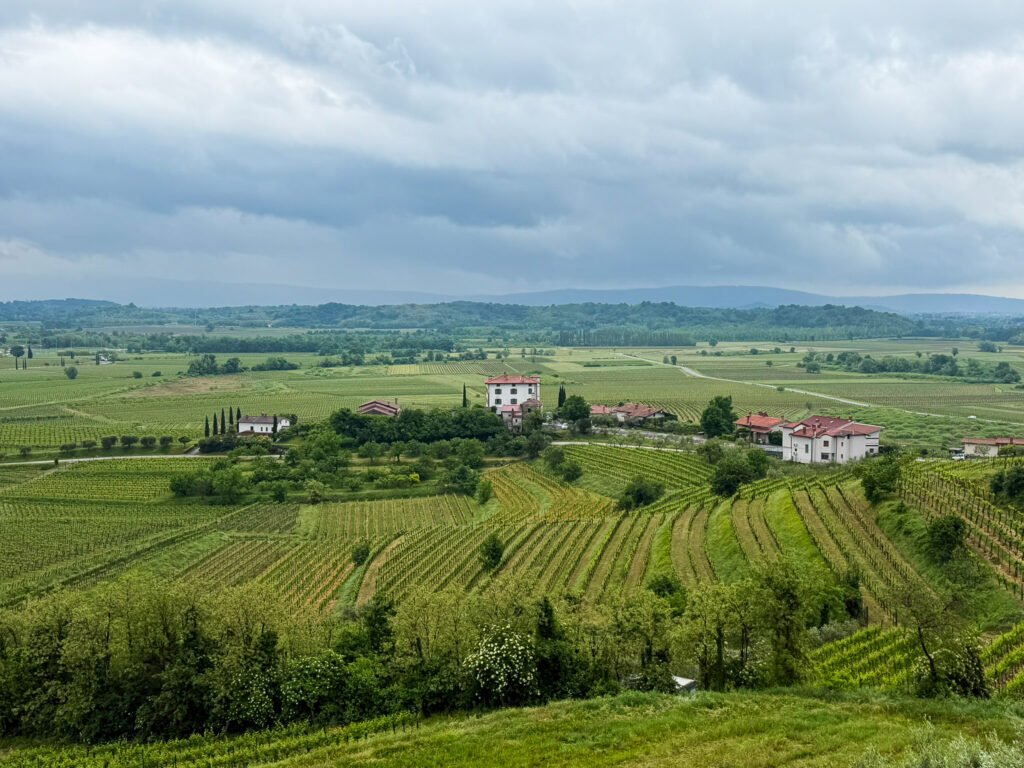
The following morning, we woke up to a landscape of small houses emerging between perfectly lined green vineyards.
The Problem with Wine Tasting in Slovenia
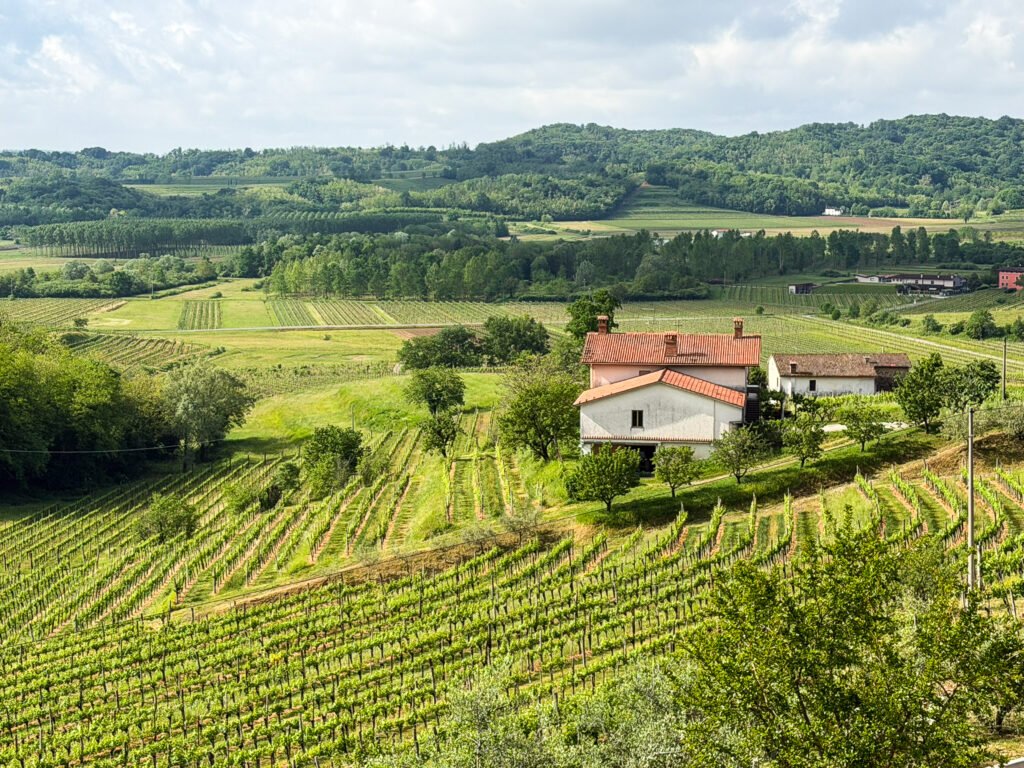
Not only had the landscape changed, but the sky had turned grey and the rain was clearly on its way.
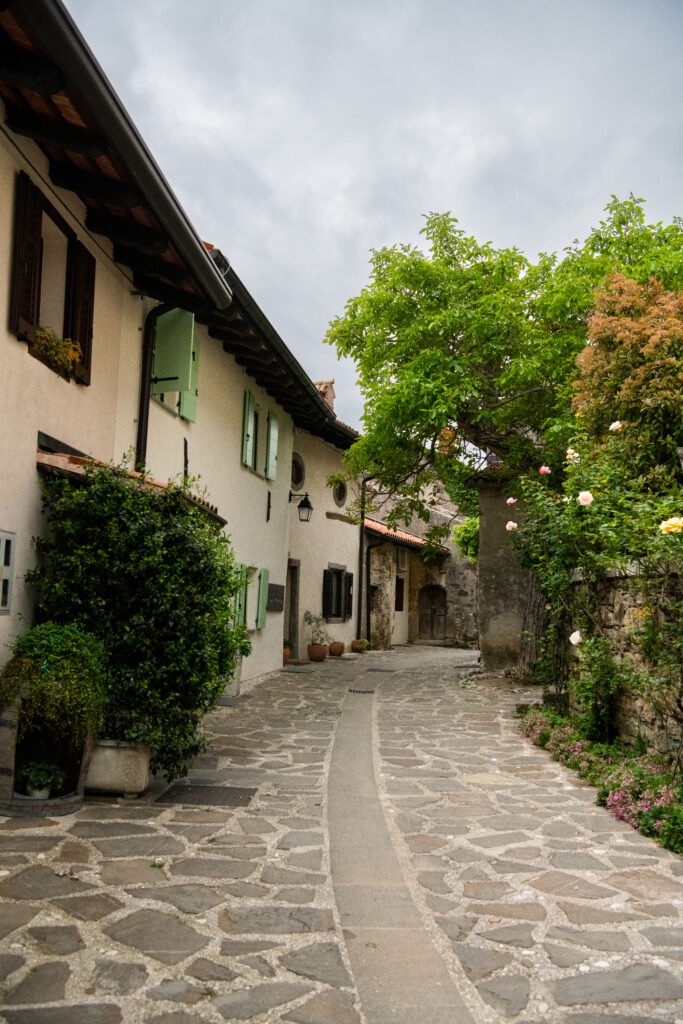
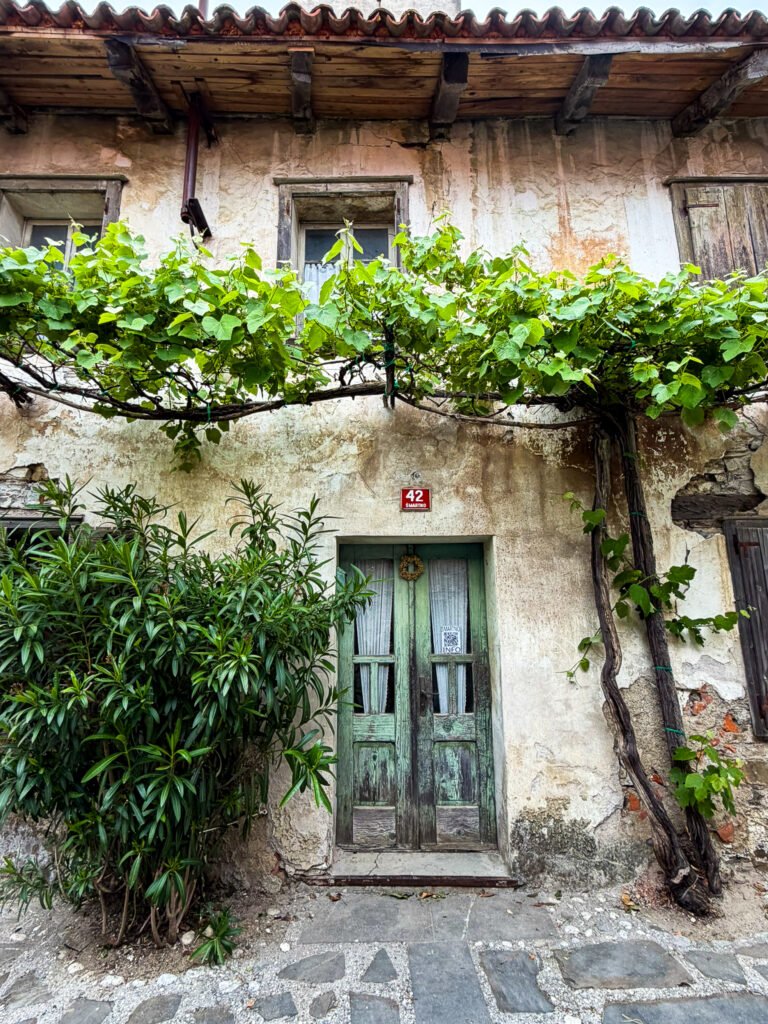
After breakfast, we drove for barely eight minutes before arriving in Šmartno, a charming medieval walled village filled with narrow cobblestone streets.
The plan was to visit a large local wine cooperative and practice what seemed to be the region’s favorite sport — wine tasting.
As soon as we crossed the village walls, I noticed the place was completely empty, which somehow made it feel even more like a movie set. At first, we assumed it was because of the weather and the early hour.
Unfortunately, it didn’t take long for us to discover that the cooperative was closed on Mondays during that time of year and, from what I could tell, it was also the village’s main attraction.
After recovering from the helpless expression on our faces, we wandered through the narrow streets exploring every corner of the village.
By then, a light drizzle had arrived and walking around no longer felt quite as pleasant.
Looking at our options, driving to Friuli Venezia Giulia in Italy suddenly sounded like a perfect idea.
But first, we stopped by the Gonjače Viewing Tower for a panoramic 360-degree view of the surrounding vineyards before getting back on the road — this time for less than an hour.
When we arrived in Italy, I was almost disappointed that the drive had been so short. The landscape along the road was mesmerizing and made the journey feel even quicker.
By the time we parked the car, the rain had grown heavier, but we still insisted on exploring downtown for a while.
Eventually, though, a good plate of pasta paired with Italian wine became more than necessary.
No need to say it wasn’t difficult to find the perfect place. After all, Italy is practically synonymous with good food.
Actually, the meal was so good it felt almost like a caress.
Bonus: we even added an Italian wine to our growing wine list — one made with the Schioppettino grape.
And then, it was finally time for our first wine tasting in Goriška Brda.
Something we thought we already knew how to handle.
The wine tasting was taking place at Ščurek, a family-run winery owned by five brothers and their father. As it happened, it was also where we were staying.
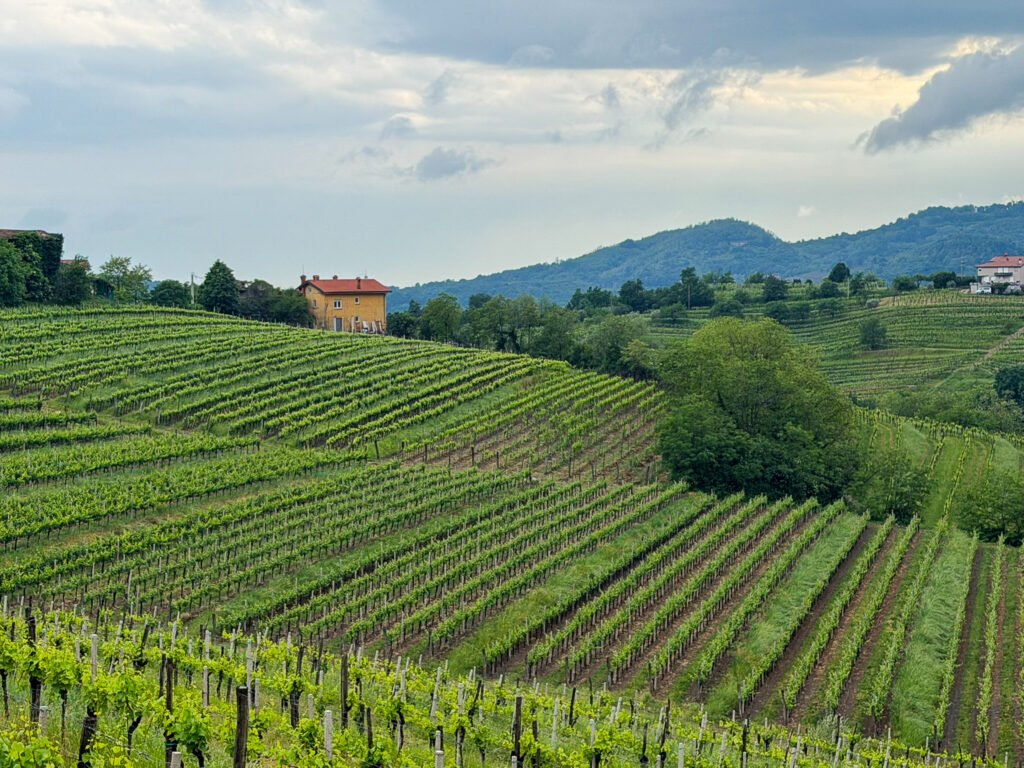
Another large group was already seated at the table next to us, cheerfully chatting and tasting wine — clearly far ahead of us in alcohol mileage.
Our own table was already prepared and, under the glasses, there was a sheet of paper showing photos of twenty different bottles produced by the winery lined up in sequence.
Looking at the twenty bottles in the photo, I immediately understood why Ščurek is known for its diversity.
The other characteristic often associated with the winery — technical precision — would become apparent soon enough.
One of the owners approached carrying a bottle of white wine, pointing at the first bottle on the left side of the paper while explaining its characteristics.
And that ritual slowly continued.
Bottle after bottle.
By the time he reached the third wine, Mirela could no longer hold herself back and finally asked:
“How many wines from this list are we actually going to try?”
He laughed.
“Five, seven… maybe eleven.”
Mirela practically jumped in her chair.
“No, no. Not eleven. Maybe five or seven is fine.”
I didn’t say a word. I didn’t want my words coming back later to prove me wrong.
The rest of the afternoon unfolded exactly like that.
At some point, even a bottle that wasn’t on the original list mysteriously appeared.
Later, we joined another of the Ščurek brothers and our table neighbours for a tour around the winery — wine glasses in hand, of course. The tasting continued there too, as he casually carried another bottle from the list with him.
When it finally seemed we had reached the end, I counted the scores on my sheet.
Twelve.
I couldn’t stop laughing at Mirela’s face.
Priceless.
And the owner looking at us with an expression that practically said:
“I knew it.”
Good thing the winery also had a jacuzzi and a sauna. They worked perfectly to bring our souls back from the dead.
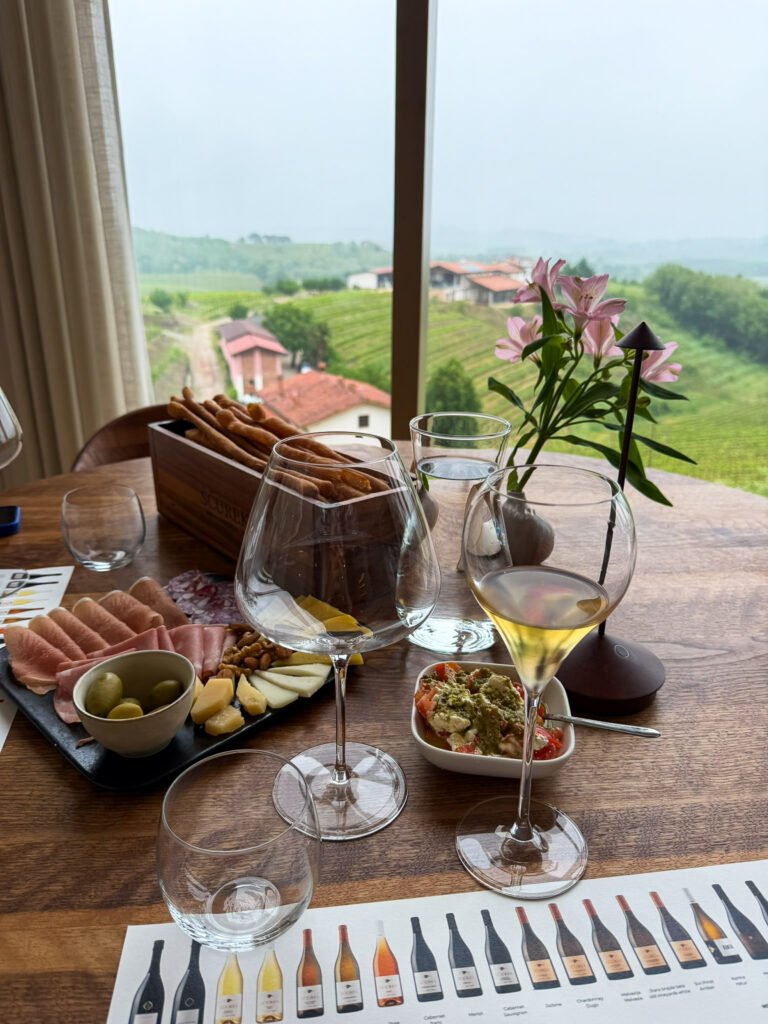
The More I Studied Wine, the Less I Knew
Given the ridiculous growth of our wine list the day before, we braced ourselves for yet another day devoted to this arduous task.
We couldn’t resist going back to Šmartno to visit the cooperative we had missed the day before.
Today, things were different.
The weather seemed to be improving and the village was no longer empty. As I had suspected, the cooperative was responsible for a good part of the activity around town.
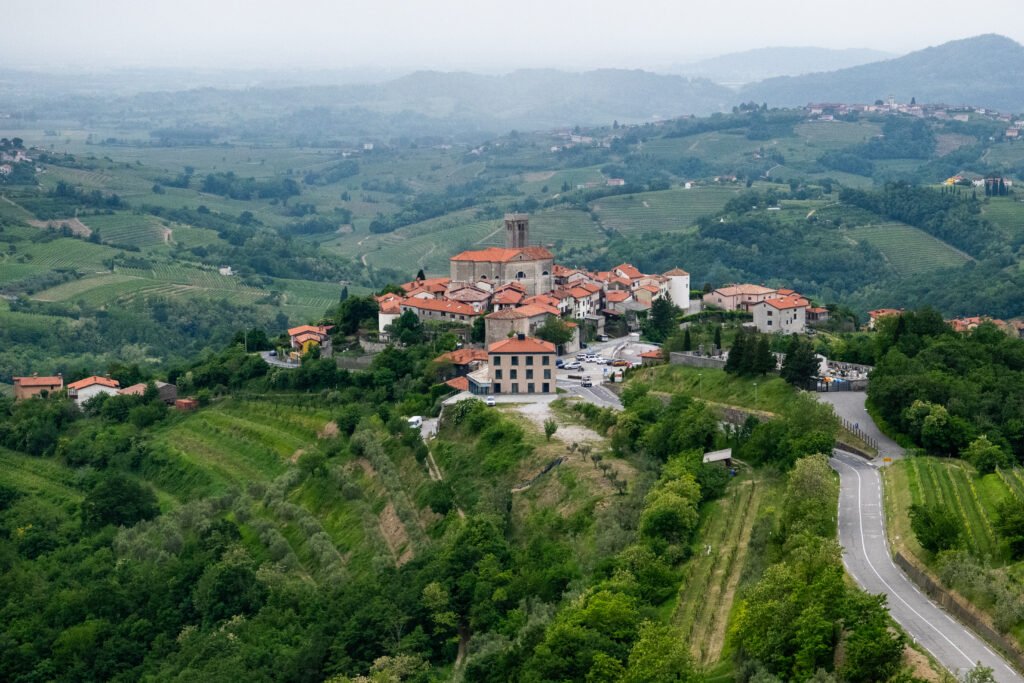
A sign outside listed tasting options by category: young and crisp, full-bodied, premium, sparkling and degustation.
Guess which one we chose?
And just like that, another wine tasting began.
We asked to try wines from producers different from those we would be visiting later ourselves.
During the tasting at Ščurek the day before, we had already been introduced to a grape that would become one of the trademarks of this trip.
Neither of us had ever heard of Rebula before arriving in Slovenia.
Known as Ribolla Gialla just across the border in Italy, it immediately caught our attention. Perhaps it was its minerality. Whatever it was, it quickly became one of our favorites.
But Rebula wasn’t the only mystery from the previous day.
At one point during the tasting, we suddenly heard the word:
“Tokaj.”
What?!
Was it the same grape used for the famous Hungarian wine?
Yet when we looked at the label, all we could read was:
Jakot.
The whole thing was so confusing that we needed to make sure we had understood it correctly.
✦ Footnotes from Elsewhere
For centuries, producers in parts of present-day Slovenia and Italy used the name Tokaj (or Tocai) for a dry white wine made from the grape now known as Friulano. The confusion is understandable: the name sounds identical to the famous sweet wines of the Tokaj region. But there is a catch — they are not made from the same grape. Hungarian Tokaji wines are produced primarily from Furmint, while the Slovenian and Italian wines come from Friulano. When Hungary secured exclusive rights to the Tokaj name, producers outside Hungary had to find a new identity for the very same wine.
In Italy, it became simply Friulano. In Slovenia, some producers adopted the name Jakot.
To make things even more confusing, the same grape was also long known as Sauvignon Vert in some regions before genetic studies confirmed they were all the same variety.
Look closely and you’ll notice the joke: Jakot is simply Tokaj spelled backwards.
The more I study wine, the less I feel I know.
Our next stop in our ongoing wine studies was Movia, another prestigious producer.
This one came with a certain degree of suspicion.
Movia is often mentioned among the leading biodynamic and natural wine producers in the region and, up to that point, my experiences with both styles were far from convincing.
On one occasion, a group of friends and I had even left a restaurant specializing in biodynamic wines. By the second glass, we had already concluded it simply wasn’t for us.
As soon as we stepped through the door set in the middle of the old rose-colored facade, I found myself in what looked more like a living room than a winery.
Had it not been for the sign above the entrance, I would have assumed we had accidentally walked into somebody’s house.
That same feeling stayed with us throughout the tasting.
There were none of the formalities often associated with wine experiences. Instead, it felt like sitting in someone’s home, chatting while excellent bottles kept appearing on the table.
And then came the biggest surprise.
The wines were mind-blowing.
Even the orange wine.
Both Mirela and I had struggled to connect with orange wines in the past, yet this one completely changed our minds.
By the end of the tasting, I was beginning to suspect that perhaps the problem had never been biodynamic wines after all.
Maybe we had simply not met the right ones yet.
And, naturally, another impressively long list of wines found its way onto our growing list.
On our way out, we asked the hostess at Movia for a dinner recommendation.
She answered immediately:
“Italy.”
And then gave us the name of the restaurant.
To our amazement, it was less than ten minutes from both Movia and Ščurek.
When we arrived, we were surprised.
The restaurant was large and surprisingly modern. A little fancy, too.
By dinner time, every table was occupied and I found myself wondering where all those people had come from.
Apparently, there are also people where I thought there were only green vineyards.
Another incredible dinner.
But then again, saying the food was great in Italy feels almost redundant.
Open Doors, Open Conversations
There is another wine region near Goriška Brda called Vipavska Dolina, where we planned to visit two wineries.
Our first stop was Tilia Estate. If it weren’t for the stainless-steel tanks outside, it could easily be mistaken for a family home.
We called out for someone and waited a few minutes. When nobody appeared, I opened the first door and found the tasting room. Completely open. Curious, I tried another door and discovered an office.
Everything was unlocked, which felt strange for someone from Rio de Janeiro, where you pile on locks, alarms and even a dog, yet somehow still don’t feel completely safe.
The owner himself, Matjaž Lemut, eventually welcomed us.
Unlike many of the producers we met in Slovenia, he wasn’t carrying on a family business. He founded Tilia himself.
He had clearly been working on something when we arrived — probably in the vineyards — yet he immediately settled into a relaxed conversation about his Pinot Noirs, his Bordeaux-style blend, the winery and the challenges he had faced along the way.
Along the way, he introduced us to another local grape variety — Zelen, one of the signatures of Vipavska Dolina.
Unlike many wineries in the region, Tilia has built its identity around Pinot Noir. In fact, it proudly calls itself the House of Pinots.
It was part wine lesson, part cultural exchange and part opportunity to meet someone highly respected in the Slovenian wine scene.
And after tasting the wines, it became very clear why Tilia is considered one of the wineries that helped put Vipava on the map.
Our final visit in the region took us to Lepa Vida.
And once again, we found ourselves sitting with one of the owners.
This time, it was Irena.
The winery felt more contemporary than the others we had visited, yet equally welcoming.
We were invited into a tasting room facing the vineyards, where Irena shared stories about the winery, her family, their passion for winemaking and even their connection with art.
Once again, we felt genuinely welcomed.
Not by marketing teams or professional hosts, but by people who deeply understood the wines they were pouring and the stories behind them.
Among the highlights were memorable wines made from Zelen, Malvasia and many others that found their way onto our ever-growing list.
And during our final dinner in Vipava, I noticed Mirela endlessly scrolling through her phone, adding yet another wine to the list.
I casually asked:
“That list is getting quite long, isn’t it?”
By then, it had already passed fifty.
The Faces Behind the Bottles
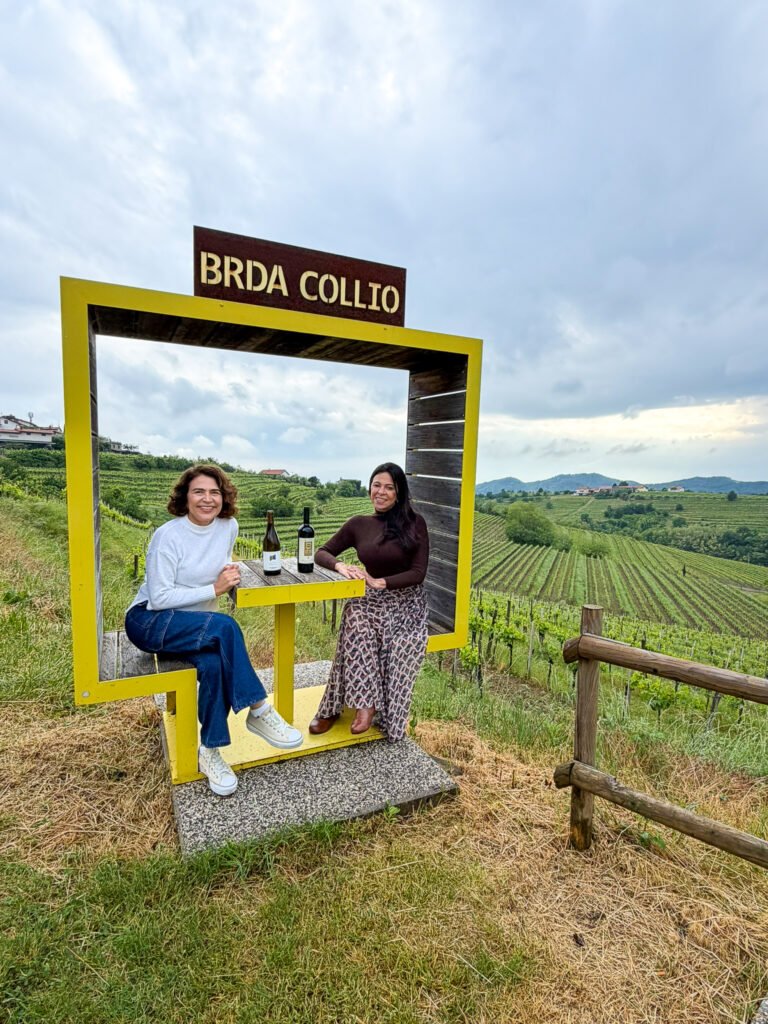
I had very high expectations for Slovenia’s wine regions. Curiously, the wine wasn’t the reason. I had never tasted Slovenian wine before.
It was something else.
At Movia, the hostess casually mentioned something that sounded almost unbelievable:
“This house once belonged to the Austro-Hungarian Empire, then Italy, Yugoslavia and finally Slovenia.”
The families living here had been forced to adapt again and again. New languages. New cultures. New laws. Even different approaches to winemaking.
Later that day, as we crossed the blue sign on the road that simply read Italy, I found myself thinking about how many times those borders had already moved.
And suddenly, all those confusing grape names started to make sense.
By then, we had also begun to understand that Slovenia offered a very different approach to wine tourism.
We tasted fantastic wines, discovered new grape varieties and collected unforgettable experiences.
But above all, we got to meet the faces behind the bottles.
More than visiting wineries, it often felt like visiting the producers’ homes.
Where the Red Rooftops Meet the Sea
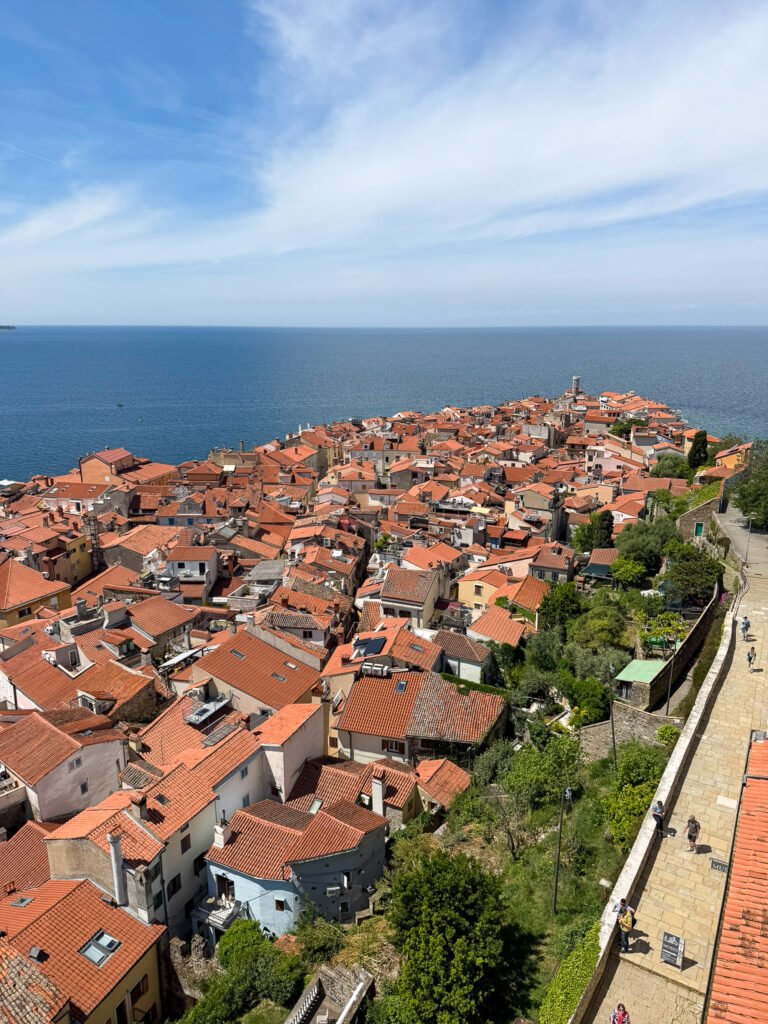
Piran was our last destination in Slovenia.
And once again, the scenery completely changed.
This time, we arrived at a small peninsula where it already felt like summer had arrived before us.
Cars are only allowed into the historic center for a short period of time to drop off luggage. After that, they must be parked outside the city.
Not a problem.
The short drive from the entrance to our hotel was enough to convince us that we would be much better off without one.
The streets were packed with people wandering around, mesmerized by the city and constantly stepping in front of our car without even noticing it.
Bikes and scooters only added to the chaos.
✦ Footnotes from Elsewhere
For more than 500 years, Piran was part of the Republic of Venice, one of the most powerful maritime states in the Mediterranean.Venetian rule shaped the town’s architecture, culture and language. Even today, its narrow streets, Gothic palaces and elegant main square feel remarkably similar to those found across the Adriatic in Venice.Look closely and you’ll still spot the Winged Lion of Saint Mark — the symbol of Venice — carved into several buildings around town.
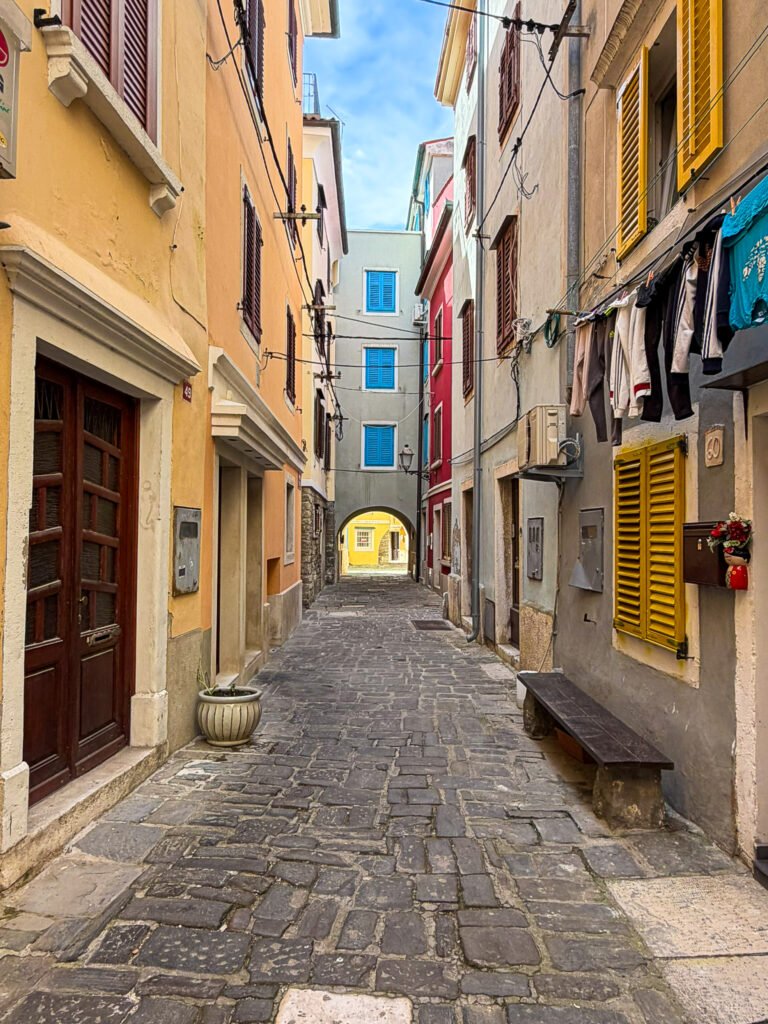
Piran is so small that one of the greatest pleasures of travel — getting lost in the streets of a new place — is almost impossible.
We left the hotel determined to try anyway.
Since every street seemed to lead back to Tartini Square, we decided to start there.
Its organic shape opens toward the sea and is framed by a mix of colorful facades and historic buildings.
From the campanile of St. George’s Parish Church overlooking the town, the view is spectacular.
The small peninsula appears blanketed in red rooftops, stretching out into the Adriatic.
The streets are so narrow that, from above, they almost disappear. It feels as though the houses were built without leaving any space between them.
Tartini Square stands out even more from that perspective, as it is the only place where the sea of red rooftops is interrupted. That small break in the pattern somehow adds even more charm to the town.
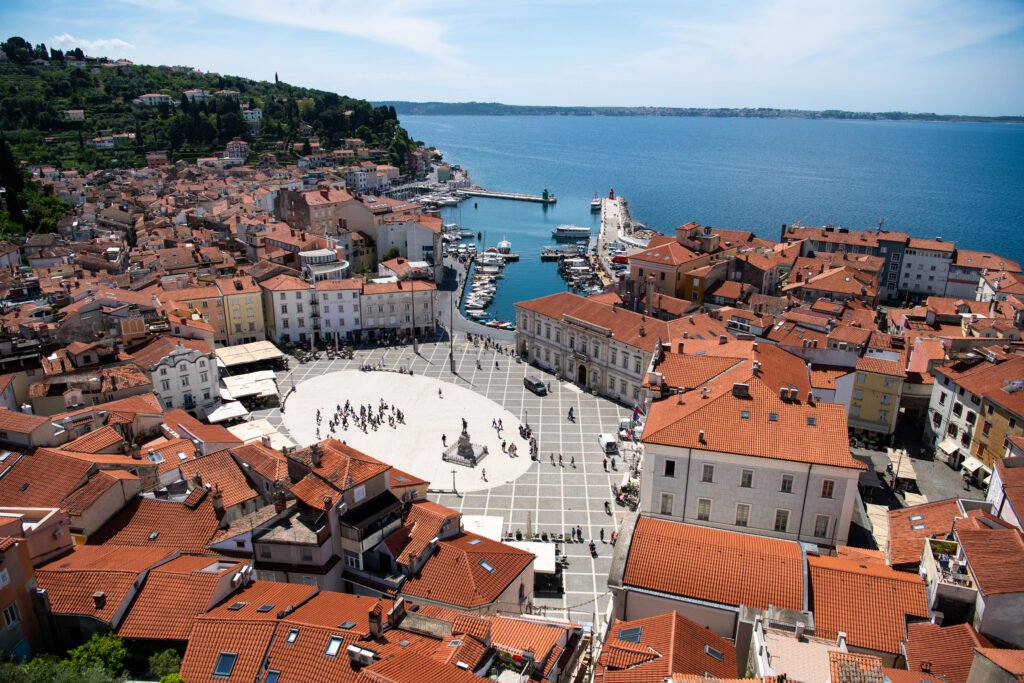
And as if that wasn’t enough, the 360-degree view also takes in the Venetian Walls, the Croatian coastline and, on a clear day, even Italy.
Time for a few glasses of wine.
After all, we had left the wine region behind, but not the wine itself. And our list was still very much alive.
The food had changed too.
Mediterranean cuisine felt perfectly matched to the atmosphere: seafood, sea views and cold white wine.
Everything facing the water.
I spent the rest of the afternoon unsuccessfully trying to get lost before, as the sun softened, making my way up to the Venetian Walls.
The next day would be our last in Slovenia and I was feeling a little sad.
Partly because the vacation was coming to an end, but mostly because I had genuinely fallen in love with the country and the thought of leaving it behind hurt more than I had expected.
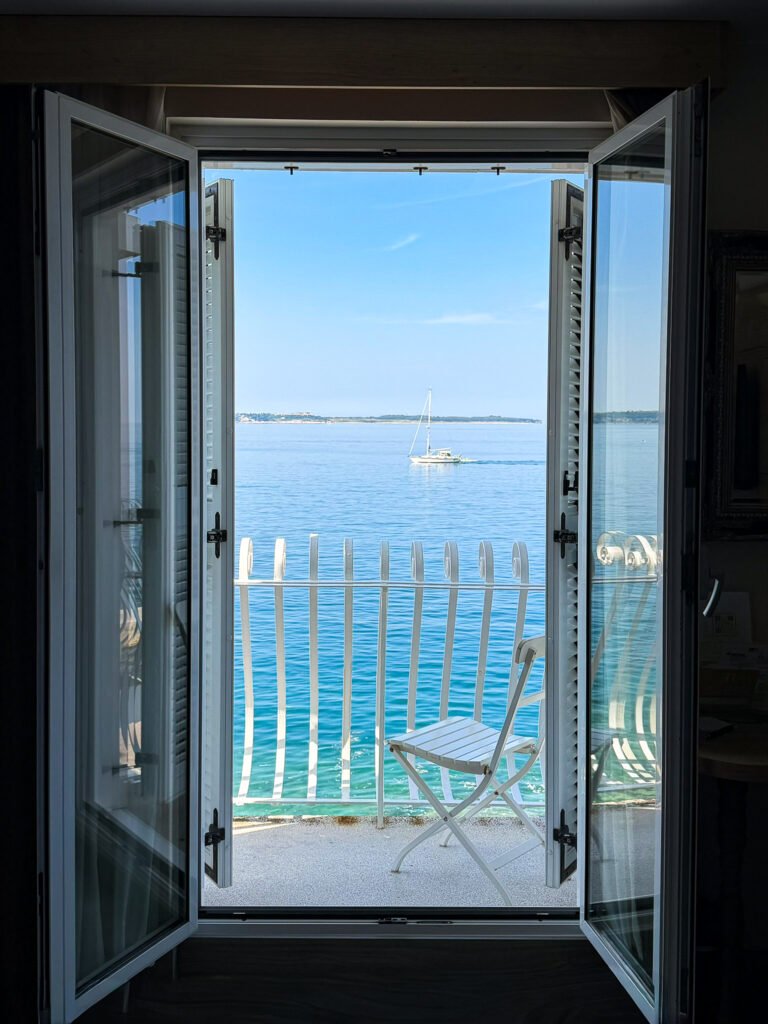
While packing, I found myself stopping every now and then to look out from our little balcony.
A slice of the Adriatic. Seagulls wheeling overhead. And on both sides, the colorful facades of the old town.
Our hotel had a small rooftop terrace and we watched a cloudy sunset from there before heading to nearby Portorož for dinner.
Portorož sits just outside Piran and the restaurant we had chosen belonged to a well-known chef.
The night before, we had dined at a Michelin-starred restaurant.
Now, sitting by the marina while delicious fresh food and wine kept arriving at our table, we reached the same conclusion:
This one was much better.
Back Where It Started
There was no way around it. It was time to head back to Ljubljana.
On our way, we stopped at Postojna Cave.
✦ Footnotes from Elsewhere
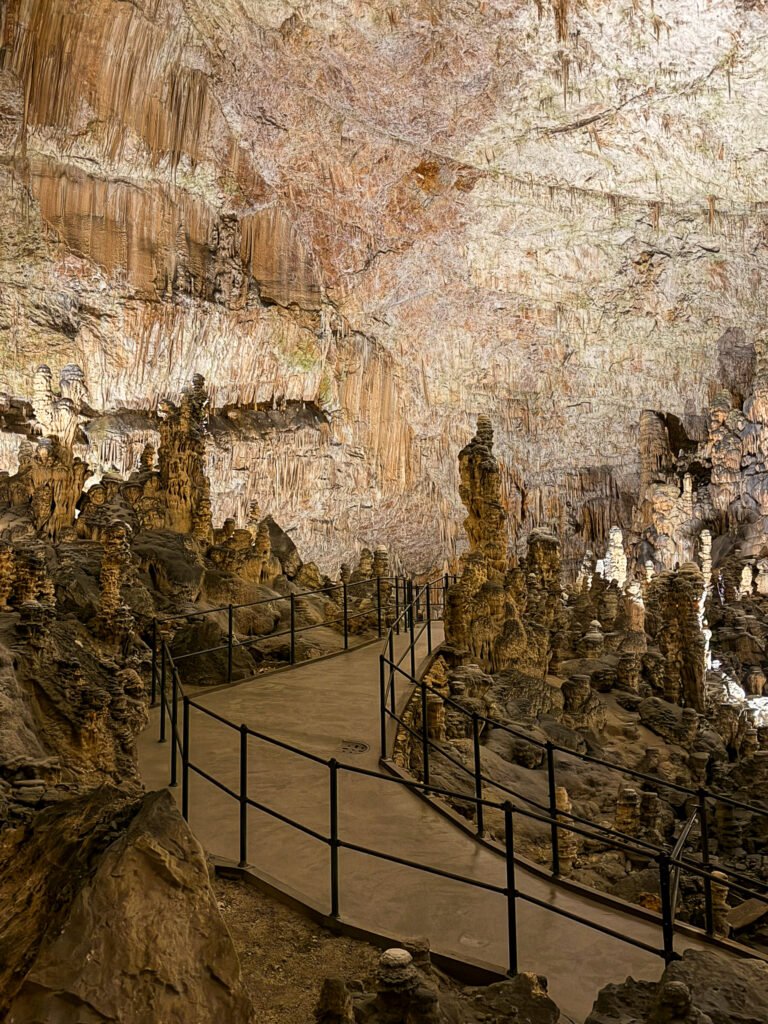
The spectacular chambers and formations of Postojna Cave were not carved by sudden geological events, but by water patiently dissolving limestone over millions of years. Many of the formations inside Postojna Cave grow at an almost unimaginable pace — roughly 1 centimeter every 100 years.Some of the cave’s most famous formations, including the Bride and Groom and the iconic white stalagmite known as the Brilliant, took hundreds of thousands of years to reach their present shape.
It turned out to be the perfect stop before returning to the capital.
After days spent among vineyards, medieval villages and coastal views, the underground world of Postojna felt like an entirely different chapter.
The cave train carried us through a fascinating gallery of chambers and formations, each one so distinct that it felt like entering a new room in a natural museum.
And no boats or waterproof gear were required — just a train ride and a coat, as the temperature inside remains around 10°C.
Nearby, we visited Predjama Castle, a dramatic fortress seemingly suspended at the entrance of a cliffside cave.
After seeing castles in every possible shape and size throughout Europe, Predjama still managed to feel unique.
As the audio guide repeatedly reminded us, it was probably not the most comfortable place to live. But comfort was rarely the priority in those days.
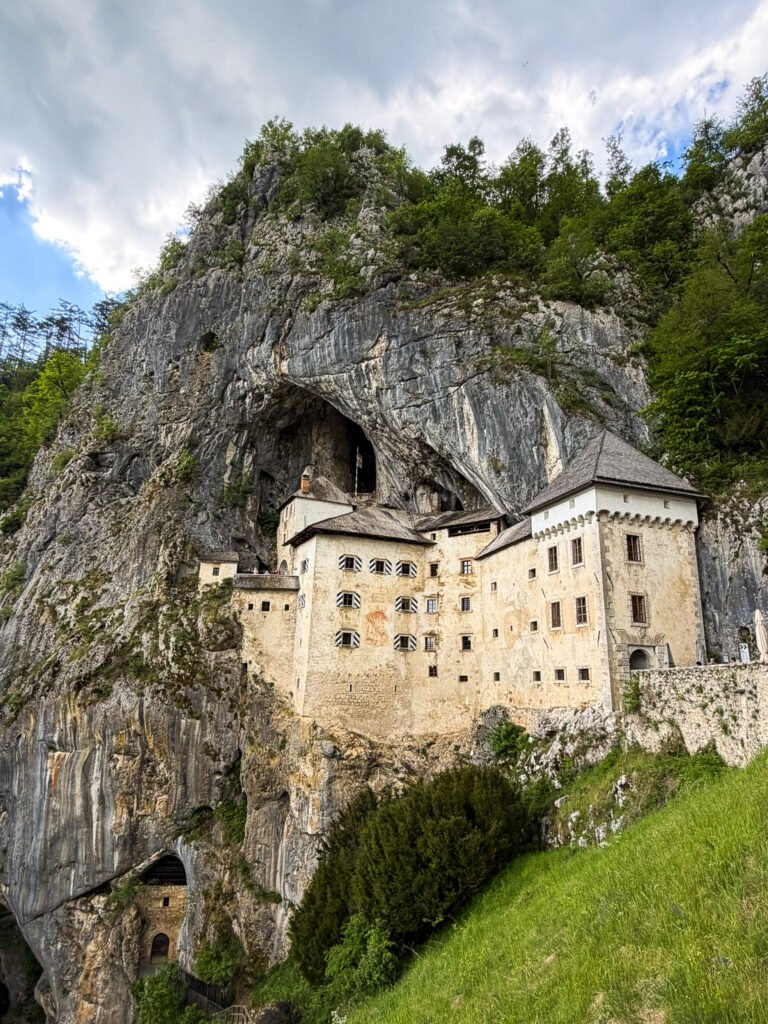
Security was.
Part of the castle extends deep into the cave system behind the façade, providing shelter and escape routes whenever turbulent times arrive.
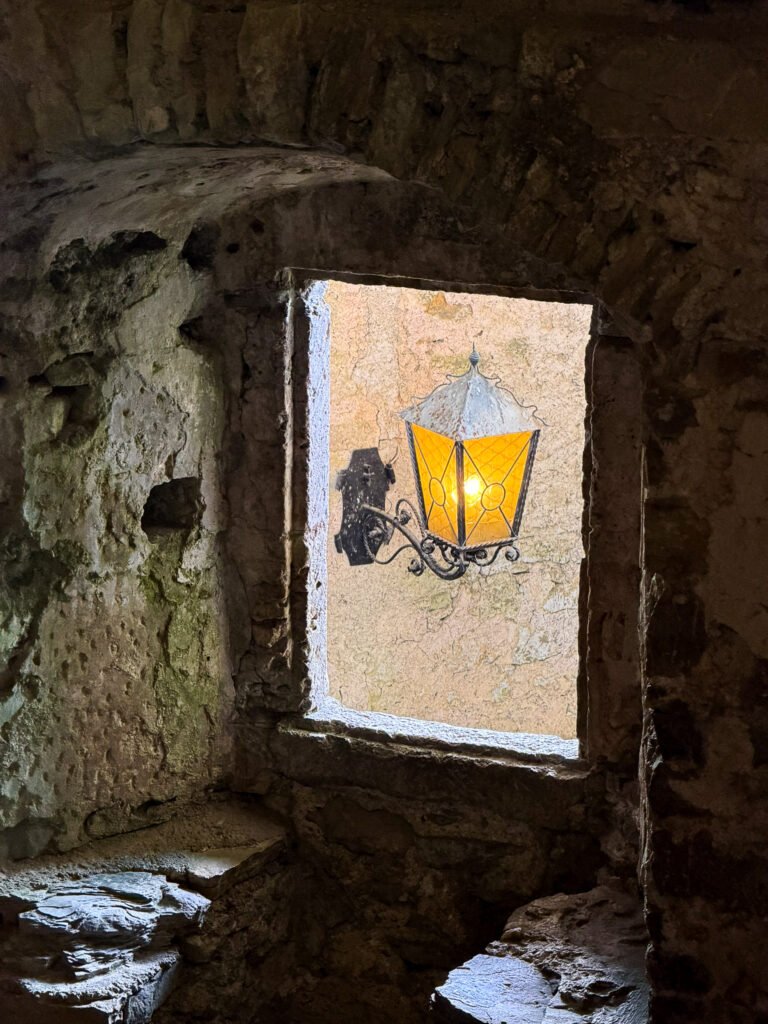
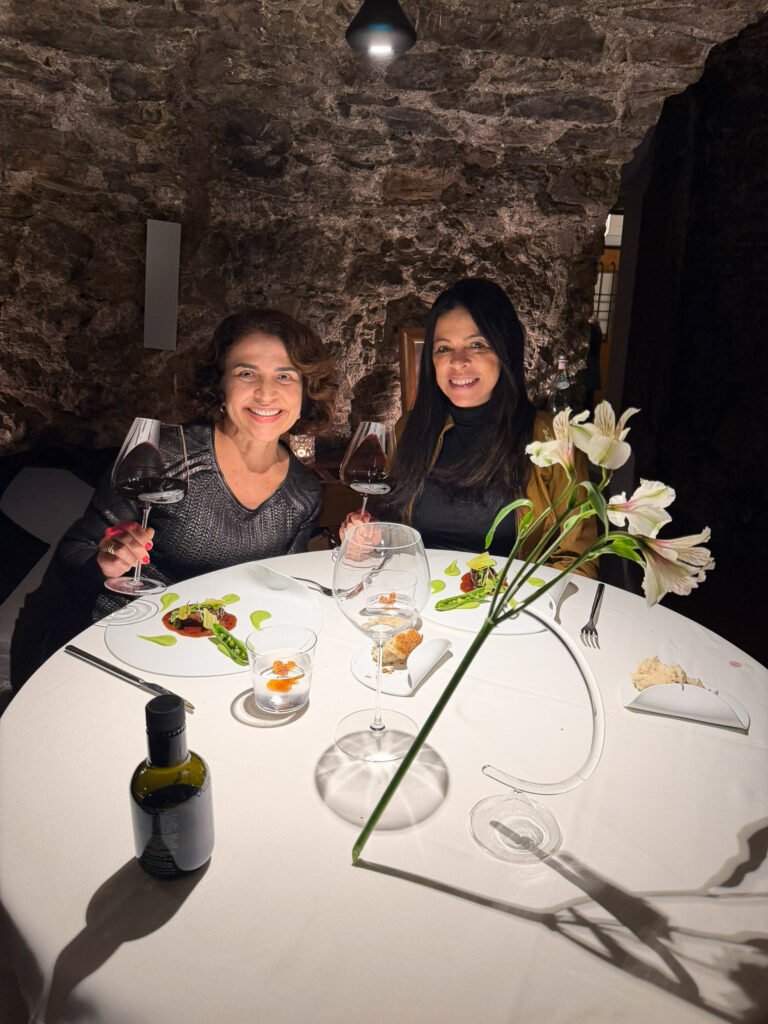
Back in Ljubljana, we celebrated our final evening with dinner inside the castle.
The restaurant occupies one of the old towers and delivered one of the most memorable meals of the trip.
I still don’t know whether it was the atmosphere, the setting or the impeccable service, but somehow the wines seemed even better that night.
We spent ten days in Slovenia.
From the feel of Central Europe in Ljubljana to alpine landscapes, vine-covered hills and the Venetian Adriatic.
Yet what remains clearest in my memory is that, despite being a place where borders have shifted repeatedly over the centuries, Slovenia possesses a remarkably strong identity.
An identity forged by the landscapes, the culture and, above all, by the people we met along the way.
We left already thinking about coming back.
And with a list that had somehow reached 62 wines.
I’m officially convinced: Slovenia has to be my next trip.
I loved following this journey: the lakes, the mountains, the villages, Piran, the caves… everything looks exactly like the kind of place I would fall in love with. I may just need to make one small adjustment to my itinerary: fewer wine tastings and a few more bike rides and nature days.
As much as I admire your dedication, I’m pretty sure I won’t be trying to beat the 62-wine record 😮
I told you I thought about you many times during this trip. It’s exactly your kind of destination. Between the lakes, mountains, villages and all those cycling routes, I’m pretty sure you’d fall in love with it.
As for the bikes, Mirela and I were fully dedicated to a different sport and didn’t want to lose focus. We even have another wine trip planned already. Not to beat the 62-wine record, of course… but I wouldn’t rule out another respectable attempt.
Orange wine remember me of Sweden , do you remember? Orange wine everywhere and was so beautiful hahahaha. Now, I have to travel to some “lake place” besides Argentina ….This is you most melancholic journal (not in na bad way). Remind me of our hero Bourdain , the focus is the people . Well done , Catinha
Aww, thank you, Bia ❤️
I do remember Sweden being beautiful (and expensive), but apparently the orange wine made a stronger impression on you than on me! 😂
And yes, you definitely need another “lake place” besides Argentina.
I’m especially happy that you noticed the people. I think that’s what stayed with me the most from this trip. The landscapes were gorgeous, the wines were great, but somehow it became more about the people we met along the way. Maybe that’s why it feels a bit more reflective than some of my other stories. Or maybe it was all the wine tasting… 😂
And comparing it to Bourdain is probably the nicest compliment you could give me.
Thank you, Catinha is smiling today. ❤️